St. Gallen: Government rejects protective measures for roe deer fawns
The St. Gallen government is opposed to a mandatory reporting requirement and additional funding to protect roe deer fawns from being killed by mowing machines.

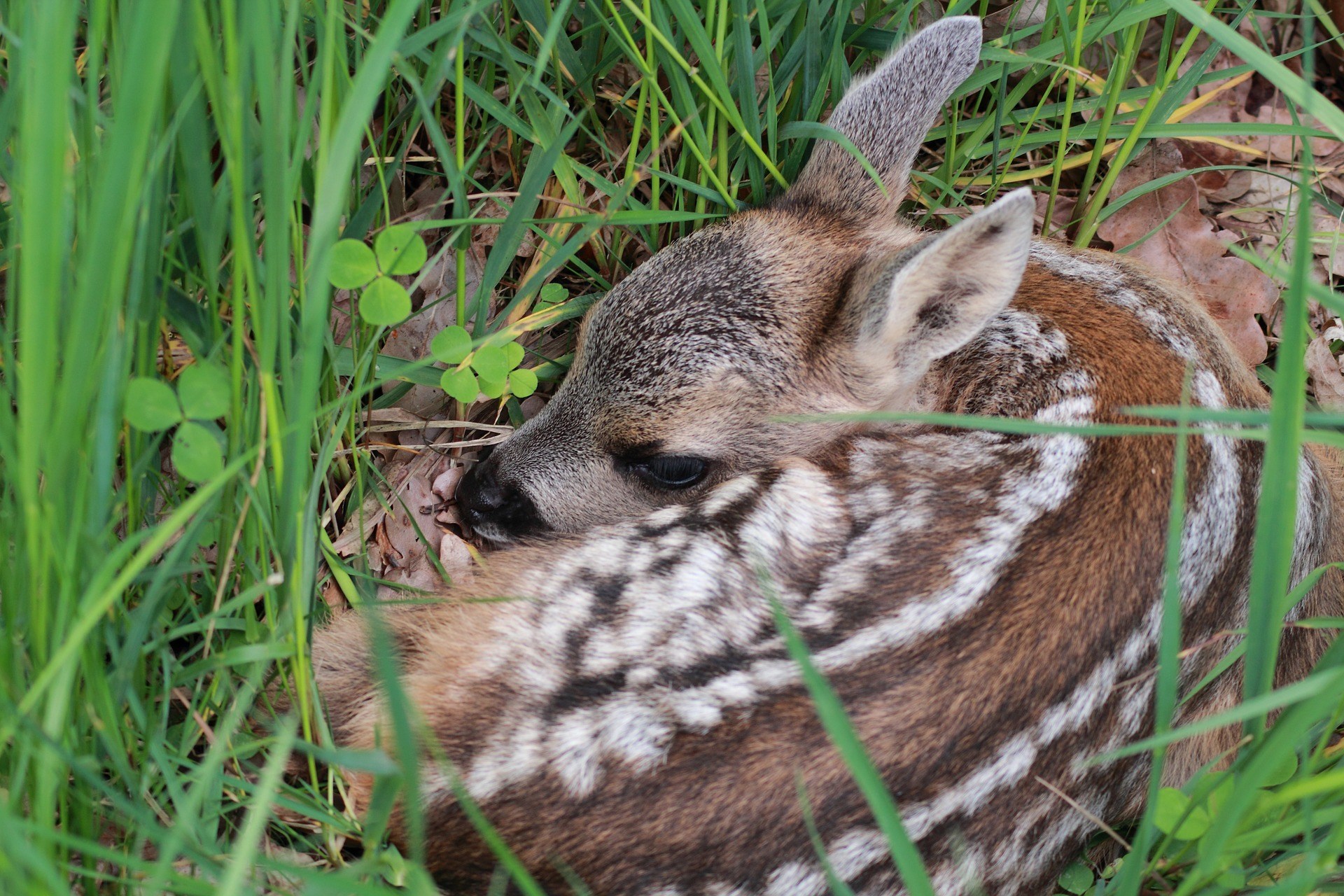
Two municipal presidents in the St. Gallen cantonal parliament, Jörg Tanner (GLP) from Sargans and Beat Tinner (FDP) from Wartau, submitted a motion in September demanding additional efforts from the St. Gallen government to address the deaths of roe deer fawns.
From April onwards each spring, thousands of roe deer fawns, young hares, wild rabbits, ground-nesting birds and other wildlife are mown down by farmers every year.
At least 1’500 roe deer fawns per year
The exact number of wild animals is not precisely known, but based on federal hunting statistics, it can be assumed that in Switzerland at least 1’500 roe deer fawns alone are killed each year.
That represents up to ten percent of all roe deer found dead each year. After hunting and road deaths, mowing is therefore the most common preventable cause of death. Despite the use of new search methods, there is no sign of a downward trend in cases. Since not all animals caught by a mower’s blades die immediately — some are left with injuries of varying severity — mowing also represents a serious animal welfare problem. Ever faster agricultural machinery and modern harvesting methods leave our wildlife with barely any chance of survival.
Recreational hunters from the city of St. Gallen reportedly stated that on the first day mowing was permitted, four young animals in the hunting territory near the city alone suffered “a painful death by mowing.” Numerous additional cases were said to have been reported from neighbouring territories. Precautionary measures are not taken everywhere before mowing begins.
It's not just about wildlife: if roe deer fawns are struck and killed by agricultural machinery, livestock could later become infected with the botulism pathogen through grass contaminated with carcasses, the motion further states. The two cantonal councillors point to the canton of Thurgau, where in 2016, in two separate cases, 68 dairy cows and 200 sheep died.
In their motion, they call for a mandatory reporting requirement for wildlife injured by agricultural machinery. They also ask whether financial contributions for the use of drones could be made available, or whether hunting associations could receive financial support for preventive measures.
Government sees no need for action
The government is not receptive to this: it is in the interest of agriculture that no roe deer fall victim to mowing, as this damages feed quality and the sector's image. It can therefore be assumed that cooperation between farmers and hunting associations to rescue roe deer before mowing “functions in the vast majority of cases.” Additional regulations and sanctions are therefore considered “not necessary.”
The rescue of roe deer fawns is not a higher-level cantonal responsibility, and there is therefore no legal basis for providing contributions to hunting associations for this purpose, the St. Gallen government explains.
More on the subject of recreational hunting: In the dossier The Role and Criticism of Recreational Hunters we shed light on the training, power and self-image of recreational hunters. The scientific evidence is presented in the overview Studies on the Effects of Recreational Hunting.
The position of IG Wild beim Wild: IG Wild beim Wild rejects recreational hunting. Our model is the canton of Geneva, which has managed without recreational hunting since 1974: without hunting seasons, without hunting dogs, without driven hunts, without high seats, without the animal cruelty and crime that go hand in hand with hunting season elsewhere. What has worked there for over fifty years disproves every position paper by JagdSchweiz. An association that bases its policy on claims it refutes in its own documents is not a professional organisation, but a factory for misinformation.