
Cantonal Popular Initiative – Canton of Solothurn
«For Professional Wildlife Protection»
Constitutional initiative in the form of an elaborated draft
Based on Art. 28 ff. of the Constitution of the Canton of Solothurn of 8 June 1986 and on the Law on Political Rights
Submitted by the initiative committee [date of submission]
Initiative text
The undersigned persons entitled to vote in the Canton of Solothurn submit the following constitutional initiative:
The Constitution of the Canton of Solothurn of 8 June 1986 is supplemented by the following paragraphs:
§ [new] Professional Wildlife Protection
1The exercise of hunting by private individuals (territorial hunting, hobby hunting) is prohibited throughout the entire territory of the Canton of Solothurn. Existing hunting lease agreements between municipalities and hunting associations will not be renewed.
2The protection, care and, where necessary, the regulation of wild animals shall be the exclusive responsibility of professionally trained wildlife managers in the service of the canton.
3The culling of wild animals is only permissible as a last resort, when all other appropriate measures for the prevention of damage or the averting of danger have been exhausted or are insufficient. It requires the prior approval of the Wildlife Commission.
4The canton shall establish an independent Wildlife Commission composed of representatives of animal and nature conservation organisations, the scientific community, and the relevant authorities. The Commission shall oversee wildlife management and decide on regulatory measures.
5The canton promotes the natural regulation of wildlife populations, the connectivity of habitats, and the coexistence of humans and wildlife.
6The canton shall compensate municipalities for the loss of hunting lease revenues within the framework of implementing legislation.
7The details shall be governed by law.
§ [new] Protection of Threatened and Protected Wildlife Species
1The canton refrains from submitting applications for the preventive population regulation of protected wildlife species under the Federal Act on Hunting and the Protection of Wild Mammals and Birds, in particular wolf, lynx, bear, beaver, otter, golden jackal, golden eagle, goosander, and other species protected under federal law.
2It relies on promoting the coexistence of humans and wildlife, passive damage prevention, the ecological enhancement of habitats, and the scientific monitoring of wildlife presence.
3 Measures against individual wild animals that pose an immediate and significant danger to humans remain reserved. They are to be kept to a minimum and carried out by the competent cantonal authority.
4 The canton actively advocates for the protection and conservation of endangered wild animal species within the framework of intercantonal cooperation and vis-à-vis the federal government.
Transitional provision
1 The cantonal government shall issue the necessary implementing provisions within two years of the adoption of this constitutional amendment.
2 Existing hunting lease agreements shall expire at the next ordinary contract renewal, but at the latest within five years of the entry into force of the implementing legislation.
3 The cantonal government shall ensure continuity of wildlife management during the transitional period and shall regulate the compensation of municipalities for lost hunting lease revenues.
Explanatory notes
1. Background
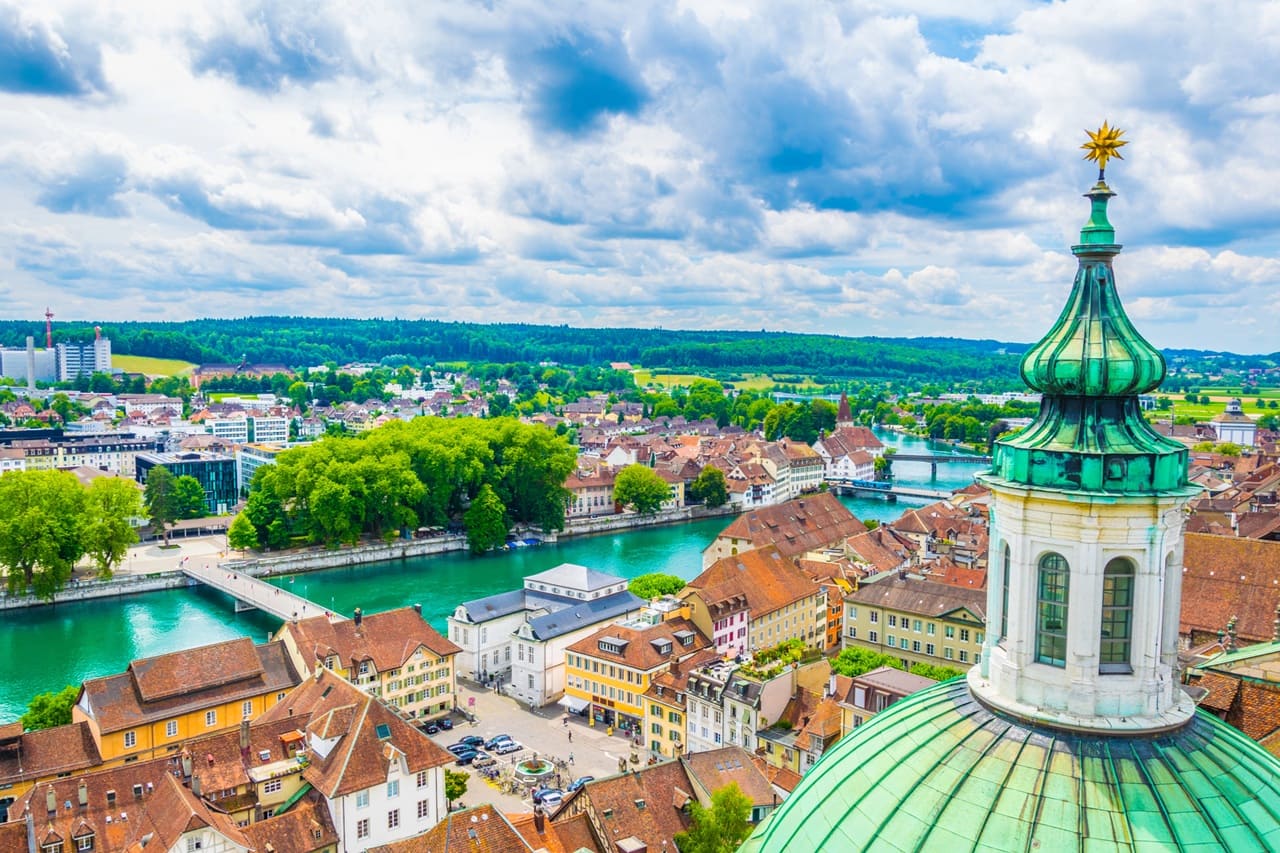
The canton of Solothurn covers 791 km² and has approximately 275’000 residents. It extends along the southern foot of the Jura and the Aare from Olten through Solothurn to Grenchen. The cantonal area consists of a mixture of Jura mountain landscape (Weissenstein, Balmberg), agriculturally used Mittelland, and the agglomerations along the Aare. The canton is geographically elongated and touches several landscape zones, which is particularly relevant for wildlife connectivity.
Hobby hunting in Solothurn is organised as a territory-based hunting system. The hunting rights belong to the resident municipalities, which lease them to hunting associations by contract. The Solothurn hunting associations, as in all territory-based hunting cantons, are closed circles that lease the right to kill wild animals and whose composition and activities are largely shielded from public scrutiny (cf. the Psychology of hunting in the canton of Solothurn as well as the critical analysis of hunting education on wildbeimwild.com).
The claim that without hobby hunters the ecological balance would collapse has been empirically refuted by the Geneva model for over 50 years. Although Solothurn, at 791 km², has a larger area than Geneva (282 km²), the fundamental principle of professional wildlife management scales proportionally: more area requires more specialists, but changes nothing about the system.
In parallel, more and more protected wildlife species are coming under pressure at the federal level. The political pressure on species such as lynx, beaver, otter, and merganser is steadily increasing (cf. the analysis of hunting policy on wildbeimwild.com).
2. The model: Canton of Geneva
On 19 May 1974, around two thirds of voters in the Canton of Geneva voted to abolish recreational hobby hunting. The experiences since the ban on hobby hunting are unambiguous:
– Biodiversity has increased markedly. The number of overwintering waterfowl has multiplied from a few hundred to around 30’000. Geneva today hosts the largest hare population and one of the last grey partridge populations in Switzerland.
– The roe deer population has stabilised at a healthy level, with an annual special cull by professional game wardens of only 20 to 36 animals.
– In 2005, 90 percent of Geneva’s electorate voted in favour of retaining the ban on hobby hunting. Total costs amount to around 1.2 million francs per year, i.e. around 2.40 francs per inhabitant. The efficiency of the Geneva model is evident in direct comparison: a professional game warden in Geneva requires an average of 8 hours and a maximum of 2 rounds of ammunition for a sanitary cull of a wild boar. A hobby hunter in the Canton of Zurich requires 60 to 80 hours and up to 15 rounds of ammunition for the same. The hare density in Geneva is 17.7 animals per 100 hectares (the highest in Switzerland), while in the Canton of Zurich it is only 1.0 per 100 hectares (cf. Fact check Canton Council Zurich).
A detailed account can be found in the dossier «Geneva and the hunting ban» on wildbeimwild.com.
3. The concept: Professional wildlife management instead of hobby hunting
The initiative replaces hobby hunting with professional wildlife management based on the game warden model:
Professional expertise instead of recreational pastime. Professional wildlife managers act on a scientific basis, within the framework of a cantonal service mandate.
Last-resort principle. A cull is only permissible once all non-lethal measures have been exhausted.
Democratic oversight through a wildlife commission. The independent commission prevents political pressure from diluting wildlife management.
Natural self-regulation as a guiding principle. Experience from Geneva, from national parks and from numerous scientific studies demonstrates: wildlife populations regulate themselves independently in most cases.
4. Why Solothurn?
Solothurn is suitable for the introduction of professional wildlife protection for several reasons:
Southern Jura foothills as an ecological key region. Solothurn is located at the southern foot of the Jura, one of the most important wildlife regions in Switzerland. The lynx is native to the Solothurn Jura, the wolf crosses the area, and the beaver is present along the Aare and its tributaries. The fragmented landscape between the Jura and the Mittelland requires professional, cross-border coordination that the game district hunting system cannot provide.
3’000 signatures in 18 months. The signature threshold is achievable. In a canton with 275’000 inhabitants and urban centres such as Solothurn, Olten and Grenchen, collection is well organisable.
Game district hunting as a conceptual weak point. The game district hunting system in Solothurn functions as in all game district hunting cantons: municipalities lease hunting rights to closed hunting associations. The population has no influence over who kills which wildlife in their municipality. The initiative returns this control to the population.
Mixed canton between urban and rural. Solothurn has both urban centres (the Olten-Solothurn agglomeration) and rural areas (Thal, Gäu, Bucheggberg). This mix makes the canton, similarly to Basel-Landschaft, a compelling test case: if professional wildlife protection works here, it works in any Mittelland canton.
Proximity to Basel. Should Basel-Landschaft adopt the parallel initiative a contiguous area from the Rhine to the Aare would emerge with Solothurn, in which professional wildlife protection is practised. This prospect is significant for wildlife connectivity and political signalling (cf. wildbeimwild.com on wildlife in settlement areas).
5. On the initiative text
The initiative text corresponds to the game district hunting variant (as in BL and SH). Cantonal competence is undisputed: Art. 3 Para. 1 JSG, the three equivalent hunting systems, over 50 years of unchallenged practice in Geneva. Existing hunting lease contracts expire with the next ordinary contract renewal, at the latest within five years. The canton compensates municipalities for the loss of lease income.
The second paragraph on the protection of protected species is particularly relevant for Solothurn: The lynx has been native to the Solothurn Jura (Weissenstein, Balmberg) for years. The beaver has colonised the Aare and its tributaries. The wolf traverses the area regularly. A constitutional waiver of preventive regulation would send a signal beyond the canton (cf. the analysis of wolf policy on wildbeimwild.com).
6. Cost implications: Concrete budget for Solothurn
For Solothurn, with an area of 791 km² and around 275’000 inhabitants, the following cost estimate applies:
Personnel costs: 360’000 to 560’000 francs annually. Required are 3 to 4 full-time positions. Solothurn, at 791 km², is almost three times the size of Geneva (282 km²). One full-time position costs approximately 120’000 to 140’000 francs annually including ancillary costs.
Operating costs: 80’000 to 120’000 francs annually. Equipment, vehicles, deterrent devices, monitoring infrastructure, electric fences, public relations.
Damage compensation: 50’000 to 100’000 francs annually. Primarily wild boar damage in agriculture and browsing damage in forests.
Compensation for municipalities: 100’000 to 200’000 francs annually. For the loss of hunting lease revenues.
Total costs: 590’000 to 980’000 francs annually (gross). That corresponds to approximately 2.15 to 3.55 francs per inhabitant per year.
These costs are offset by savings: No hunting lease administration, no hunting examinations, no hunting supervision. The net additional costs are likely to amount to 300’000 to 600’000 francs annually which corresponds to approximately 1.10 to 2.20 francs per inhabitant (cf. hunting myths fact-check on wildbeimwild.com).
Lost revenues
Abolishing hobby hunting would eliminate rental income from hunting leases, estimated at 300’000 to 500’000 francs annually. However, this must be weighed against the never-accounted external costs of militia hunting — wildlife accidents, hunting-related browsing damage in protective forests, administrative burdens, police and court deployments — which amount to a multiple of these revenues. In the canton of Geneva, these revenues have been absent since 1974 — without financial problems: Before the hunting ban, more than 400 hobby hunters were active; today, three full-time positions do the same work better. Sanitary and therapeutic culls by professional wildlife wardens are not the same as regulatory hunting based on hunters' lore or the misguided “nature experience” of hobby hunters. A full-cost analysis shows: militia hunting costs the taxpayer significantly more than it generates (cf. «What hobby hunting really costs Switzerland» on wildbeimwild.com).
Hobby hunters in politics vote against nature conservation. The hobby hunting lobby systematically opposes biodiversity and species protection concerns. In 2024, it opposed the Biodiversity Initiative (63 percent No). In 2020, the hunting law it helped shape failed at the ballot box (51.9 percent No). In 2016, the Ticino hunters' association torpedoed the Parc Adula national park. During the 2015 to 2019 legislative term, hobby hunters in parliament voted predominantly against environmental concerns. Anyone claiming that hobby hunters are conservationists is ignoring their voting record (cf. Ticino Hunters' Association: 30 Years of Nonsense and Cost Dossier).
7. Compatibility with superior law
The initiative is compliant with federal law. Art. 3 para. 1 JSG, the three equivalent hunting systems, over 50 years of unchallenged practice in Geneva. The termination of hunting lease contracts through non-renewal does not affect the guarantee of property rights, as these are fixed-term contracts under public law to whose renewal no legal entitlement exists. Art. 7a JSG enables preventive regulation but does not mandate it. The initiative preserves the unity of subject matter.
8. Anticipating foreseeable objections
«Solothurn is almost three times the size of Geneva»
The facts: The larger area requires more specialists (3–4 instead of 2–3 full-time positions), but does not change the fundamental principle. Costs scale proportionally, and the per capita costs remain at 1.10 to 2.20 francs per inhabitant, because Solothurn, with 275’000 inhabitants, has a sufficient population base.
Key communication formula: «More area requires more specialists. But with 275’000 inhabitants, they cost less than 2.20 francs per person per year.»
«Rental income will be lost»
The facts: Rental income is fiscally marginal for Solothurn municipalities. The initiative provides for cantonal compensation. And wildlife will no longer be killed for recreational pleasure.
Key communication formula: «Rental income is small change in the municipal budget. The initiative compensates — and the animals live.»
«Hunting societies do valuable work»
The facts: Hunting societies fulfil a contractual obligation in exchange for the right to kill wildlife. In a professional system, these tasks are better served: with better training and without the systemic conflict of interest inherent in hobby hunting (cf. the Psychology of Hunting in the Canton of Solothurn).
Key communication formula: «Hunting societies do not perform voluntary service. They fulfil a contractual obligation for the right to kill. Professionals can do this better.»
9. Summary
This initiative gives the population of Solothurn the opportunity to endorse a modern, evidence-based wildlife management system. The location at the southern foot of the Jura, with lynx, beaver and wolf, makes professional wildlife protection a concrete necessity. The costs are manageable at 1.10 to 2.20 francs per inhabitant, the legal basis is secured, and with 3’000 signatures within 18 months the threshold is achievable.
Initiative Committee «For Professional Wildlife Protection»
[Name 1], [Name 2], [Name 3] …
(Committee members in accordance with cantonal law, with residence in the Canton of Solothurn)
Contact address: [Committee address]
Appendix: Further Documentation
Geneva model in detail: wildbeimwild.com/genf-jagdverbot
Scientific studies: wildbeimwild.com/studien-ueber-die-auswirkung-der-jagd-auf-wildtiere-und-jaeger
Hunting in Switzerland: wildbeimwild.com/warum-die-hobby-jagd-in-der-schweiz-kein-naturschutz-ist
Psychology of Hunting in the Canton of Solothurn: wildbeimwild.com – Psychologie der Jagd im Kanton SO
Psychology of Hobby Hunting: wildbeimwild.com/category/psychologie-jagd
Wolf Dossier: wildbeimwild.com/dossiers/wolf-in-der-schweiz-fakten-politik-und-die-grenzen-der-jagd
Wildlife and Predators: wildbeimwild.com/category/wildtiere – Information on wildlife, predators and the coexistence of humans and wild animals.
Hunting Myths: wildbeimwild.com/dossiers/jaeger – Fact-check on the most common claims made by the hobby hunting lobby.
Cantonal Popular Initiative Basel-Stadt: Model text of the initiative in the canton of Basel-Stadt
Note on the procedure
The initiative committee submits the initiative text to the State Chancellery of the canton of Solothurn for preliminary review before the signature collection begins. For the initiative to be valid, 3’000 valid signatures are required. The collection period is 18 months from publication in the Official Gazette. The submission modalities are governed by the cantonal law on political rights.
Strategic Briefing for Activists
Popular Initiative «For Professional Wildlife Protection» – Canton of Solothurn Internal Working Document – Status March 2026
Summary
Solothurn is the third hunting district canton in the series (after BL and SH) and is strategically important as a bridge between Basel and the Mittelland. Its location at the southern foot of the Jura makes the species protection clause particularly relevant (lynx, beaver, wolf). The 3’000 signatures in 18 months are achievable, and the per-capita cost of 1.10 to 2.20 francs is favourable.
1. Why Solothurn?
Southern foot of the Jura as a key region. The lynx lives in the Solothurn Jura, the beaver along the Aare, and the wolf passes through the area. Professional wildlife management is no abstraction here.
Proximity to Basel. A success in Solothurn together with Basel-Landschaft would create a contiguous area from the Rhine to the Aare.
Mixed canton. Urban (Olten, Solothurn, Grenchen) and rural (Thal, Gäu). An ideal test case for the Mittelland.
3’000 signatures in 18 months. Achievable with the support of associations.
2. Lessons from Zurich
Zurich’s mistake 1: Confrontational title. Our title «For Professional Wildlife Protection» is positive.
Zurich’s mistake 2: Cost argument left unanswered. Our initiative includes a detailed budget calculation: 1.10 to 2.20 francs per resident.
Zurich’s mistake 3: No party support. Contacts with the SP, the Greens and the GLP must be established at an early stage.
3. Communication Strategy: The Three Core Messages
«Geneva has been leading the way for 50 years. What works there works here too.»
«Professional instead of hobby. Specialists instead of recreational shooters.»
«Less than 2.20 francs per person per year. That's half a cup of coffee.»
4. Opposition Analysis
The hunting associations are locally rooted and will fight against the loss of their leased territories. The campaign must remain factual and emphasize the compensation guarantee.
The municipalities will lament the loss of lease revenues. The answer: marginal, and the initiative provides compensation.
The cost argument is easily countered at 1.10 to 2.20 francs per resident. That is less than in Geneva (2.40 francs) (cf. the Psychology of Hunting in the Canton of Solothurn).
5. Timeline
| Phase | Content | Timeframe |
|---|---|---|
| Committee formation & text pre-review | Consult a lawyer; recruit committee members with SO residence in accordance with cantonal law | Month 1–3 |
| Submission for preliminary review | State Chancellery of Solothurn | Month 3–4 |
| Publication & start of signature collection | 18-month deadline; target: 3’500+ signatures as a buffer | Month 4 |
| Party contacts & coalition building | SP, Greens, GLP; involve nature conservation associations | Month 1–12 |
| Submission of signatures | State Chancellery, official verification | Month 20–22 |
| Cantonal council debate | Parliamentary entrenchment; media work | Month 23–30 |
| Referendum campaign | Final mobilization, infographics, media presence | Month 30–36 |
6. Campaign Materials
- The Geneva Dossier as the central body of arguments.
- The Psychology of Hunting in the Canton of Solothurn as background material.
- Local media: Solothurner Zeitung, Oltner Tagblatt, Grenchner Tagblatt, Tele M1.
- Infographic: Cost comparison SO/GE, lynx in the Solothurn Jura as a visual element.
7. Further Sources
- The Geneva hunting ban in detail
- Scientific studies
- Hunting in Switzerland
- Psychology of Hunting in the Canton of Solothurn
- Hunting myths fact-check
- Wolf policy
- Predators
- Federal hunting statistics (FOEN)
- Cantonal popular initiative Basel-Stadt
This document is a sample text by IG Wild beim Wild. It may be freely used and adapted to the conditions in the Canton of Solothurn by activists, organizations, or initiative committees.
Fact-check: The claims of the hobby hunting lobby
The brochure «Die Jagd in der Schweiz schützt und nützt» by JagdSchweiz reads like a promotional pamphlet – yet its central claims do not hold up to a fact-check. Ten narratives put to the test, from “state duty” to “biodiversity” to “80 % approval”:Dossier: Fact-Check JagdSchweiz Brochure →