Melanie Glaus from Buochs is Killer of the Year
The association JagdSchweiz cultivates above all disrespect and a culture of violence — the exact opposite of what a civilised person in our society should aspire to.

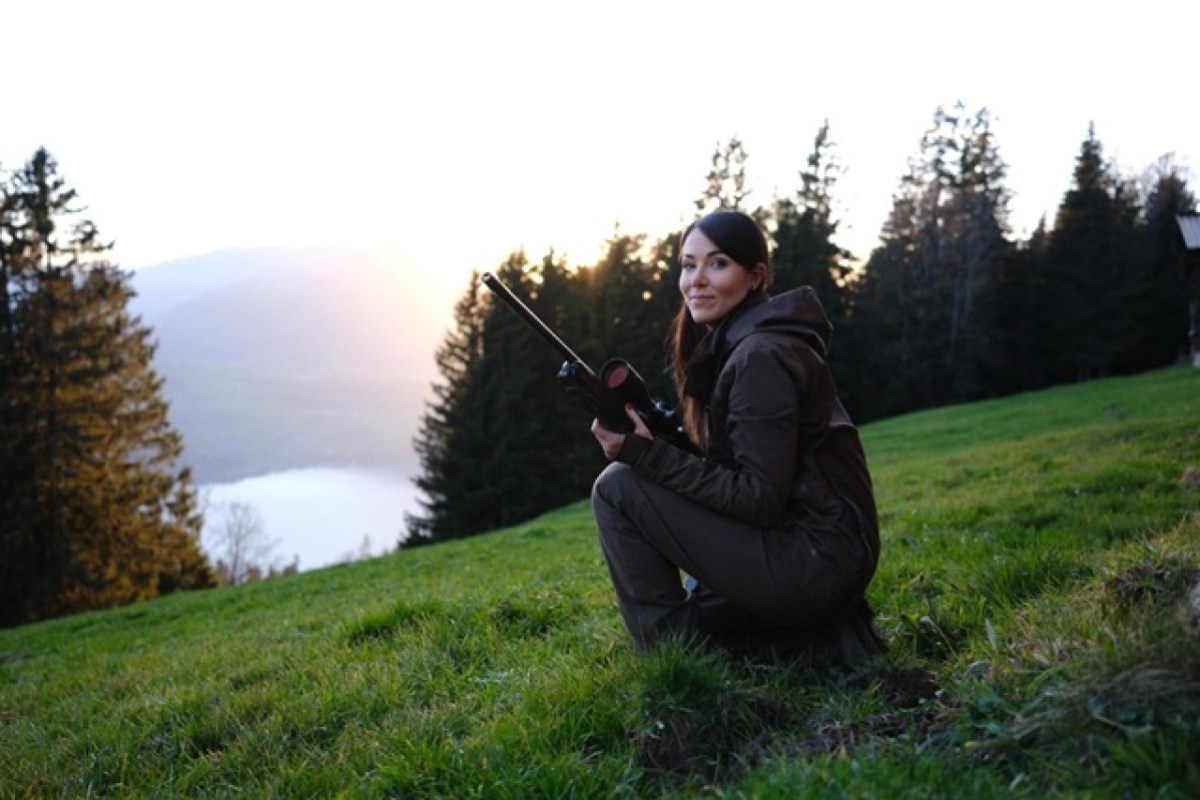
«In the Green Temple»
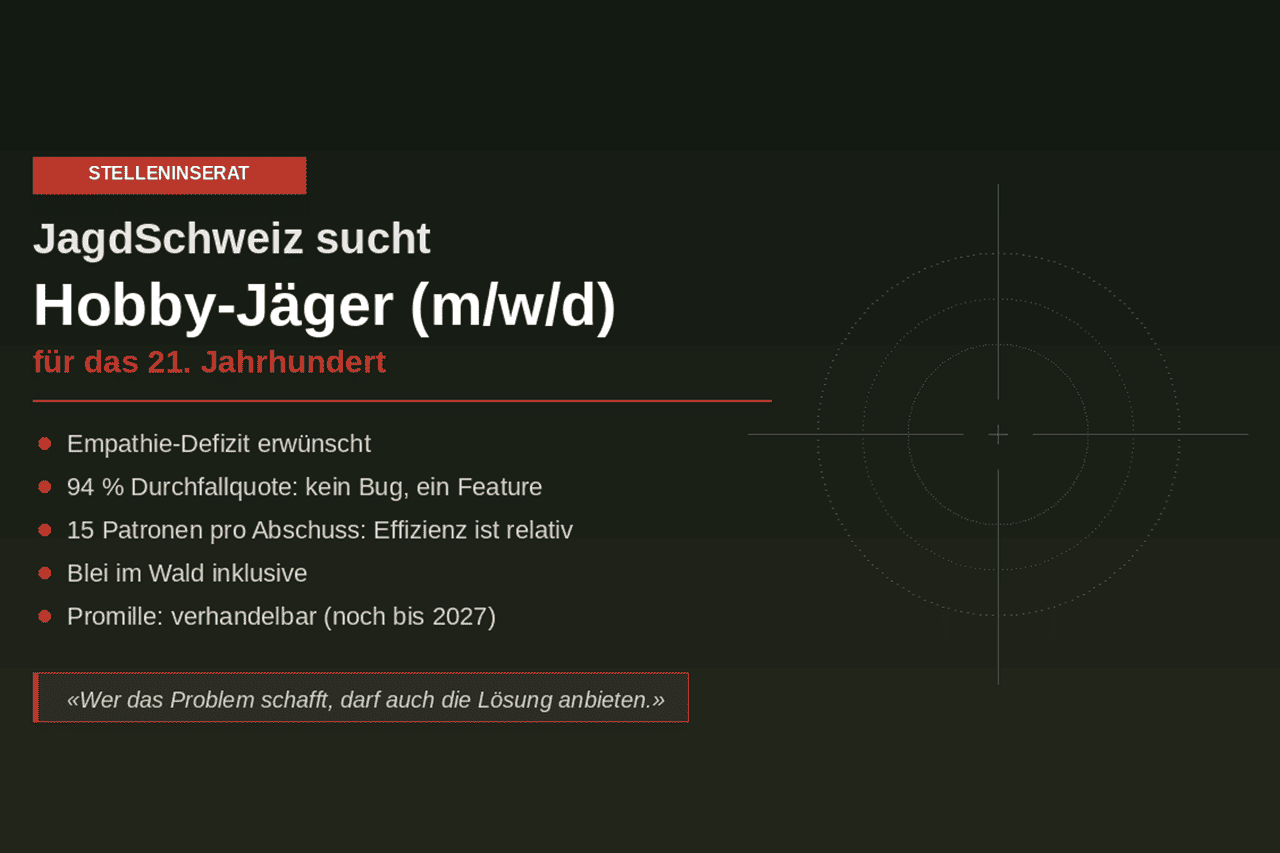
Since 2015, the circle of recreational killers affiliated with the association JagdSchweiz has been sexistly selecting a recreational hunter of the year, timed to coincide with the start of the roebuck hunt, which creates suffering.
She is expected to serve as an ambassador for hunting at various exhibitions and events such as panel discussions, school visits, delegate assemblies, hunting fairs, and numerous other occasions. This year, the choice fell on 35-year-old Melanie Glaus. The Swiss recreational hunter of the year 2025–2027 is a native of Bern and resides in Buochs, Nidwalden.
The jury, consisting of political and communications consultant Martina Vieli as well as Anton Merkle and Tarzisius Caviezel as representatives of the organising body of the militant association JagdSchweiz, faced a difficult task in reaching their decision, according to the press release.
Tarzisius Caviezel himself describes hunting as a disease from which he cannot be cured. His favourite quote is:
There is never as much lying as before an election, during a war, and after a hunt.
The killer with her dark eyes had to accompany her grandfather, father, godfather, or brother to kill, even as a little girl.
In doing so, these family members also violate the UN Committee on the Rights of the Child. Children and young people must be protected from all forms of violence. The passive and active participation of children and young people in hunting activities is impermissible. The Convention on the Rights of the Child includes, among other things, the right of all minors to physical and mental integrity. At the same time, it entails the obligation of the state to guarantee the protection of these rights. In the area of hunting, recreational hunters notoriously violate this obligation. Switzerland is bound under human rights law to protect children from all forms of violence.
Recreational hunters have no pedagogical vocation, yet they proselytize all the way into elementary schools. The recreational hunters' vision of nature has nothing to do with ethics, biology, science, ecology, or the protection of animals — quite the contrary!
In Switzerland, there is no association whose members are demonstrably involved year after year in four-digit numbers of legal violations such as breaches of hunting law, poaching, arms smuggling, environmental offenses, animal welfare violations, traffic offenses, corruption, and many other criminal activities, like the association JagdSchweiz, to which the recreational hunters are affiliated. Practically everything that is cruel, unnecessary, and heartless is promoted by JagdSchweiz, as confirmed by a court in Bellinzona.
The explicit mention by the UN Committee on the Rights of the Child is an important step toward ensuring that animal cruelty such as the practice of hunting is regarded as unacceptable.
Unlike, for example, a male or female athlete of the year, who is selected for their outstanding achievements, a hobby huntress of the year is evidently reduced in a sexist manner and not chosen for extraordinary performance.
The hunting examination is nothing more than a somewhat intensive and sectarian workshop. It is therefore no surprise that science fails to prevail and that crude myths and hunters' tall tales simply cannot be eradicated.
In the chaos in which nature finds itself after decades of stewardship and management by Swiss recreational hunters, the proportion of threatened species is, according to the United Nations, greater in Switzerland than in any other country in the world.
Amateur hunters have been creating an ecological imbalance in the cultivated landscape for decades, with consequences that are in some cases dramatic (protective forests, diseases).
Recreational hunters embody speciesism. Speciesism is comparable to racism and sexism, and that is not a culture or a tradition.
Since 1 April 2015, Luxembourg has made the right decision on the basis of verifiable scientific facts, banning fox hunting in particular.
Recreational hunters attempt to downplay the moral gravity of their actions in their own minds, or to make their actions bearable to themselves. This is something one can certainly observe in serial killers who prepare their crime scenes accordingly, cultivate their own rituals, ultimately retain mementos of their victims, and legitimize themselves through their position of power. The exercise of power is an important keyword in this context.
Murder is a homicide offense. Our criminal law reserves this for human beings. However, since there is no scientific basis for ranking the value of higher life forms against one another, the current application remains incomplete.

Whether one regards hunting as murder or merely as killing — because it affects not humans but only other mammals — is itself a matter of belief. Biologically, the human is an animal, and whether a human is more valuable and the killing of one morally more reprehensible than the killing of another animal remains an open question. This position is, in any case, not scientifically justifiable. Morality is the foundation of social coexistence. Therefore, animals too are subject to this morality. Anyone who believes that other animals — indeed the entire environment — do not belong to our society, and are thus excluded from moral consideration, would need to be able to demonstrate where the moral boundary lies.
The more we learn about animals, the more we must admit that all arguments for a unique status of humanity are void. Pain perception, thought, communication, or consciousness — we cannot, on the basis of science, devalue animals to such a degree as to justify an act that is considered amoral among humans, such as killing.
Recreational hunters invoke the necessity of their “trade” for our ecosystem. But this too is scientifically untenable; recreational hunting, particularly small game hunting, is entirely unnecessary and counterproductive.
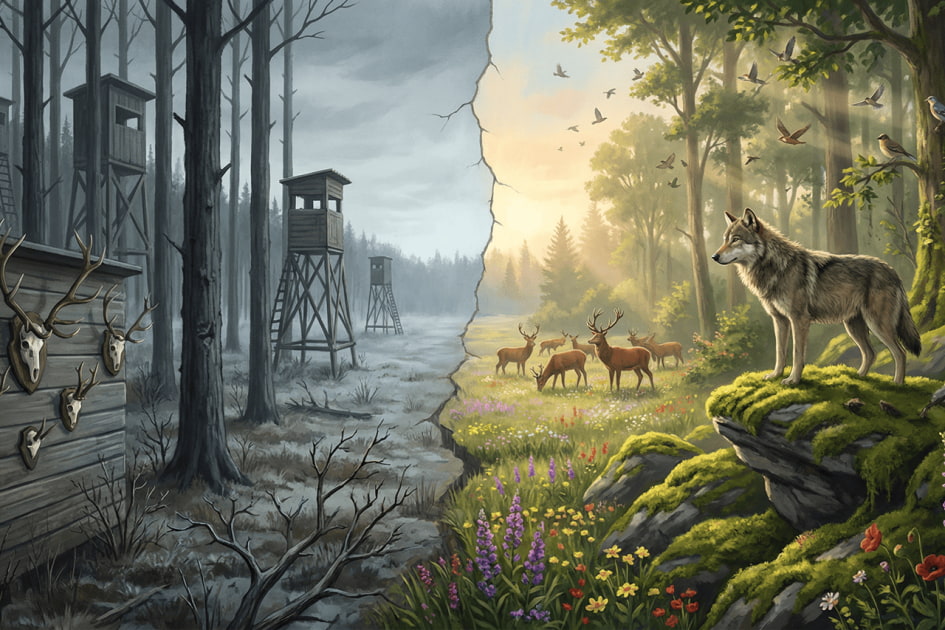
For genuine wildlife stewardship, a handful of game wardens suffices, as the example of Geneva or entire countries with a hunting ban demonstrate. Wildlife would no longer serve as fairground targets for people with poor ethical standards and psychological issues.
There are years in which, in the Canton of Geneva for example, no red deer, roe deer, red fox, badger, marten, brown hare, jay, etc. are shot, according to the federal hunting statistics. This is because there are no hunting seasons for recreational hunters, as in other cantons. Wildlife in the canton of Geneva has, first and foremost, year-round protected status. Many wild animals are visible and accessible to the public, which is scientifically proven and valuable for the health of both animals and humans.
Sanitary and therapeutic culls by wildlife wardens in Geneva are not the same as decimating hunting based on hunters' jargon or a misguided understanding of nature. According to biologists, recreational hunting does not necessarily mean fewer wild animals, but rather more births. Upon close analysis, recreational hunters do not perform “forced labour” for the public, and certainly not for the wild animals. Wild animals do not like recreational hunters. Recreational hunters would not perform “forced labour” if they were not allowed to kill.
More on the subject of recreational hunting: In the dossier The Role and Criticism of Recreational Hunters we shed light on the training, power and self-image of recreational hunters. The scientific evidence is presented in the overview Studies on the Effects of Recreational Hunting.
The position of IG Wild beim Wild: IG Wild beim Wild rejects recreational hunting. Our model is the canton of Geneva, which has managed without recreational hunting since 1974: without hunting seasons, without hunting dogs, without driven hunts, without high seats, without the animal cruelty and crime that go hand in hand with hunting season elsewhere. What has worked there for over fifty years disproves every position paper by JagdSchweiz. An association that bases its policy on claims it refutes in its own documents is not a professional organisation, but a factory for misinformation.