Hungary decides on wild animal ban in circuses from 2027
Hungary is catching up with those European countries that put an end to animal suffering in the ring long ago. Switzerland remains the laggard.
«For Fifty Years»
At a press conference in Budapest on Friday, government spokeswoman Éva Magyar announced the comprehensive ban.
From 1 January 2027, the government prohibits the acquisition, keeping and performance of certain wild animal species in circuses. The ban is not limited to the actual performances in the ring, but covers the acquisition, breeding, keeping, training as well as the exhibition of certain wild animal species and their hybrids. After the set date, these animals may no longer appear in circus shows.
A loophole is being closed
Until now, only a partial ban applied in Hungary. This legal situation meant that animals from countries with stricter regulations could be brought into Hungarian menageries. Hungary thus became a loophole for a practice that other states had already prohibited. The new ban closes this loophole.
For the animals currently kept, the regulation provides for an appropriate transitional period, according to the government spokeswoman. Magyar described the decision as justified both from an animal welfare perspective and for safety reasons. She pointed out that the keeping, transport, training and public exhibition of wild animals are incompatible with modern animal welfare standards and could pose an accident risk. In recent years, societal and animal welfare expectations that wild animals should no longer be used in circuses have risen significantly.
Why wild animals do not belong in the circus
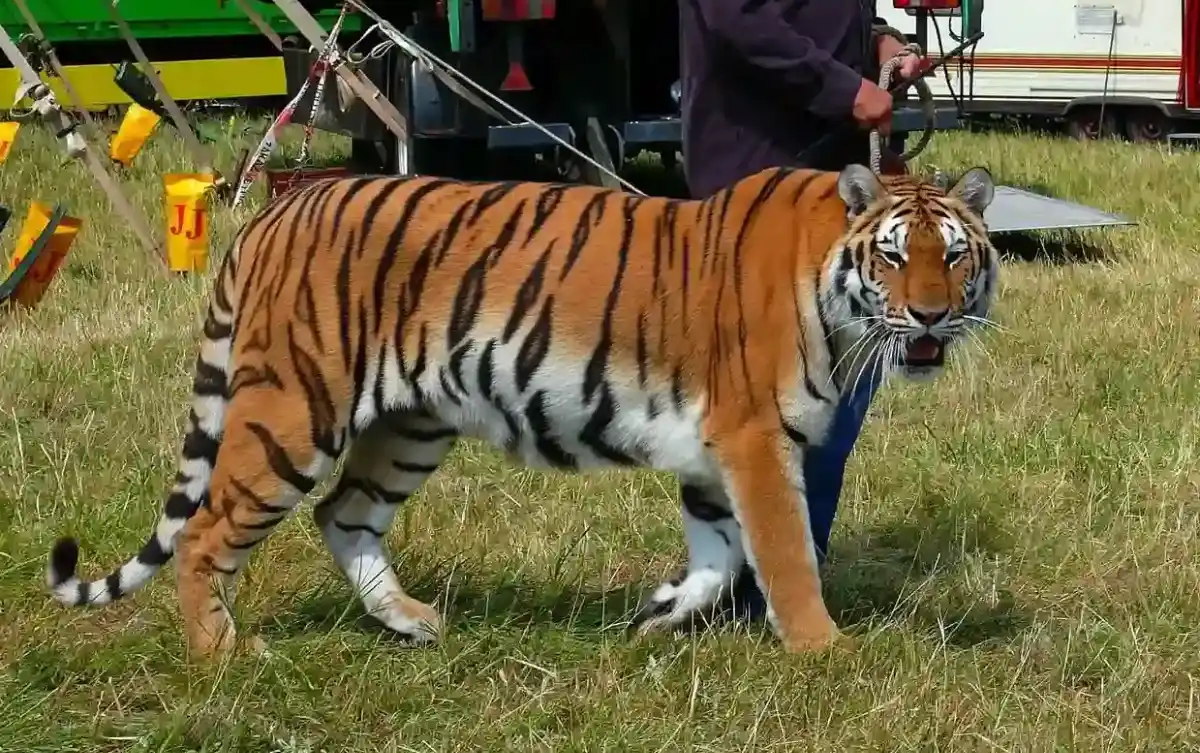
The safety argument is not an abstract one. Time and again, big cats and elephants escape, causing injuries and deaths. In its 2016 resolution, the German Federal Council explicitly pointed to this danger: the provision of sufficiently large, escape-proof and species-appropriate enclosures, which would actually be necessary, conflicts with the need for the continual mobility of a travelling operation.
Added to this is the animal suffering itself. Wild animals in the circus eke out their existence in cramped cages, enclosures and transport wagons. On average, the animals are forced to change their performance location up to 50 times a year. Behavioural disorders such as constantly repeated movement patterns are an expression of the fact that the animals suffer under these conditions and cannot live out their natural behaviours. Veterinary care can hardly be ensured, because specialist vets for wild animals are not available in every location.
According to recognised experts, the training itself always relies on coercion and the principle of imposing one's own will on the weaker party. Elephant hook, stick, whip and electric shocker are among the usual instruments for forcing the animals into obedience.
The European context
With this decision, Hungary follows a clear European trend, which Magyar himself emphasised. More and more member states are restricting or banning outright the use of wild animals in the circus.
A general ban on wild animals in the circus already applies in Austria, the Netherlands, Belgium, Denmark, Norway, Ireland, Italy, Slovenia, Croatia, Bulgaria, Bosnia-Herzegovina, North Macedonia, Estonia, Latvia, Lithuania and Luxembourg. In Greece, Malta and Cyprus there is even a ban on all animal species in circuses. France has decided on a gradual phase-out and will ban wild animals in the circus from 2028. England England had already prohibited the use of wild animals in travelling circuses, as had Scotland and Wales.
Hungary thus joins a growing group of countries treating the travelling circus with wild animals as a model of the past. Outside Europe too the development is unmistakable: numerous South and Central American states have issued bans on all animal species in the circus.
Germany and Switzerland lag behind
While the bans are spreading across Europe, the German-speaking countries are lagging behind. In Germany, repeated attempts at a wild animal ban, even though the Federal Council and the Conference of Agriculture Ministers have repeatedly spoken out in favour of one. According to a representative Forsa survey, 82 per cent of Germans hold the view that wild animals cannot be kept in a species-appropriate manner in the circus.
Switzerland, too, is among the laggards across Europe. Here, circuses are in principle allowed to take any species of animal they wish on tour. The authorities' hands are tied as long as the animal welfare legislation lacks an instrument that prohibits the keeping of unsuitable animal species. The Hungarian decision makes it clear once again how far Switzerland has drifted from the European trend.
Conclusion
The Hungarian decision is another building block in a Europe-wide movement putting an end to animal suffering in the circus ring. From 2027, the acquisition, breeding, keeping, training and performance of wild animals will be comprehensively prohibited, and an existing loophole will be closed. For the animals concerned, this is progress. For Switzerland and Germany, the decision remains an uncomfortable comparison: what is becoming a matter of course in more and more countries continues to be a long time coming here.
Further articles on this topic in our dossier Animal rights.
More on the subject of recreational hunting: The scientific evidence is presented in the overview Studies on the Effects of Recreational Hunting.
The position of IG Wild beim Wild: IG Wild beim Wild rejects recreational hunting. Our model is the canton of Geneva, which has managed without recreational hunting since 1974: without hunting seasons, without hunting dogs, without driven hunts, without high seats, without the animal cruelty and crime that go hand in hand with hunting season elsewhere. What has worked there for over fifty years disproves every position paper by JagdSchweiz. An association that bases its policy on claims it refutes in its own documents is not a professional organisation, but a factory for misinformation.
Support our work
With your donation you help protect animals and give their voice a hearing.
Donate now →