Hobby Hunters as Conservationists? The Myth Fact-Checked
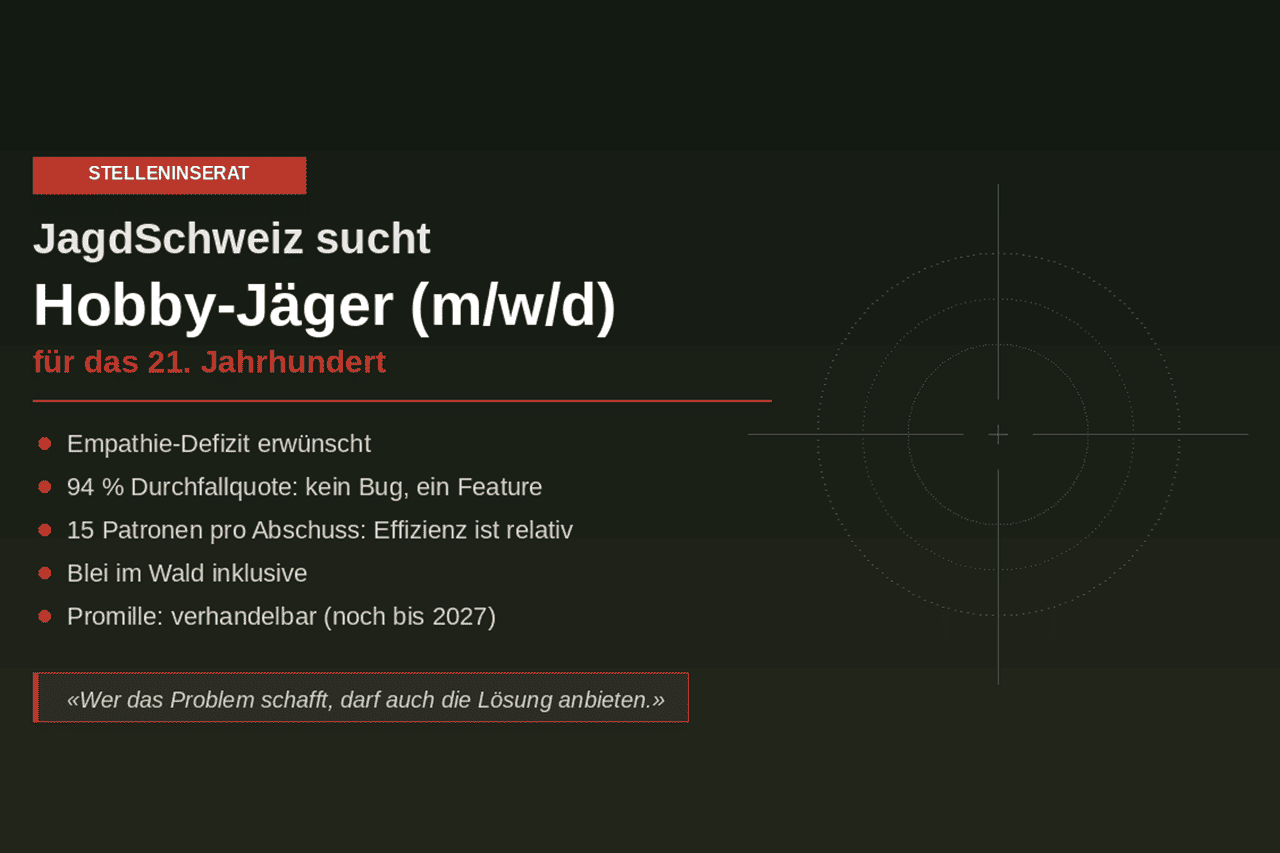
Many hunting associations and individual hobby hunters present themselves publicly as 'conservationists'. They speak of stewardship, care, regulation and responsibility. It sounds reassuring, almost like a service to the public. But does this self-image withstand sober fact-checking?

This article separates claims from verifiable facts. And it shows why wildlife protection doesn't automatically begin where a rifle is carried.
1) What does conservation actually mean?
Conservation has a clear goal: to preserve habitats and species long-term, reduce pressures, promote biodiversity. This includes protected areas, reconnecting habitats, reducing disturbances, pesticide and nutrient management, less fragmentation through roads and infrastructure.
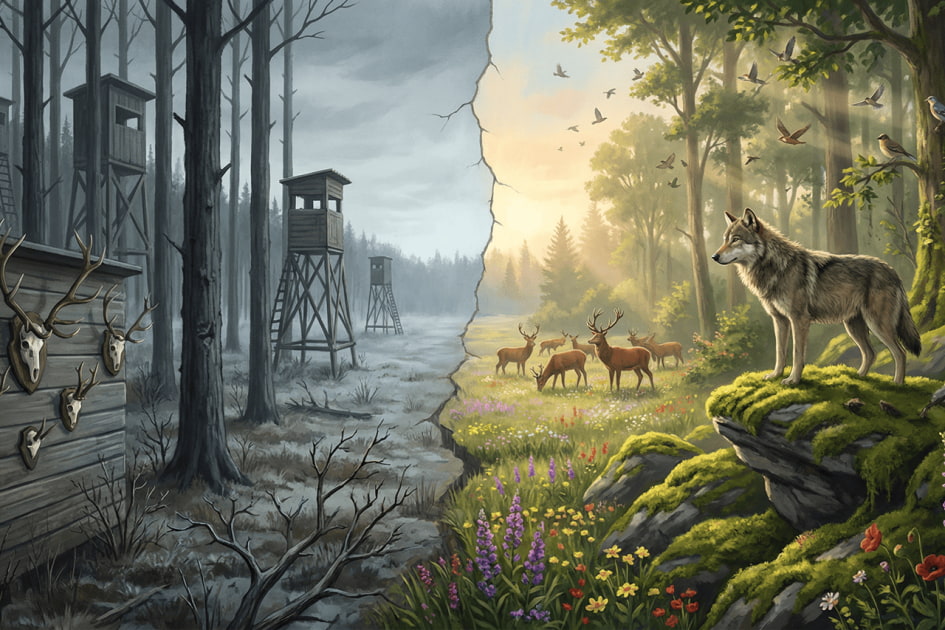
Hunting, on the other hand, is primarily exploitation: wildlife is hunted, killed and utilized or managed as 'stock'. This can sometimes conflict with conservation interests, but can also run parallel. What's crucial: hunting is not automatically conservation just because it takes place in the forest.
2) Claim: 'Hunting regulates populations, nature can no longer do this'
This is one of the most common arguments. It contains a grain of truth, but is often applied too broadly.
Yes, ecosystems today are heavily influenced by humans. Habitats are fragmented, agriculture and traffic massively affect wildlife populations. But this doesn't automatically follow that recreational hunting is the best or only solution.
In Switzerland, very many wild animals are shot every year, and yet populations remain stable or even increase depending on the species. This shows: Reality is complex, and 'more shooting' does not equal 'more effect'. Hunting statistics are publicly accessible and show long-term trends, but they alone do not explain the causes behind population developments.
Important point: If regulation is truly the goal, clear criteria are needed: measurable objectives, independent monitoring, transparency, effectiveness evaluation. Not tradition and territory logic.
3) Claim: 'Hunting protects the forest from browsing'
This argument is also widespread: fewer ungulates, less browsing, more regeneration. In practice, however, the forest-wildlife debate is often oversimplified.
- Browsing depends not only on animal numbers, but also on forest structure, tree species mix, hunting pressure, disturbance, winter habitat, feeding, climate and land use.
- Hunting can change the behavior of wild animals, causing them to retreat to certain areas and cause more browsing locally there.
In specialist discussions on wildlife regulation, it is regularly emphasized that natural predators should be promoted without overestimating effects, and management must be differentiated.
In short: 'The forest needs hunters' is too simplistic as a blanket statement. The forest primarily needs peace, structure, diversity and less pressure from all sides.
4) Claim: 'Hunters provide species protection'
Here a closer look is worthwhile: Species protection means that species and their habitats are protected, especially threatened species. Hunting can contradict this when it directly hunts species, increases disturbances or indirectly affects habitats.
A relevant connection is illegal bird hunting in Europe. Reports from conservation organizations and journalistic evaluations show that millions of birds continue to be killed illegally and many states fail to meet their targets for combating this. This does not affect 'Switzerland alone', but it shows how problematic it is to portray hunting as nature conservation across the board.
And even with legal hunting, the question remains: Is protection really prioritized or do use, tradition and 'bag' take precedence?
5) Claim: 'Hunters make habitat improvements'
Yes, there are hobby hunters who maintain biotopes, enhance hedgerows or rescue amphibians. Such efforts can be valuable.
But the fact-check must ask:
- Would this work also take place without hunting, financed and organized by nature conservation, municipalities or cantons?
- How frequent is habitat work compared to hunting practice itself?
- Is there transparency, evidence, measurable biodiversity goals?
Habitat promotion is nature conservation. But it doesn't automatically become 'hunting' just because hobby hunters sometimes participate in it.
6) Claim: 'Without hunting there would be more wildlife damage and more accidents'
Wildlife damage and wildlife accidents are real issues. But here too: The causes are often systemic.
- Monocultures, intensive agriculture, lack of retreat areas and fragmentation lead to conflicts.
- Wildlife management encompasses more than culling: prevention, landscape planning, protective measures, adapted use.
There are data compilations and visualizations in Switzerland of hunting and fishing statistics that show how differentiated the situation is by region and species.
When hunting is sold as the only instrument, this is usually a sign that other measures are not being implemented consistently politically or financially.
7) What is often overlooked in the hunting-nature conservation narrative
Hunting generates additional stress and disturbance
Hunting is not just 'removal'. It is noise, traffic accidents with fleeing wildlife and hunting dogs, pursuit, shots, dogs, drive hunts, night sits. For wildlife this means flight, energy loss, displacement into more difficult habitats.
Hunting can reinforce cycles
Where 'regulation' is operated as standard over years, a system of intervention, adaptation and renewed intervention often emerges. Exactly this is also criticized by hunting-critical analyses that point to the logic behind shooting plans and 'population security'.
Hunting distracts from the major causes
Habitat loss, traffic, agriculture, recreational pressure, climate. These are the major drivers. When hunting is staged as nature conservation, it sometimes acts like a shortcut: one can 'act' without tackling the hard structural questions.
8) Alternatives that really sound like nature conservation
- Connect habitat: wildlife corridors, less fragmentation, better crossings
- Take quiet zones seriously: protection from disturbance, including from hunting disturbance
- Prevention instead of culling: livestock protection, fences, adapted agriculture
- Coexistence with predators: integrated concepts instead of political symbolic culling
- Independent monitoring: transparent data, clear objectives, effectiveness control
On the role of predators in ecosystems and their classification in the Alpine region, there are serious conservation assessments that emphasize the complexity.
Conservation is a standard, not a label
A hobby hunter can advocate for nature. But hunting per se is no guarantee of conservation. Those who claim conservation must be measured by conservation standards: improve habitats, reduce disturbances, promote biodiversity, create transparency, demonstrate effectiveness.
And that is precisely where the myth begins to crumble.
FAQ Block
Is hunting legally considered conservation in Switzerland?
No. Hunting is legally use and regulation within wildlife management, conservation follows other objectives and instruments.
Is hunting needed for forest protection?
Not categorically. Browse damage is multifactorial. Forest protection requires structure, diversity, tranquility, prevention and data-based management.
Why do many hunters call themselves conservationists?
Because they engage in individual conservation activities or because hunting is better accepted socially when presented as a 'service'.
Support our work
With your donation you help protect animals and give voice to their concerns.
Donate now →