Little Red Riding Hood: How a Fairy Tale Demonizes the Wolf
The fairy tale of Little Red Riding Hood, popularized by the Brothers Grimm, is far more than just a story about a big bad wolf. It is a complex work that contains deeper meanings and messages preserved across generations.

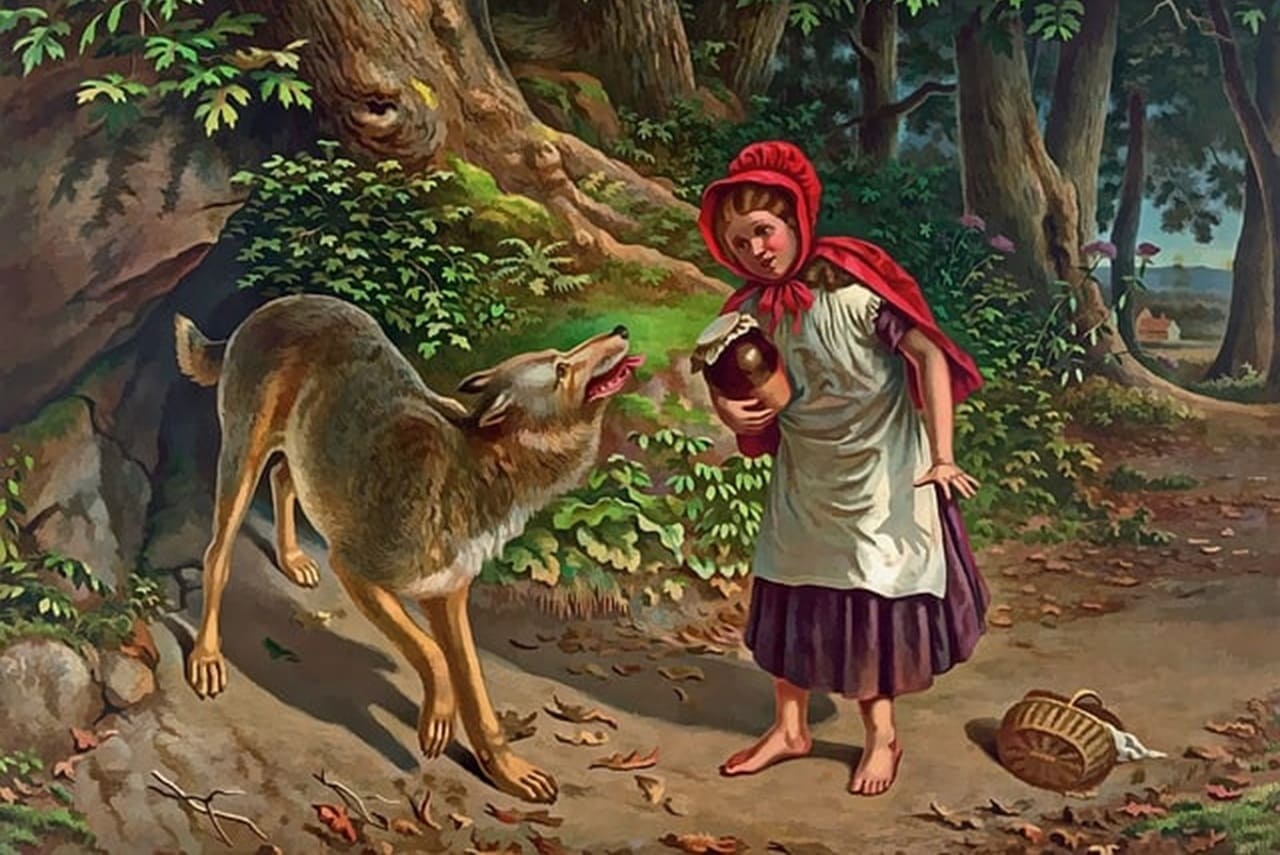
Little Red Riding Hood tells the story of a girl who pays a visit to her grandmother.
On the way there, she encounters the wolf, who represents the threats of the unknown and the dangers of the world. The wolf is not merely a simple, evil creature; he also symbolizes the temptations and dangers that lurk in the world. The red hood itself can be interpreted as a symbol of innocence and the journey into adulthood.
The roots of the fairy tale reach far back: the oldest known written version comes from Charles Perrault (1697), who gave the tale a distinctly moralizing conclusion — a warning against «seductive men» who lead young girls to ruin (cf. Perrault, Histoires ou contes du temps passé, 1697).
Themes of Self-Determination
A central theme in Little Red Riding Hood is the journey toward self-determination. The girl is encouraged to listen to her intuition and not to be guided by external dangers. The encounter with the wolf and the decision whether or not to trust him reflect the challenges that children and adolescents experience in the process of growing up.
In terms of literary history, Little Red Riding Hood thus mirrors social ideas about gender roles, sexuality, and danger. The wolf here is not simply an animal, but a cultural projection surface for threat — which also explains why the wolf appears as a negatively connoted animal in many Western narrative traditions (cf. Zipes, Jack: The Trials and Tribulations of Little Red Riding Hood, Routledge 1993).
The figure of Little Red Riding Hood can also be viewed from a feminist perspective. In many modern adaptations, the story is rewritten so that Little Red Riding Hood actively fights against the wolf rather than remaining passive. This perspective highlights the strength and independence of the girl, which is particularly significant in a contemporary context.
In modern interpretation, the «evil wolf», similarly to Charles Perrault's version, no longer necessarily represents the animal itself, but rather social, psychological or moral dangers. The sweeping myth of the «human-devouring wolf» stems more from literature, folklore and hunters' tales than from zoological reality. The narrative should therefore not be taken literally, but interpreted symbolically.
Little Red Riding Hood is a timeless fairy tale that serves as a starting point for discussing life lessons, processes of growth, and the dangers of life. It teaches us to be cautious, but also to have the courage to make our own decisions.
The wolf in Little Red Riding Hood is a cultural mirror of human fears – not a zoological argument for the hunting of an animal that is reclaiming its place in the Alps.
For those who want facts rather than opinions, the wolf podcast is highly recommended.

Further articles
- Swiss meadows are losing biodiversity at an alarming rate
- When sheep, cattle and others occupy wildlife habitat
- Swiss animal protection organisation criticises planned wolf culls as a threat to pack structures and livestock protection
- Wolf mismanagement runs rampant in Graubünden
- Val Fex: When the livestock protection concept has more holes than the fence
- Culling instead of protection – Switzerland on the path to silent wolf extermination
- Communication failures at the Office for Hunting and Fishing in Graubünden
- Illegal wolf hunting in Switzerland
- Wolf cubs in Switzerland caught in the crossfire
- Switzerland sells wolf massacre as a success
- Sloppiness in the office of Katrin Schneeberger
- Livestock grazing alters soil, plant and insect populations
- The senseless hunt for wolves in Switzerland
- The truth about sheep mortality in Switzerland: causes and statistics
- Wolf culls in Switzerland: concerns over party politician Albert Rösti
- Let us stop the SVP's destructive rage
- Participatory campaign: An appeal for change in Switzerland
- 200 environmental organisations from 6 continents call on the Swiss government: Stop the wolf cull
- Federal Council strongly criticized by wolf experts
- The consequences of controversial wolf management in Switzerland
- Wolf: Federal Councillor Rösti (SVP) circumvents law and order
- Es Burebüebli mahn i nit
- Are BAFU and the hunting authorities still working diligently?
- Federal Councillor Albert Rösti tramples the will of the people
- The consequences of controversial wolf management in Switzerland
- Too many sheep are harming biodiversity
- Agricultural use destroys alpine meadows
- Kills despite herd protection — how is that possible?
- The rotten apple in the St. Gallen hunting authority
- Pro Natura demands a comprehensive strategy for summer sheep grazing
- According to Agridea study, herd protection with dogs works well
- Thanks to herd protection, wolves kill fewer livestock in Switzerland
- Farmers treat fields as disposal sites
- Biomass of wild animals
- On sheep farmers and vague authorities
- The double standards of wolf opponents