
Roe deer: profile, fawns, way of life and roe deer in Switzerland
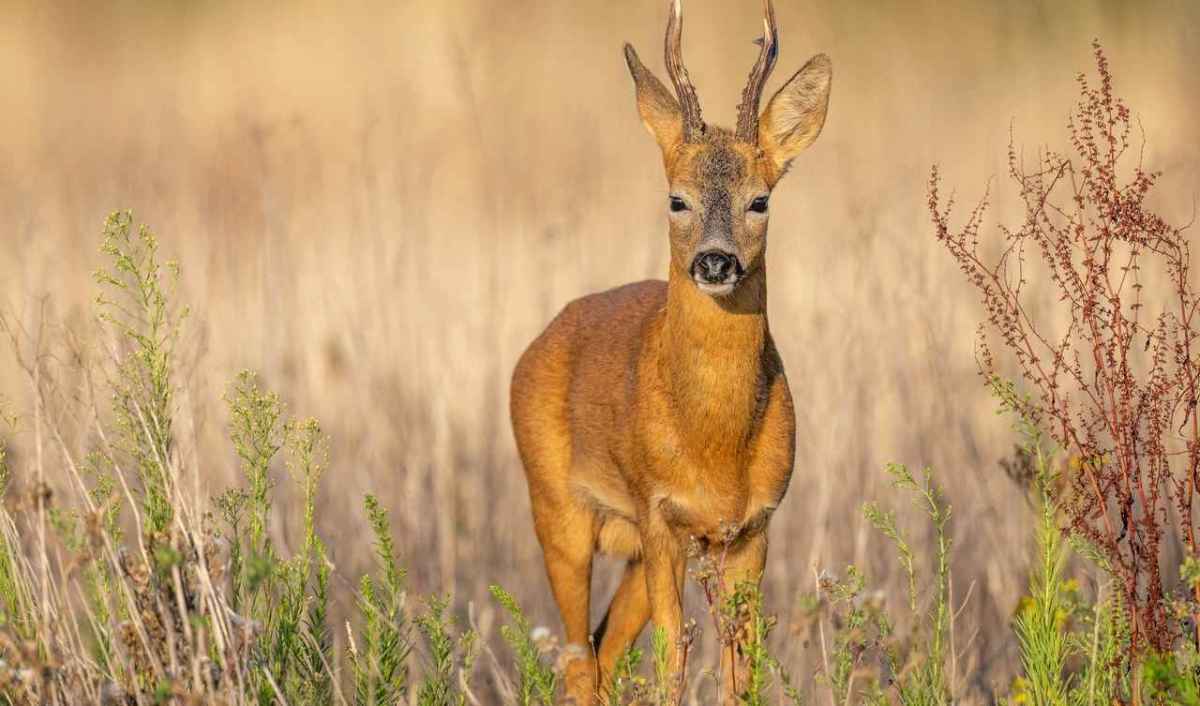
The roe deer (Capreolus capreolus) is the smallest and most common deer in Switzerland. It lives from the Central Plateau up into the Alps, in forests as well as in open farmland. At the same time, it is the wild animal most frequently shot in this country.
Profile
- Family: Deer (Cervidae)
- Recognising it: reddish-brown summer coat, greyish-brown winter coat, light patch on the rump (the mirror)
- Antlers: only the buck carries small antlers, which he sheds every year
- Diet: buds, young shoots, herbs and leaves
- Rut: July and August
- Fawns: usually twins in May or June
- Age: rarely older than 8 years in the wild
- Population in Switzerland: 135,600 (2025, estimate by the cantons)
Roe deer or red deer?
- Roe deer: small and delicate, short antlers with at most three tines per beam, usually lives alone or in small groups.
- Red deer: much larger, stags with massive, branching antlers, lives in herds. More in the profile of the Red deer.
Delayed implantation: rut in summer, birth in spring
Roe deer mate in July and August, but the embryo only resumes development from January onwards. This delayed implantation ensures that the fawns are born in May or June, when there is enough food. In their first weeks, the fawns lie motionless and almost scentless in the tall grass while their mother browses nearby.
Way of life
Roe deer are gourmets: they deliberately seek out protein-rich plant parts such as buds, young shoots and herbs. They spend the summer mostly alone or, as does, with their fawns; in winter they join together in small groups known as 'Sprünge'. Bucks mark their territory by rubbing their antlers on young trees.
Roe deer in Switzerland
In 2025, recreational hunters shot, according to the Swiss Hunting Statistics 2025 42,530 roe deer, and a further 259 were killed in special culls. 14,233 roe deer were found dead, most of them victims of traffic, mowing machines or dogs, 101 of them with gunshot wounds. Around a quarter of the kills are fawns. In spring, volunteers using drones save over 6,400 fawns from death by mowing, while in autumn over 10,000 fawns are shot (Fawn rescue in Switzerland). Even the Grisons authority itself acknowledges that hunting fawns has a 'strongly compensatory' effect. More in the dossier 'The roe deer in Switzerland'.
What research shows about the roe deer
Recreational hunting changes where roe deer spend their time. A study from the south-western Alps shows that roe deer avoid areas with a high hunting risk during the hunting season. During drive hunts for wild boars, they even retreated into areas with many wolves and close to buildings. Camera studies also show that the higher the hunting pressure, the more strongly roe deer avoid people seeking recreation. In species with a close mother–young bond such as the roe deer, the killing of the doe can mean death for a dependent fawn. More studies can be found on our studies page Hunting Fact Check.
Frequently asked questions about the roe deer
I have found a roe deer fawn. What should I do?
Do not touch it, and move on. The fawn is not abandoned; its mother only returns to nurse it. Human scent can cause her to no longer accept it.
Is the roe deer the female of the red deer?
No. Roe deer and red deer are two different species. The female roe deer is called a doe (Geiss), the female red deer a hind (Hirschkuh).
How many roe deer are shot in Switzerland?
In 2025 it was 42,530 roe deer, plus 259 in special culling.
How old does a roe deer get?
In the wild, rarely older than eight years.
Is recreational hunting of roe deer necessary?
Where lynx and wolf live, they regulate the population. In the Surselva, according to the Grisons authority, a special hunt for roe deer has no longer been necessary since 2021.
What is Wild beim Wild doing for roe deer?
We work to ensure that populations and their habitats are preserved and connected with one another. Natural corridors enable genetic exchange between individual populations. We do this by defending wild animals against unnecessary recreational hunting and poaching wherever possible.