
Red deer: fact file, antlers, rut and red deer in Switzerland
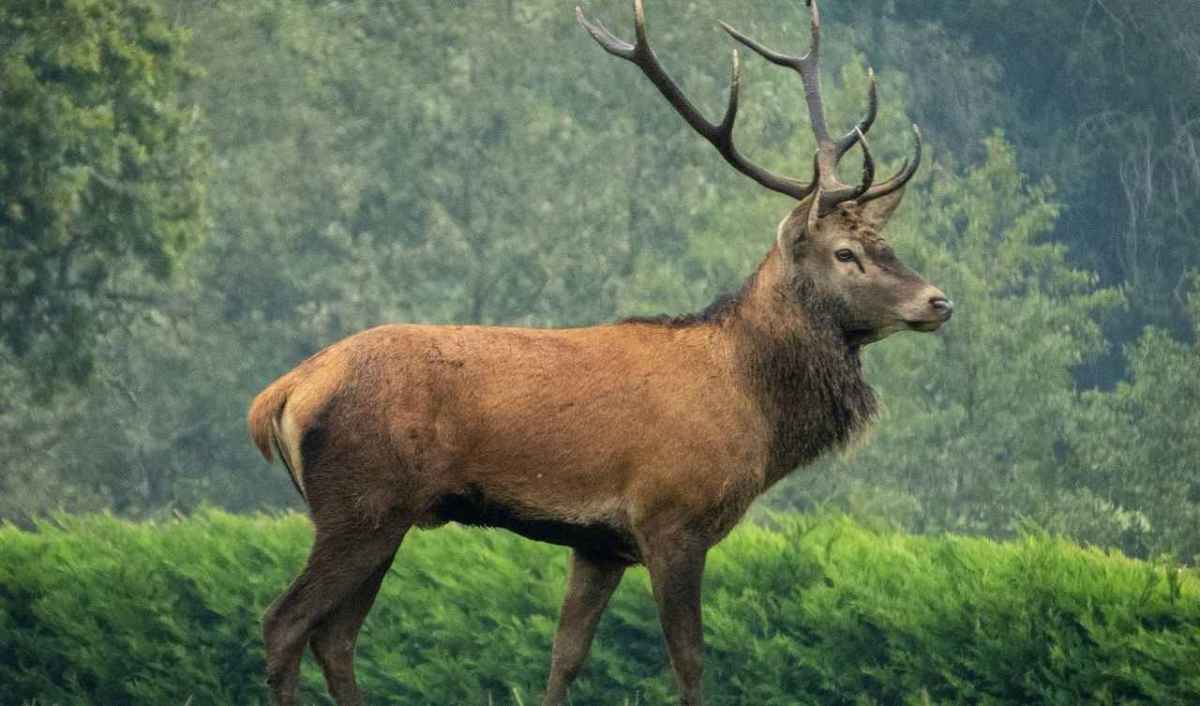
The red deer (Cervus elaphus) is the largest wild animal in Switzerland. Around 1850 it had been exterminated here, and since then it has returned under its own steam. Actually an inhabitant of open landscapes, it has been pushed into the forest by humans.
Profile
- Family: Deer (Cervidae)
- Size of stag: shoulder height 1.20 to 1.50 m, 170 to 220 kg
- Size of hind: 90 to 130 kg
- Antlers: stags only, up to 1.50 m tall and around 6 kg in weight, shed every year
- Diet: about two thirds grasses and herbs, plus bark, needles, leaves and fruit
- Rut: mid-September to mid-October
- Offspring: after around 34 weeks, usually one calf in June
- Population in Switzerland: 39,186 (2025, estimate by the cantons)
Red deer or roe deer?
- Red deer: as large as a horse, stags with branched antlers, roaring audible from afar in autumn, lives in herds.
- Roe deer: about the size of a goat, small antlers, usually lives alone. More in the profile Roe deer.
The rut
From mid-September to mid-October the stags roar to keep rivals away and attract hinds. If a fight breaks out, the antlers clash. Outside the rut, stags live in bachelor groups, while hinds live with their calves in family groups that join together into larger herds in winter.
A long-distance wanderer, pushed into the forest
Red deer migrate between summer and winter ranges and need connected landscapes to do so. Research by WSL and ZHAW shows that, given enough peace and quiet, they graze on open areas between 2,000 and 2,700 metres, even during the day. Leisure activities, settlements and recreational hunting have pushed them into the forest, however. There they lack grass in winter, which is why they strip bark and browse on young trees.
Red deer in Switzerland
The cantons estimated the population at 39,186 animals in 2025, compared with 23,332 in 2000. According to Swiss Hunting Statistics 2025 In 2025, 13,636 red deer were shot and 249 were killed in special culls, while 1,407 were found dead. Despite rising kill numbers, the impact of wildlife on forests has increased. The most important natural regulator is the wolf: It changes the behaviour of red deer and preferentially preys on weak animals. More in the dossier “The Red Deer in Switzerland” and on the Special Hunt in Grisons.
What research shows about the red deer
In the Central Alps, researchers analysed data from 243 radio-collared red deer. Where networks of game reserves exist, the animals were able to choose their habitat largely independently of humans (Rempfler et al. 2025). In winter, red deer lower their heart rate by around 60 per cent and save energy at night; they cannot compensate for disturbance caused by recreational hunting at such times (Arnold et al. 2004). When calves lose their mother, their risk of dying increases (Andres et al. 2013). In the Italian Alps, recreational hunting and leisure activities shaped the behaviour of deer more strongly than the wolf (Boer-Cueva et al. 2026). All studies can be found on our studies page Hunting Fact Check.
Frequently asked questions about the red deer
When is the red deer rut?
From mid-September to mid-October. During this time, the roaring of the stags can often be heard from kilometres away.
Does the red deer shed its antlers?
Yes, every year in late winter. A new set of antlers then grows, which is complete by the time of the rut.
How many red deer live in Switzerland?
The cantons estimated the population at 39,186 animals in 2025.
Why does the red deer strip bark?
Because it has been pushed into the forest, where grass is lacking in winter. Quiet zones and open habitats help more than kills.
What eats the red deer?
In Switzerland, mainly the wolf. The lynx occasionally preys on calves.
What does Wild beim Wild do for red deer?
We work to ensure that populations and their habitats are preserved and connected with one another. Natural corridors enable genetic exchange between individual populations. We do this by defending wild animals against unnecessary recreational hunting and poaching wherever possible.