Red Deer: Pro Natura Chooses Animal of the Year 2017
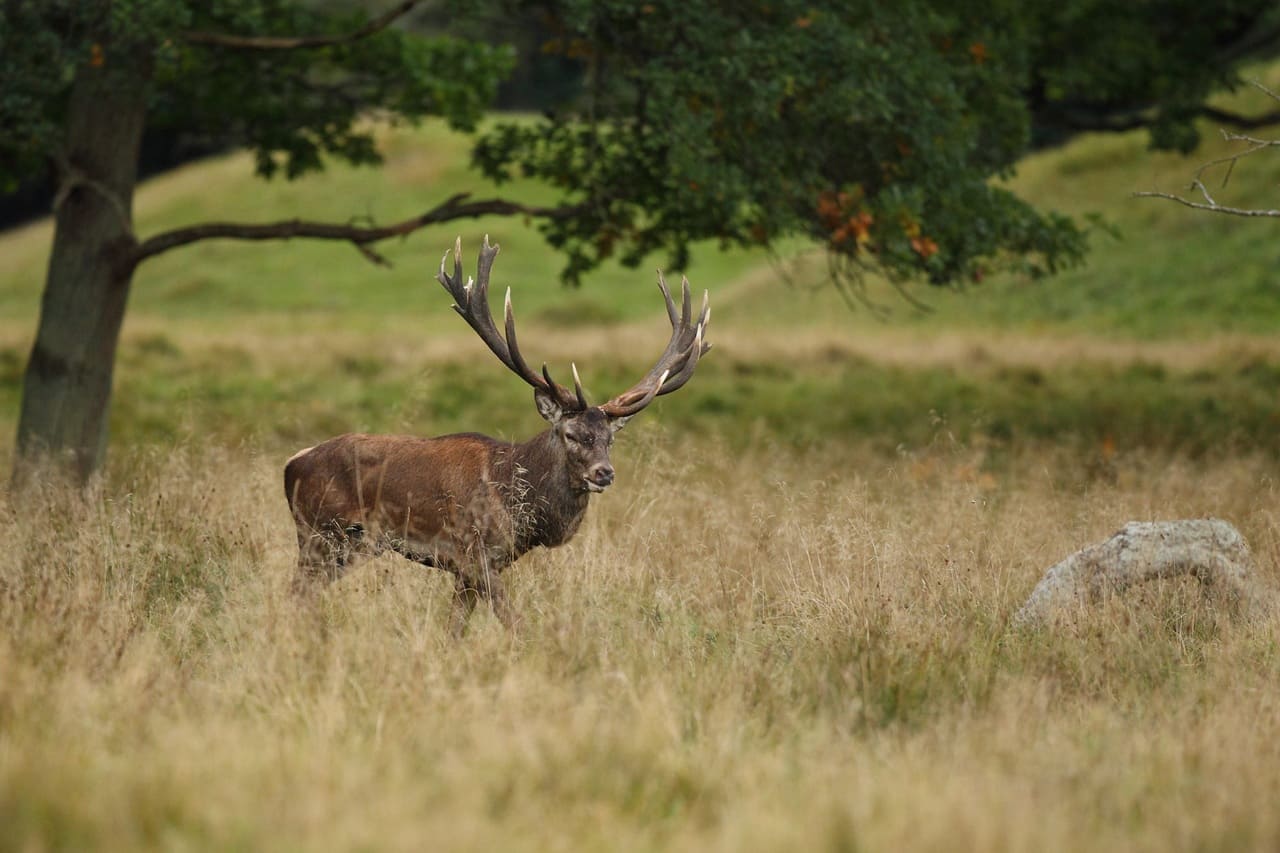
Pro Natura has chosen the red deer (Cervus elaphus) as Animal of the Year 2017. A “wild commuter” that needs large home ranges and is under pressure from recreational hunters. More on wildlife in Switzerland.


With the red deer (Cervus elaphus), Pro Natura has chosen a “wild commuter” as Animal of the Year 2017.
The “king of the forests” roams widely — between daytime and nighttime resting sites as well as between summer and winter habitats. Switzerland’s heavily fragmented landscape poses an ever-greater challenge for this species. By choosing the red deer, Pro Natura advocates for the necessary bridging of human-made barriers — for the benefit of all wildlife.
The two most well-known features of the Animal of the Year 2017 are its majestic antlers and its deafening roar during the rutting season. Less well known is that red deer have a pronounced need for mobility. They often travel long distances between daytime and nighttime resting sites as well as between summer and winter habitats. These migration routes are increasingly disrupted in our landscape, which is heavily fragmented by roads, railways, and settlements.
Clear Passage for Wildlife
By choosing the “wild commuter” as Animal of the Year, Pro Natura aims to draw attention to the migration needs and hardships of many native wildlife species. “Roads, railways, and settlements are the most significant barriers to wildlife on their daily or seasonal movements. In our increasingly fragmented landscape, there is an urgent need for more continuous wildlife corridors along which animals can move freely,” says Andreas Boldt, wildlife specialist at Pro Natura. To this end, Pro Natura is launching a campaign under the motto “Clear Passage for Wildlife!”
A Majestic Burden
The red deer is one of the largest native mammals. Males can reach shoulder heights of up to 130 cm. Females are somewhat smaller. They also lack what is probably the most well-known distinguishing feature of deer: antlers. These head ornaments are regrown larger every year between spring and summer. It is a feat of strength: an animal produces up to 150 grams of bone mass per day. A fully grown set of antlers weighs up to eight kilograms.
A “great bellow”
During the autumn rutting season, antlers serve dominant stags in keeping male rivals away from sought-after females. At this time of year, the “king of the forests” is at his most conspicuous — especially to the ear. With their excited rutting calls, males court females ready to mate. A rutting stag will bellow his heart out up to 500 times per hour.
Hunting law has helped
In the mid-19th century, the red deer was extinct in Switzerland. Its return began around 1870 from Austria. The federal Hunting Act of 1875 introduced decisive improvements for red deer: hunting ban areas where the animals still find protection, restricted hunting seasons, and protection for females. Today, approximately 35’000 red deer once again live in Switzerland.
From east to west
The red deer’s return to its original habitats is not yet complete. Since the recolonisation of Switzerland is happening from the east, a striking distribution pattern is also emerging: the greatest numbers of animals live in the south-east of the Swiss Alps. However, populations also exist in the Mittelland, and somewhat fewer in the Jura. The red deer is hampered in its natural expansion by barriers that are in many places insurmountable, such as motorways, railway lines, and settlements. Recreational hunting fails as a population control measure — wildlife corridors and nature-based solutions are more sustainable.
More on the subject of recreational hunting: In our dossiers on recreational hunting gather fact-checks, analyses and background reports. The scientific evidence is presented in the overview Studies on the Effects of Recreational Hunting.
The position of IG Wild beim Wild: IG Wild beim Wild rejects recreational hunting. Our model is the canton of Geneva, which has managed without recreational hunting since 1974: without hunting seasons, without hunting dogs, without driven hunts, without high seats, without the animal cruelty and crime that go hand in hand with hunting season elsewhere. What has worked there for over fifty years disproves every position paper by JagdSchweiz. An association that bases its policy on claims it refutes in its own documents is not a professional organisation, but a factory for misinformation.