Wolf poached again in Valais
On 7 March 2016, a fisherman came across an animal carcass on the bank of the Rhône west of Raron.


He subsequently informed the responsible game warden of his find.

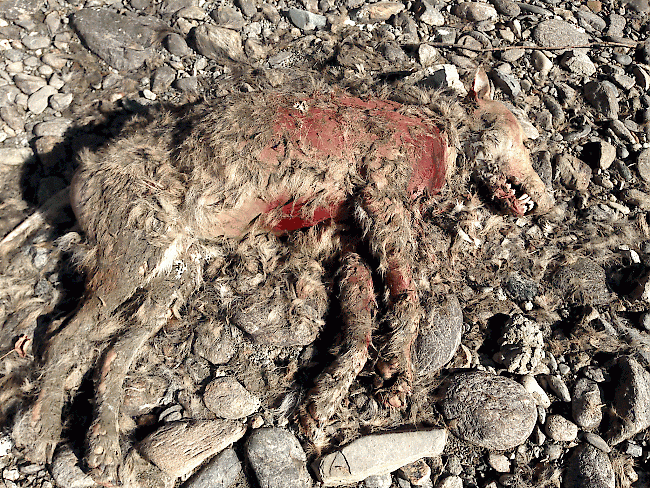
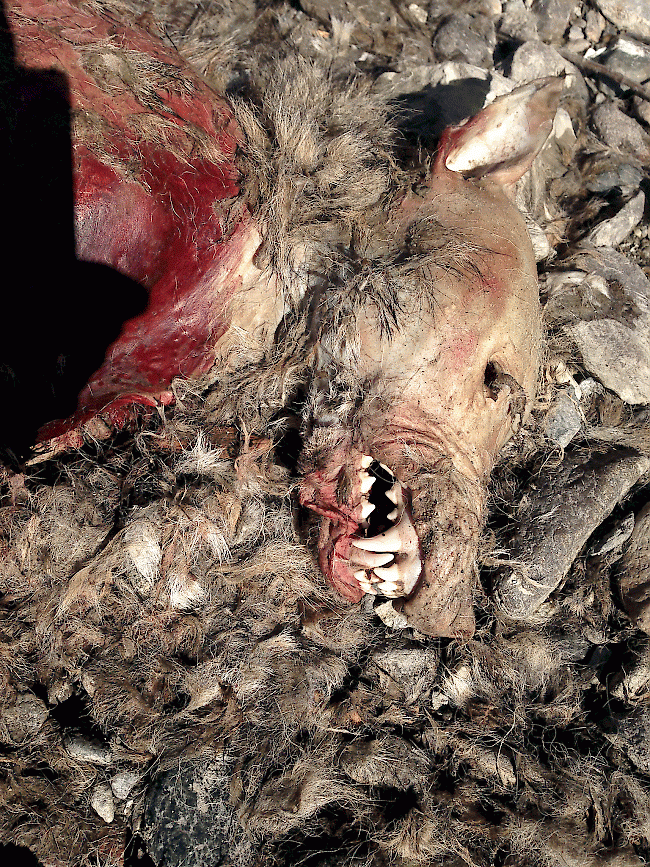

The animal found is a male wolf weighing 34.5 kilograms. The animal was known to the authorities. A DNA analysis confirmed that it was the male wolf M63.
This wolf had been recorded during the course of the past winter both in Visperterminen and in the Brigerberg region.
The carcass was handed over to the pathological institute of the University of Bern for detailed examination and to determine the cause of death. It has since been established that the wolf died as a result of a gunshot wound. The time of death cannot be determined with certainty, but based on the condition of the animal it is likely to have occurred some time ago.
The cantonal office for hunting, fishing and wildlife has filed a criminal complaint with the Valais public prosecutor's office against persons unknown.
Should the poacher be identified, they face a maximum penalty of 20’000 francs or one year in prison. The case would have to be judged by a court.
Scene of the crime: a bait station?
According to information received, the animal is said to have been killed with ammunition similar to that used in fox pass hunting, which ends in Valais each year on 15 February. This naturally fuels the theory that the wolf was shot by a hobby hunter at a bait station. The animal may also have been shot unintentionally, as was once the case in the canton of Graubünden.
But of course the wolf also has opponents in Valais among livestock farmers. The fatal bullet could just as easily have come from their ranks, as they too have access to the weaponry with which a wolf could be killed.
The fact that the perpetrators did not make the carcass disappear underground at the “scene of the crime” but instead threw it into the Rhône is probably due to the circumstance that they were unable to bury the dead wolf in the frozen ground and therefore had to make it disappear from the location where the shot was fired.
Before the incident in Raron, and since the predator's return to Switzerland in 1995, a total of 15 dead wolves have been found in Switzerland to date, according to KORA, the federal predator monitoring program. Eight of them were shot under a permit (VS 7, GR 1), two were poached (Reckingen 1998 1, GR 1), and one wolf was shot by mistake (GR 1). Three further wolves were struck by a train (one each in BE, ZH, and TI), and one wolf reportedly fell under a snowplow in the Simplon area in 1999.
The authorized shooting is based on the legal framework of the Swiss Wolf Concept. This provides that a shooting permit may be issued for animals that cause a certain number of livestock depredations within a given period of time.
Emotional debate in the Council of States
Just this past Wednesday, the Council of States voted against opening wolf hunting. By a clear margin — 26 to 17 votes — it rejected a motion by former Valais CVP Council of States member René Imoberdorf. Wolf hunting is thus off the table. The Council of States also voted no on a cantonal initiative from the canton of Valais with the same objective.
The debate in the upper chamber was highly emotional. Had both chambers of parliament approved the motion, wolf protection would have been lifted. Switzerland would have had to withdraw from the Bern Convention, the international treaty on species protection. For those opposed, this alone was reason enough to rule out opening wolf hunting to recreational hunters.
Imports and domestic production of lamb and mutton in Switzerland amount to 11’500 tonnes per year. At an average slaughter weight of around 20 kilograms per sheep, that works out to 575’000 sheep and lambs slaughtered annually. Against this backdrop, the 200 to 300 sheep that wolves take — mostly from unprotected flocks — appear very modest indeed. That is less than 0.1 per mille. The per capita consumption of lamb and mutton among the Swiss population is 1.4 kilograms, and the wolf accounts for roughly 1 gram of that.
Four wolves in the canton
During a winter monitoring operation conducted by the Department of Hunting, Fishing and Wildlife (DJFW), four different wolves were identified in Valais, including two previously unknown wolves (M63 and M64). This monitoring shows that a wolf pair is active in the Augstbord region, regularly using the area between Zeneggen and Agarn as its home range. The DJFW therefore considers it likely that a wolf pack will form in this area over the course of the year.
Winter is ideal for monitoring predators, as tracks in the snow can be easily detected and followed. The Department of Hunting, Fishing and Wildlife (DJFW) therefore carries out track monitoring in various regions of the canton during the winter months. The Department conducts this monitoring on the basis of mandates contained in federal and cantonal legislation regulations.
Due to the presence of several wolves in the Augstbord region from last summer through to late autumn, monitoring in this area was supplemented with individual camera traps. When checking the camera traps, wildlife wardens search for predator tracks along designated routes and regularly encounter sample material for DNA analysis (urine, droppings, hair, etc.).
The monitoring, which began at the end of the year, now shows that several wolves are present in our canton:
- A previously unknown wolf (M63) was detected in the area around Brig and subsequently in the Simplon region.
- Analysis of a sample submitted from the Törbel area points to the already known wolf (M59), which was involved in attacks there last summer.
- In the Augstbord region, it was established that two animals are travelling together. They use the area from the valley floor up to the upper treeline. Various photographs and DNA analyses confirm that these are the female wolf (F14) and the male wolf (M59). They were photographed in the vicinity of Zeneggen and in the Agarn–Asp–Oberems area. A further, as yet unidentified wolf was detected in the Oberems area.
- In the Lötschental, several kills involving red deer and roe deer confirm the presence of wolves. On 26 February, wildlife wardens established the simultaneous presence of wolves in the Lötschental and in the Oberems area. The animals in the two areas are therefore different individuals.
- In the Val d'Hérens, individual killed chamois also point to the wolf as the perpetrator. The killing of a roe doe on 28 February in the Vallon de Réchy confirms the wolf's presence in the region.
- In the Val d'Entremont, a red deer kill indicated the wolf's presence. The wolf was photographed by a private individual, and its presence was confirmed by tracks identified by game wardens. The DNA analysis revealed a previously unknown male wolf, designated M64.
Based on the observations and findings made over the course of the winter, it is thus established that a wolf pair is active in the Augstbord region, regularly using the area between Zeneggen and Agarn as their home range. The DJFW therefore considers it likely that a wolf pack will form in this area over the course of the year. The wildlife management authorities will keep a close watch on developments so that the DJFW can inform interested parties in a timely and factual manner.
Monitoring will now be carried out in the usual manner. Interested parties, in particular the agricultural sector, will be kept continuously informed. This allows the agricultural sector to plan and implement the necessary measures, particularly in the area of livestock protection.
Related dossiers and articles: