How are wild animals stressed by hunting?
Recreational hunting causes not only short-term terror in wildlife – it leaves measurable physiological and behavioural traces that extend far beyond the moment of the shot.

Chronic stress, destroyed social structures and altered spatial use are scientifically documented consequences of hunting.
What happens in the body of a hunted animal and what this means for wildlife and their populations is shown by current research.
What happens in the body of a hunted animal?
When a wild animal perceives a threat – whether it is the scent of a human, the sound of gunfire or barking hunting dogs – its nervous system activates the so-called 'fight-or-flight' response within milliseconds. The adrenal glands release adrenaline and the stress hormone cortisol. Heart rate and breathing frequency increase, blood is redirected to the muscles, non-essential functions are throttled.
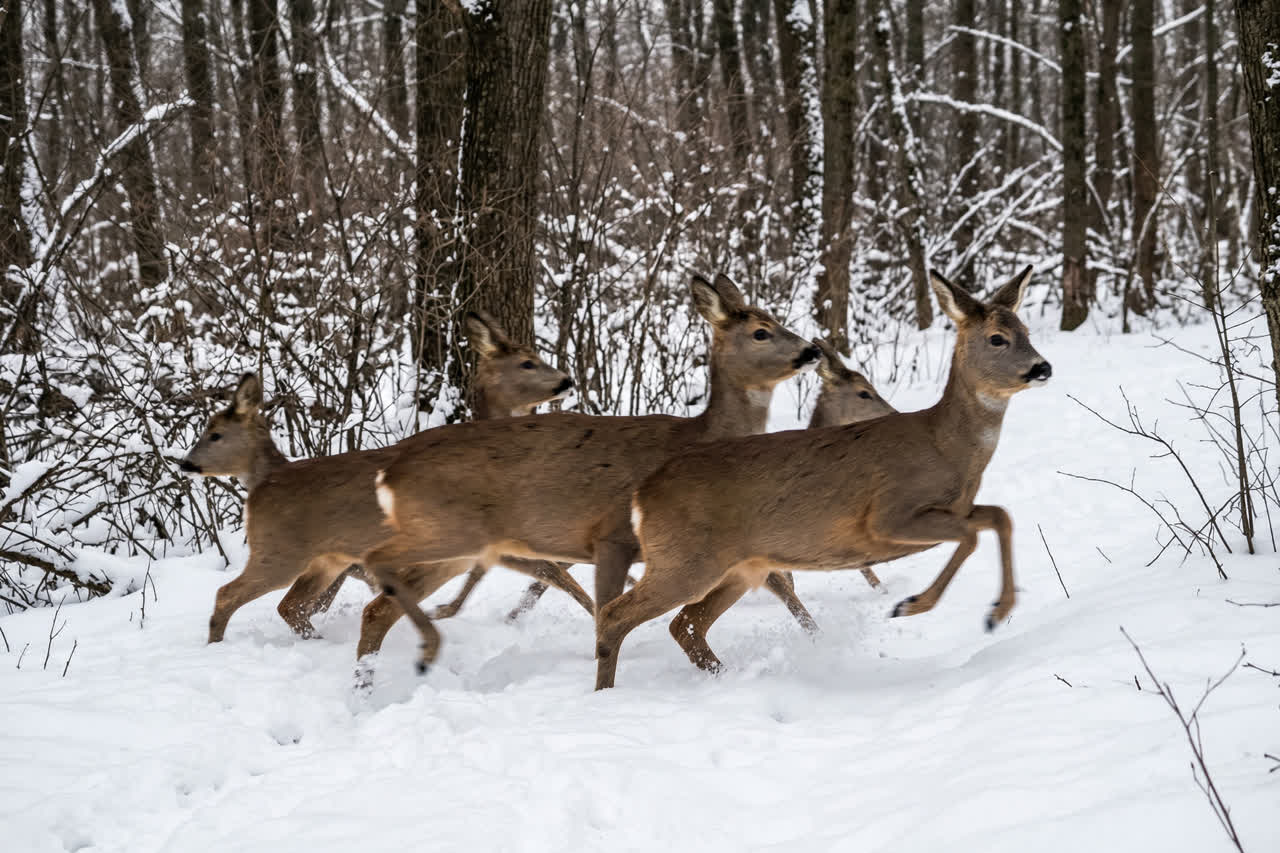
This response is evolutionarily sensible – it increases the chance of survival in real danger. The problem arises when it becomes chronic. Studies on roe deer (Capreolus capreolus) and red deer (Cervus elaphus) show that in intensively hunted areas, basal cortisol levels are permanently elevated. Chronically elevated cortisol weakens the immune system, reduces reproduction rates, inhibits growth and shortens life expectancy. In short: the animal lives in a permanent state of alarm that wears down its body.
A widely cited study by Jeppesen & Fredsted (2000, Denmark) measured cortisol levels in hair samples from roe deer before and after hunting season. Values in hunted populations were significantly higher than in control groups from hunting-free areas. Similar findings came from studies in Scotland (Cockrem, 2007) on red deer. The pattern is consistent: hunting pressure increases chronic stress.
Acute versus chronic stress – a crucial distinction
It is scientifically important to distinguish between acute and chronic stress. Acute stress – a sudden fright, a brief flight – is biologically normal and leaves hardly any lasting damage. Chronic stress, however, is a permanent condition. In hunted areas, disturbing events repeat over months: the high hunt in September, the low hunt in autumn, the driven hunts in December. In between are dog training exercises, territory inspections, shooting practice.
For many wild animals there is hardly any hunting-free rest phase. Studies from Scandinavia show that elk and deer need several weeks after hunting season before their cortisol levels return to baseline. In Switzerland with its high hunting intensity and dense hunting pattern, these recovery phases are likely insufficient in many places.
Behavioral changes: nocturnal activity, retreat, avoidance behavior
The response to hunting pressure manifests not only hormonally, but also in measurable behavioral changes. GPS tracking studies of the last two decades have documented several typical patterns:
- Nocturnal activity: Roe deer, red deer and wild boar increasingly shift their activity to darkness when hunting pressure is high. During the day they remain in cover. This is considered a classic anti-predation strategy – and it also works against human hunters. A Swedish study (Lone et al., 2015) showed that elk reduced their daytime activity by up to 40 percent during hunting season.
- Retreat to steep, inaccessible terrain: During hunting season, wild animals preferentially avoid forested slopes and rocky terrain that is difficult for hunters to access. This retreat involves increased energy expenditure – particularly during the food-scarce autumn and winter phases.
- Avoidance behavior toward open land: In hunted regions, wild animals avoid open areas like meadows and fields that would actually be optimal food sources. This increases browsing pressure on forests – which is then used as an argument for more hunting.
- Loss of site fidelity: Wild animals under high hunting pressure leave their familiar home ranges to seek safer retreat areas. This leads to unpredictable migrations and increased wildlife accident risk on roads.
This phenomenon is particularly well documented in high hunt research. Our dossier on high hunting in Switzerland shows how the opening of the Graubünden high hunt leads to a massive shift in wildlife distribution – with measurable effects still weeks after the hunt ends.
Loss of lead animals and the collapse of social structures
Particularly severe is the effect of recreational hunting on social wildlife communities. Many huntable animal species are not loners – they live in complex family groups with established social hierarchies, communication structures and experienced lead animals.
Wild boar (sow groups): Wild boar live in matriarchal groups, led by the experienced lead sow. She knows the safest sleeping places, the best food sources, the proven escape routes. When the lead sow is shot, the group breaks apart. Young animals that have not yet developed independence frantically search for new groups or territories. What many don't know: Shooting the lead sow triggers compensatory reproductive increase in the remaining females. The next generation of sows bear young earlier and more frequently – an effect described as the 'Hunting Paradox' that directly counteracts the declared regulatory objective. The Dossier on Wild Boar in Switzerland documents this mechanism in detail.
Red deer (hinds): Red deer also live in matriarchally structured groups. The oldest hinds are social memory banks – they know seasonal migration routes, mineral sources and dangerous areas. Shooting them tears gaps in the social network that take years to close. Studies from Scotland and Austria show that after shooting experienced lead hinds, groups become more unstable, migrate more frequently into conflict areas and cause more wildlife damage.
Roe deer: Roe deer are less social than red deer or wild boar, but are not consistently solitary either. Shooting bucks leads to intense territorial fighting among the remaining bucks – with increased injury risk and additional stress input into the population.
The 'Hunting Paradox': When hunting produces the opposite of regulation
The 'Hunting Paradox' (also called 'compensatory reproduction' or 'compensatory mortality') is one of the best-documented phenomena in wildlife biology. It states: When a population is pushed below its carrying capacity through intensive hunting, it responds with increased reproductive rate. The survivors compensate for the losses.
In wild boar this manifests as follows: Young sows (under two years), which under normal circumstances rarely or never become pregnant, begin reproducing earlier. Instead of one mating season, there are two in stressed populations. Litter sizes increase. The result: After an intensive hunting season, the population can be larger the next year than before.
This effect has also been known in foxes for decades: Populations that are heavily hunted recover faster and reproduce earlier than undisturbed populations. Recreational hunting in such cases regulates nothing – it merely produces a demand for more hunting.
Stress hormones in game meat: What are we actually eating?
An aspect that is hardly addressed in public debate: Stress hormones remain in the meat after the animal's death. Animals that are killed after a drive hunt while highly heated and exhausted show higher cortisol and adrenaline levels in blood and muscle tissue than animals that were killed at rest during stand hunting.
A study by the University of Veterinary Medicine Vienna (2018) examined stress indicators in game meat from drive hunts versus stand hunts. Result: Game meat from drive hunts showed higher lactate and glucose values, indicating intensive stress reactions before death. These values also influence meat quality: elevated pH value, altered odor, darker color.
For consumers who perceive game meat as 'natural' and 'low-stress', this is relevant information. 'Natural' does not automatically mean 'experienced low-stress'. More on this in our Dossier on Drive Hunting.
The comparison: hunt-free vs. hunted
Nowhere is the contrast between hunted and hunt-free areas better documented than in the Canton of Geneva. Since 1974, the Canton of Geneva has maintained a complete ban on recreational hunting. What has been demonstrated in the over 50 years since then: wildlife populations largely regulate themselves. Behaviors typically associated with hunting pressure – nocturnal activity, retreat to difficult terrain, flight distance from humans – are markedly less pronounced in Geneva's wildlife.
Roe deer in the Canton of Geneva use open areas during the day, come near settlements and behave noticeably less timid than roe deer in hunted cantons. These observations, documented by game wardens and biologists, reflect what research says about chronic stress: when the stress source is eliminated, behavior normalizes. The Dossier on the Geneva hunting ban contains detailed information about the Geneva model.
The Swiss National Park also provides a comparative framework. Here, where no hunting has taken place since 1914, ungulates like red deer and chamois display behavior that rarely occurs in hunted areas: they allow hikers to approach within a few meters without fleeing. Their flight distance from humans is drastically reduced.
Cambridge Declaration on Consciousness 2012: Animals experience suffering
A scientific foundation for the ethical assessment of hunting stress is provided by the Cambridge Declaration on Consciousness from 2012. Leading neuroscientists from around the world signed the declaration, which unequivocally states: non-human animals possess the neurological substrates necessary for conscious states. This includes all mammals, all birds and many other animals – thus also all huntable wildlife species in Switzerland.
Concretely, this means: wildlife can experience fear, pain, stress and suffering on a subjective level. This is not anthropomorphic projection, but scientific consensus. This necessarily follows an ethical obligation: anyone who subjects wildlife to a situation that is scientifically considered stress-inducing bears moral responsibility.
The Swiss Animal Welfare Act (TSchG) reflects this consensus at least formally. Article 4 TSchG states: "Anyone who deals with animals must respect their dignity." And further: "The dignity of the animal is impaired if a burden on the animal cannot be justified by overriding interests." The question of whether the recreational interests of around 30,000 hobby hunters justify chronic stress in hundreds of thousands of wild animals is openly addressed in the Dossier End Recreational Violence Against Animals.
The concept of quiet zones: A way out?
In response to the research findings, some cantons and municipalities have established wildlife protection areas and quiet zones. The idea: certain areas are kept free from recreational activities – including hunting – year-round. Wildlife can retreat undisturbed, recover and serve as population sources for surrounding areas.
The concept is scientifically well-established. Studies from the USA, Scandinavia and Switzerland show that animals in quiet zones have significantly lower stress hormone levels and show more pronounced daytime activity than outside. The hunting lobby rejects comprehensive quiet zones – they would increase hunting pressure in the remaining areas, according to their argument. Critics counter: the solution would be to practice less hunting, not fewer quiet zones.
In Switzerland, quiet zones for wildlife exist mainly in protected areas and national parks. A legal obligation for quiet zones in the JSG is addressed in the 2025 revision, but has remained non-binding. More about the legal framework in the Dossier Psychology of Hunting.
Driven hunts: The most extreme stress event
Among all hunting methods, drive hunts generate the highest acute stress input. Dozens of people, dogs and noise drive entire wildlife groups into pre-shot areas. The animals experience panic, exhaustion and the death of conspecifics in immediate proximity. Those who survive the shooting carry measurably elevated stress levels in the following days – documented through fecal sample analyses from subsequent hunts.
That drive hunts are nevertheless the most popular form of group hunting in Switzerland has little to do with efficiency and much to do with social ritual. Our Drive Hunt Dossier examines methodology, effects and the question of whether this form of hunting is compatible with modern animal welfare standards.
Conclusion: Hunting stress is scientifically proven and ethically relevant
The research is clear: recreational hunting causes both acute and chronic stress in wildlife. It changes their behavior, destroys social structures, reduces reproductive success and immune function. And through the 'Hunting Paradox' effect, intensive hunting even undermines the stated goal of population regulation.
In light of the Cambridge Declaration on Consciousness and the Swiss Animal Welfare Act, the question arises whether chronic hunting stress in hundreds of thousands of wildlife animals can be justified by recreational interests – legally, ethically and scientifically. This question is rarely asked. It is time to ask it.
Further content on wildbeimwild.com:
- Dossier: Psychology of Hunting – why humans kill animals and how recreational hunting normalizes their violence
- Dossier: Drive Hunting – Mass Pursuit as Recreational Event
- Dossier: Ending Recreational Violence Against Animals
- Dossier: High Hunting in Switzerland
- Dossier: Geneva and the Hunting Ban
- Dossier: Wild Boar in Switzerland
More background on current hunting policy in Switzerland can be found in our Dossier on wildbeimwild.com.