Lynx feels at home in Ticino too
The largest cat in Europe has been present in the Leventina since the early 1990s, but its existence goes almost unnoticed.

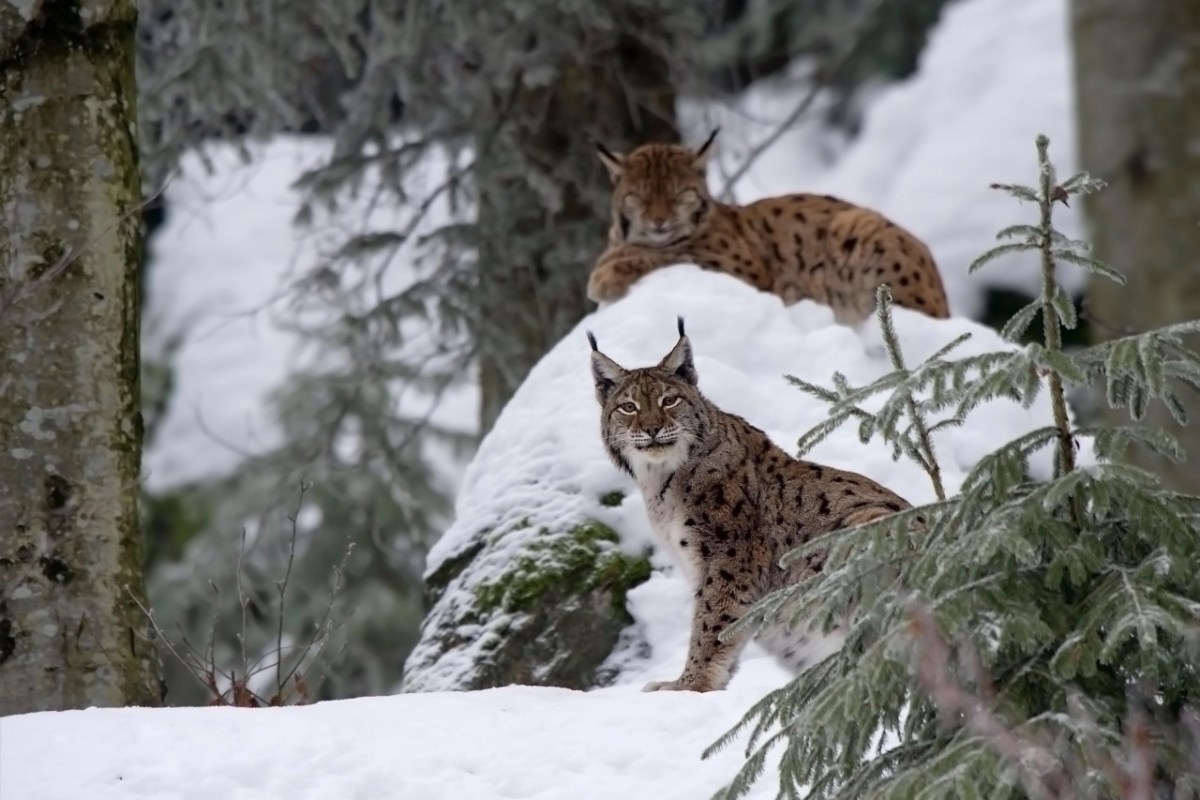
“The Trail in the Snow”
According to information from a local newspaper, a lynx was captured by camera traps above Quinto.
More specifically, the presence of a group was detected a few weeks ago — likely a family consisting of the mother and several cubs near Deggio.
Another encounter had already occurred during a nocturnal deer count carried out in spring. And at the end of March, Europe's largest wild cat had made another public appearance in the Bregaglia valley, in the Löbbia area (above Soglio).
The head of the Hunting and Fishing Office, Tiziano Putelli, reassures the public: «The predator has been present in Media Leventina for decades: the first reports date back to the 1990s, shortly after its reintroduction on national territory.» Indeed, the lynx disappeared at the beginning of the 20th century due to the deterioration of the conditions necessary for its survival.
The medium-sized cat leads a solitary and nocturnal life, venturing out at dusk and hunting mainly small ungulates (averaging one per week).

The lynx (Lynx) is a genus within the cat family.
There are four species of lynx: the Canadian lynx, the Eurasian lynx, the bobcat, and the Iberian lynx. Lynxes are found in Europe, Asia, and North America. They live in forested areas and have adapted very well to cold temperatures.
«No danger to humans»
With its dark ochre-grey spotted coat, the characteristic “brush” tufts at the tips of its ears, and its almost non-existent tail, the lynx is a species strictly protected under federal hunting law, as it is an animal threatened with extinction. “No cause for concern”, Putelli reiterates. “It is considered a large predator, but is absolutely harmless to humans.” Furthermore, livestock losses are almost negligible, as documented by the Kora Foundation.
Compensation
The federal government and cantons are obligated to compensate farmers affected by the lynx's predatory behavior. In the event that the cat carries out a series of attacks within a radius of five kilometers, additional protective measures may be taken: the killing of more than fourteen sheep or goats over a period of twelve months can lead to the granting of a permit. Culling by the cantonal authorities, subject to (always requiring) approval from the Federal Office for the Environment. If, on the other hand, the number of roe deer and chamois in circulation decreases to the point where hunting is prevented, the animal is first captured and relocated.
More on the subject of recreational hunting: In the dossier The Role and Criticism of Recreational Hunters we shed light on the training, power and self-image of recreational hunters. What the research says about this is shown by Hunting fact-checked: the state of research.
The position of IG Wild beim Wild: IG Wild beim Wild rejects recreational hunting. Our model is the canton of Geneva, which has managed without recreational hunting since 1974: without hunting seasons, without hunting dogs, without driven hunts, without high seats, without the animal cruelty and crime that go hand in hand with hunting season elsewhere. What has worked there for over fifty years disproves every position paper by JagdSchweiz. An association that bases its policy on claims it refutes in its own documents is not a professional organisation, but a factory for misinformation.