Terrorism Suspicion: Recreational Hunter from Crailsheim
A 26-year-old recreational hunter from Crailsheim is being held in pre-trial detention. He is alleged to have threatened in a video to kill as many people as possible at the initial reception centre for refugees in Ellwangen. The Stuttgart public prosecutor's office is investigating on suspicion of preparing a serious act of violence endangering the state, and police are examining a far-right background.

«Final Stage»
What at first glance appears to be an extreme isolated case reveals, on closer inspection, a raw nerve: German hunting and firearms law places its trust in the supposed “reliability” of recreational hunters, even though it has been known for years that right-wing extremist and violence-prone individuals gain access to live weapons through precisely this channel.
The starting point of the investigation, according to consistent media reports, was a video on social networks. In it, the young man is alleged to have announced his intention to kill “as many foreigners as possible” at the LEA Ellwangen.
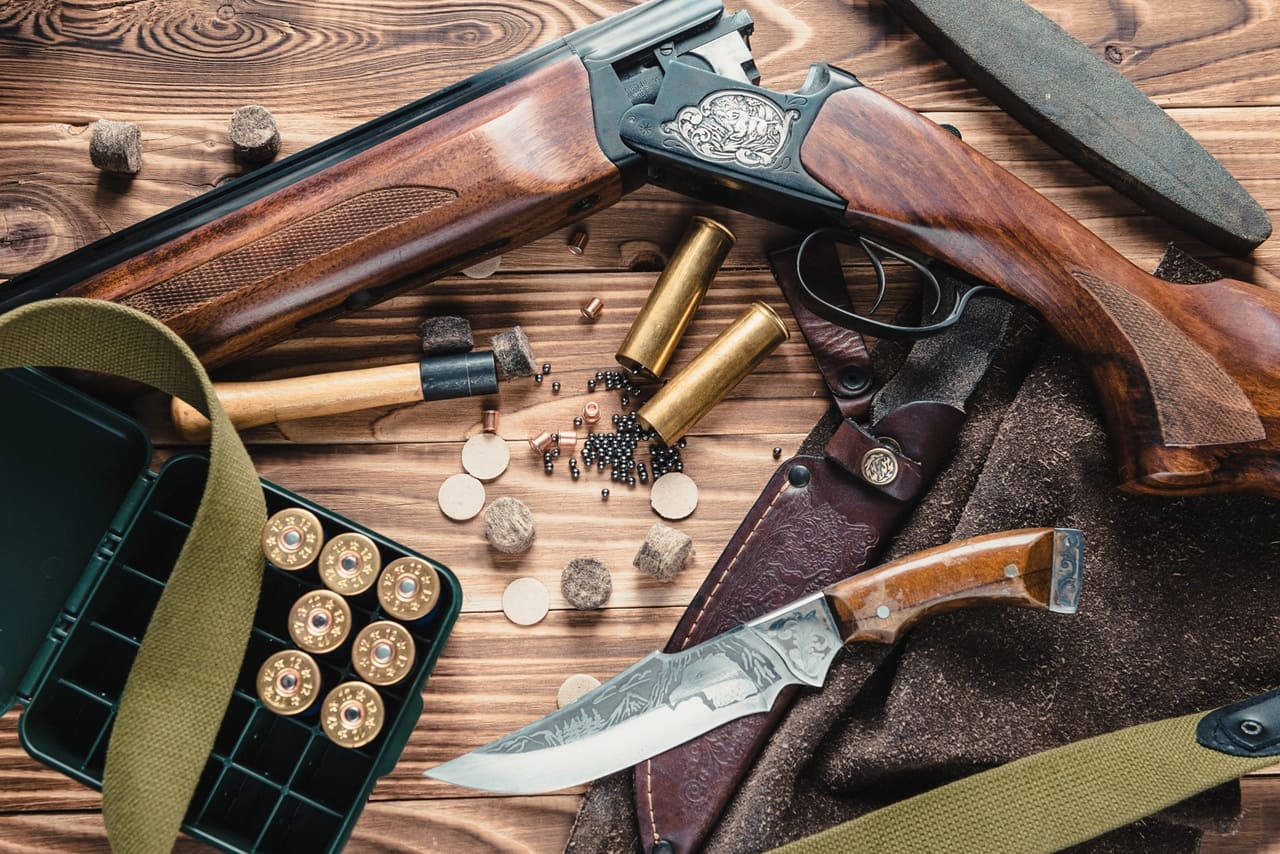
Police took the threat seriously. On 6 November, officers searched the man's apartment in Crailsheim. In the process, they seized five live firearms, several knives and a larger quantity of ammunition. The man is said to have legally possessed all the weapons because he held a hunting licence and the corresponding firearms permits. He has been in pre-trial detention since 7 November.
Interior Minister Thomas Strobl stated that the authorities were pursuing the suspicion of whether a far-right extremist motive was involved. Investigations into possible backgrounds and contacts are continuing with both police and the public prosecutor's office.
Swastika beneath the camouflage jacket: A recreational hunter with Nazi tattoos
The case becomes particularly explosive due to details published by a regional newspaper: According to these reports, a video circulated on social media showing the man with his upper body bare. On his skin, a swastika and SS runes are said to have been tattooed.
If this account is confirmed, the questions directed at the responsible weapons authorities are urgent: How can a man openly displaying neo-Nazi symbols and exhibiting his ideology online be permitted for years to hold a hunting license, own firearms, and stockpile ammunition without interference?
The authorities must now not only account for the fact that they only reacted upon a concrete death threat. They must also explain whether earlier indications — for instance from the individual's social circle or from the internet — never reached the weapons authorities, or whether they were received but had no consequences.
When the hunting license becomes a gateway to live firearms
Anyone in Germany who wants to become a recreational hunter must pass a hunting examination. The hunting license regularly also grants access to high-powered long-barrelled firearms. The weapons authority does check for “reliability” under the Weapons Act. However, once this check has been passed, many years of trust-based structures rather than ongoing controls tend to follow.
In practice, this means:
- Anyone holding a hunting license is considered responsible.
- Regular reliability checks are technically possible, but are contested and in some cases even legally challenged — for instance when it comes to fees for routine inspections.
- Residential and gun cabinet inspections do take place, but focus on storage conditions and serial number records, not on political radicalization or hate content on social media.
At the same time, the number of people with access to hunting firearms continues to grow. Germany now records more than 460’000 hunting license holders — a troubling record. Hunting is permitted on approximately 89 percent of the country's total area.
More hunting license holders means more legally held firearms in private residences. And the larger this group becomes, the more difficult it is for the authorities to conduct thorough and regular checks on all of them.
Not the first extremist with a firearms permit
The Crailsheim case is not an isolated anomaly. As early as 2018, Bavaria reported that 325 individuals associated with the Reichsbürger movement were in possession of a firearms permit. These permits were generally based on activities as recreational hunters or sport shooters. Revocation proceedings were initiated against all of them, and a total of 670 firearms were confiscated.
More recently, the Ansbach Administrative Court has confirmed that hunting licenses and firearms ownership cards may be revoked from Reichsbürger members on the grounds that they do not meet the required standard of reliability.
For years, the Interior Ministry and the Office for the Protection of the Constitution have been reporting that right-wing extremist networks use shooting clubs and the hunting scene as a gateway to weapons and firearms training.
Against this backdrop, it appears negligent that hunting associations continue to act as though the scene is largely politically neutral and that radical outliers are mere exceptions.
Ellwangen as a symbolic location
The fact that the threat was directed specifically against the LEA Ellwangen is no coincidence. The facility has been a flashpoint in Baden-Württemberg's migration policy for years. In 2018, a large-scale police operation to deport a Togolese national made headlines across Germany; later, there was talk of excessive police violence and one-sided media coverage.
Today, hundreds of people still live there in cramped conditions, waiting for their asylum proceedings or their transfer to other facilities. At the same time, the region is debating the future of the site, the closure of the LEA, and new forms of accommodation.
Anyone who posts a video online in this climate announcing their intention to kill “foreigners” at this facility is tapping into a charged atmosphere in which refugees are repeatedly framed as a burden or a threat. The choice of target is a political statement.
Hunting romanticism meets reality
Recreational hunting is currently being marketed in many media outlets as a modern, nature-oriented leisure activity. Articles extol the “renaissance of hunting” and the growing number of young, urban people who wish to roast their own venison.
What rarely features in this narrative: with every new hunting licence issued, the stock of privately held firearms grows. Nationwide, well over five million weapons are now registered, distributed among more than 900’000 gun owners.
The hunting lobby is fond of emphasising that it invests heavily in nature conservation and habitat management. This cannot, however, distract from the following: weapons are not neutral tools. They amplify power imbalances; they enable acts that would otherwise be more difficult or entirely impossible. When right-wing extremist or mentally unstable individuals infiltrate these structures, the narrative of the “guardian of the forest” can very quickly give way to a real and present danger.
A structural problem, not an isolated incident
The Crailsheim case raises fundamental questions:
- Early detection rather than mere file reviews
Reliability is currently understood in strongly formal terms: criminal records, police registers, perhaps a glance at old files. Radicalization today, however, takes place primarily online. When a hunting licence holder openly wears NS symbols and publishes violent fantasies targeting refugees, this must reach the weapons authority and have consequences. - Automatic interfaces
There are information channels between the domestic intelligence services, police, and weapons authorities, but in practice they appear full of gaps. Cases such as Crailsheim demonstrate that real-time cross-referencing between extremist indicators and weapons registers would be necessary. - Scrutinizing the privileges of the hunting scene
Court rulings according to which recreational hunters do not even have to pay fees for unannounced reliability checks send a political signal: this group is being handled with kid gloves. In view of the security policy risks, the question arises whether, on the contrary, more rigorous, cost-covering checks would not be more appropriate. - Limiting the total number of private weapons
When the number of recreational hunters grows substantially and at the same time the total number of registered weapons nationwide exceeds five million, every new weapon represents an additional risk factor. A public debate about how many private weapons a democratic society actually wants and needs has so far barely taken place.
Recreational hunting has a radicalization problem
Yes, the vast majority of recreational hunters shoot wildlife, not people. But that is not sufficient as an exculpatory formula. Where live firearms and a traditional culture of masculinity converge, milieus arise in which right-wing extremist and racist attitudes are not infrequently dismissed as a “private opinion”, as long as everything runs “properly” in the hunting ground.
The case of the young recreational hunter from Crailsheim illustrates how thin this facade can be. One video, a few clicks online, and suddenly the licence holder finds himself at the centre of a terrorism investigation.
For the hunting associations and politicians, this means: those who continue to speak of “isolated incidents” become complicit. What is needed are honest assessments, consistent disarmament of extremists, and the recognition that a romanticized hunting culture must not be allowed to obscure how dangerous it becomes when the “sportsman” turns into an ideological fighter with a legal rifle.
In the view of IG Wild beim Wild, hobby hunters annual medical-psychological fitness assessments modelled on the Netherlands, as well as a binding upper age limit. The largest age group among recreational hunters today is 65+. In this group, age-related limitations such as declining eyesight, slowed reaction times, lapses in concentration and cognitive deficits increase statistically in a marked fashion. At the same time, accident analyses show that the number of serious hunting accidents involving injured persons and fatalities rises significantly from middle age onwards.
The regular reports of hunting accidents, fatal errors of judgment and the misuse of hunting weapons highlight a structural problem. The private ownership and use of lethal firearms for recreational purposes largely eludes continuous oversight. From the perspective of IG Wild beim Wild, this is no longer justifiable. A practice that is based on voluntary killing while simultaneously generating considerable risks for humans and animals forfeits its social legitimacy.
Hobby-hunting is furthermore rooted in speciesism. Speciesism describes the systematic devaluation of non-human animals solely on the basis of their species membership. It is comparable to racism or sexism and can be justified neither culturally nor ethically. Tradition is no substitute for moral scrutiny.
Critical scrutiny is particularly indispensable in the field of recreational hunting. Scarcely any other field is so thoroughly shaped by euphemistic narratives, half-truths and deliberate disinformation. Where violence is normalised, narratives frequently serve the purpose of justification. Transparency, verifiable facts and an open public debate are therefore essential.
More on the subject of recreational hunting: In our dossiers on the criticism of recreational hunting gather fact-checks, analyses and background reports. The scientific evidence is presented in the overview Studies on the Effects of Recreational Hunting.
The position of IG Wild beim Wild: IG Wild beim Wild rejects recreational hunting. Our model is the canton of Geneva, which has managed without recreational hunting since 1974: without hunting seasons, without hunting dogs, without driven hunts, without high seats, without the animal cruelty and crime that go hand in hand with hunting season elsewhere. What has worked there for over fifty years disproves every position paper by JagdSchweiz. An association that bases its policy on claims it refutes in its own documents is not a professional organisation, but a factory for misinformation.