Roe deer fawn rescue: farmers, register your fields now
Hundreds of roe deer fawns are caught by mowing machines in Switzerland every year. The Swiss Animal Protection STS is calling on farmers to request drone operations in good time.
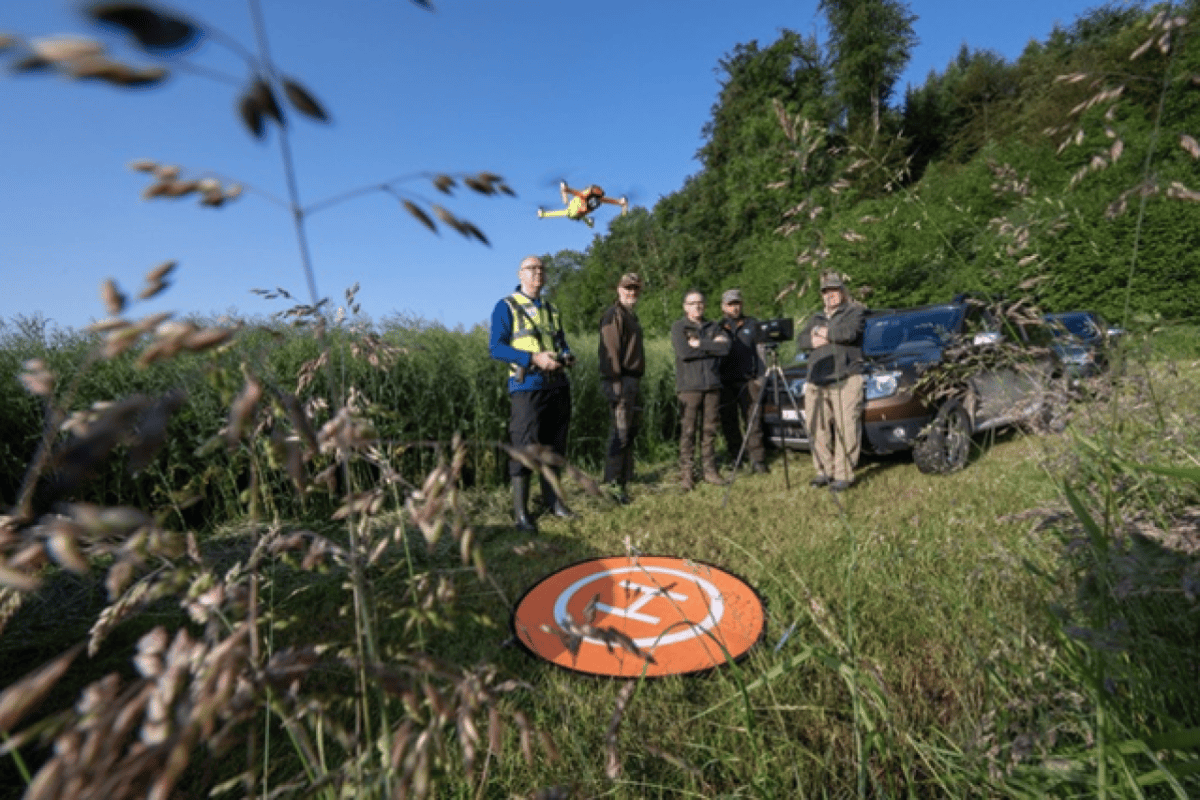
Every year during the hay harvest in Switzerland, hundreds of roe deer fawns and other wild animals are caught by mowing machines and fatally injured.
To prevent this animal suffering, the Swiss Animal Protection STS, together with the association Rehkitzrettung Schweiz (RKRS), is calling on farmers to take an active part in fawn rescue and to request drone operations in good time. Using drones with thermal imaging cameras is the most efficient method of finding fawns and bringing them to safety.
The newborn animals spend their first weeks of life hidden in the tall grass and, when danger threatens, remain motionless on the ground – an innate crouching instinct that protects them from predators but becomes a deadly trap when meadows are mown. Using a multicopter is highly efficient, spares the grass stand and saves human effort. A field of two to three hectares can be searched in 20 to 30 minutes – including the journey there, unpacking and setting up the drone.
Register your fields now, free of charge
Farmers can contact their local hunting association to organise a fawn rescue together before mowing. Alternatively, they can register their meadows free of charge and without any complications via the website of the association Rehkitzrettung Schweiz. This ensures that a drone team searches the field before mowing and moves fawns out of the danger zone. Fawn rescue is always teamwork between farmers, drone pilots and hunters. They also decide whether the fawn is carried to the edge of the forest in a box or left in the meadow with the farmer mowing around it. Once the work is done, the fawn is released again immediately. The fawn and its mother find each other again by calling.
STS supports RKRS with a fleet of drones
Thanks to the great commitment of volunteer drone pilots, RKRS has been able to rescue several thousand roe deer fawns in recent years. To expand these operations further, the STS is once again providing a fleet of ten drones this year. In 2024, 198 fawns were rescued with the STS drones; the year before, the figure was 292 fawns.
Fawn rescue starts soon – public asked for understanding
The drone pilots will soon be out in the early morning hours again to rescue roe deer fawns. The STS and RKRS ask the public for understanding regarding possible noise emissions caused by the drone flights.
More information:
www.rehkitzrettung.ch/feldanmeldung
Do you have a tip, a source or a correction for this article? Write to us.
Seen something yourself?
A driven hunt next to a hiking trail, a shot fired near houses, a trap in the forest or an injured wild animal: report it to the Recreational Hunter Radar. We check every tip-off and treat your details confidentially.
More on the subject of recreational hunting: In our dossiers on the criticism of recreational hunting gather fact-checks, analyses and background reports. The scientific evidence is presented in the overview Studies on the Effects of Recreational Hunting.
The position of IG Wild beim Wild: IG Wild beim Wild rejects recreational hunting. Our model is the canton of Geneva, which has managed without recreational hunting since 1974: without hunting seasons, without hunting dogs, without driven hunts, without high seats, without the animal cruelty and crime that go hand in hand with hunting season elsewhere. What has worked there for over fifty years disproves every position paper by JagdSchweiz. An association that bases its policy on claims it refutes in its own documents is not a professional organisation, but a factory for misinformation.
Wild animals need a voice
Investigations, petitions and background on recreational hunting. As a thank-you, you will immediately receive our free guide «Recreational hunting on your doorstep: what you can do».
Support our work
With your donation you help protect animals and give their voice a hearing.
Donate now →