Psychology of recreational hunting in Canton Ticino
Hunting in Canton Ticino is psychologically structured differently than in many other Swiss cantons. It is less an administrative instrument for wildlife regulation than an identity-forming power structure. Anyone who critically questions hunting in Ticino encounters not primarily factual arguments, but defensive reactions, emotionalization and political blockade. Precisely these patterns explain why national parks are prevented, protection projects torpedoed and predators systematically turned into enemy images.

The basic mechanisms of this hunting psychology are known from other cantons, such as Grisons or Valais. In Ticino, however, they condense into a particularly closed system. Central to this is the role of the Ticino hunters' association FCTI, which not only represents interests but claims interpretive authority.
Although Ticino operates under a patent hunting system with no formal hunting districts, long-term practice creates a psychological claim of ownership. Certain areas become internalized as 'one's own' hunting grounds, socially secured and emotionally defended.
This informal mental ownership explains precisely why conservation projects, hunting-free zones, or national parks in Ticino trigger such strong defensive reactions.
This pattern is particularly evident in the prevention of national parks.
National parks as enemy image: The Locarnese case
The failed Locarnese National Park is one of the most important examples of recreational hunting psychology in Ticino. The 2018 referendum was accompanied by an aggressive opposition campaign in which hunting-affiliated circles deliberately stoked fears. The core of the rejection was not the park idea itself, but the notion that core zones would be withdrawn from recreational hunting.
Psychologically, this involves fear of loss of control. Protection is not perceived as a collective gain, but as expropriation. The fact that a national park could bring long-term ecological, touristic, and economic benefits played hardly any role in the debate. Hunting interests dominated.
This pattern already repeated itself with Park Adula, which also failed due to resistance from hunting-affiliated circles. The repeated successful blockade acts as self-reinforcing. Those who have once prevented a national park experience this as confirmation of their own position of power.
Symbolic charging of recreational hunting
Recreational hunting is heavily symbolized in Ticino. It stands for masculinity, autonomy, regional self-assertion, and supposed connection to nature. This symbolism explains why factual objections from wildlife biology or animal welfare have little effect.
Facts threaten actions. Symbolism threatens identity. And identity is defended. This creates a parallel reality with its own truths, its own rules, and its own narratives. Outsiders are considered clueless or hostile.
This idealization is highly effective politically. It makes recreational hunting mobilizable.
The Ticino Hunters' Association FCTI as psychological power factor
In Ticino, the hunters' association FCTI plays a special role. It acts not only as interest representation, but also as moral authority. Criticism is not discussed, but delegitimized. Anniversaries, commemorative publications, and media appearances serve self-congratulation and the stabilization of a closed worldview.
- The detailed analysis can be found here: Ticino Hunters' Association FCTI celebrates 30 years of mischief
- as well as supplementary: When self-congratulation becomes hunting ethos: 30 years of Ticino Hunters' Association
The often-cited 'hunting ethos' fulfills primarily a psychological function. It replaces ethical examination with self-attribution. Those who describe themselves as ethically correct no longer need to be measured. This is a classic mechanism of moral licensing. Ethos should mean that actions are examined, corrected, and sanctioned. In practice, however, the term functions as a shield.
This creates a closed thought space in which misshot kills, suffering of wild animals, or structural problems are no longer perceived as such. An ethos without consequences is not an ethos, but PR.
Fabio Regazzi: Political responsibility and hunting lobby
In Ticino hunting criticism, the name Fabio Regazzi holds a special position. As a political actor with close ties to the hunting lobby he stands exemplarily for the structural problems in Ticino. Regazzi is linked in multiple contexts with the blockade of nature and wildlife protection projects and is considered a key figure when it comes to politically implementing hunting interests.
Wild beim Wild classifies Fabio Regazzi as a political actor who repeatedly supports hunting interests publicly and thereby exemplifies structural blockades in Ticino. From a hunting-critical perspective, this politics shifts the wildlife debate away from evidence and ethics toward interests and loyalties.
- Fabio Regazzi and the politics of hasty action on wolves in Switzerland
- Politics of hasty action: How Fabio Regazzi shifts the wildlife debate from evidence-based to interest-based terrain
- Dispute over the goosander: Fabio Regazzi demands culling, conservationists warn against hasty action
- Hunting president agitates at the Federal Council
- Success: Swiss Hunting Association loses
The particular recognition of his role does not stem from personal polemics, but because it makes a structural problem visible: the close entanglement of hunting association, politics and public communication. This proximity massively complicates independent decision-making processes and contributes to systematic deflection of criticism.
Group pressure, loyalty and silence
Ticino recreational hunting is a tight social network. In such structures, informal rules work more powerfully than laws. Loyalty is rewarded, criticism sanctioned. Those who express doubts endanger their belonging.
The proximity between recreational hunting, politics and administration intensifies this effect. Criticism is not understood as a contribution to improvement, but as betrayal. The result is silence, looking away and institutional inertia.
Comparable mechanisms have already been described in the canton of Graubünden. In Ticino, however, the regulatory framework present there is missing, which additionally intensifies the emotional charge.
Border region, border mentality
As a border canton, Ticino exhibits an additional psychological peculiarity. Rules are interpreted situationally, responsibilities blur, accountability is relativized. Reports of cross-border recreational hunting, rule violations and inadequate control fit this pattern.
Psychologically, an 'us here, them there' mindset emerges. One's own norms apply absolutely, external rules are perceived as disruptive.
Predators as projection surface
Wolf and lynx intensify these mechanisms. They are not discussed objectively, but instrumentalized emotionally. Predators serve as enemy images to confirm one's own role as an ordering force.
Recreational hunting thereby appears as a necessary counterforce to 'uncontrolled nature'. Fears, frustration and loss of control are projected onto the predator. Culling provides the feeling of order, even when it does not solve structural problems. The psychological function clearly takes precedence over scientific evidence.
Wild boar hunting, illusion of control and the systematic failure of hunting logic
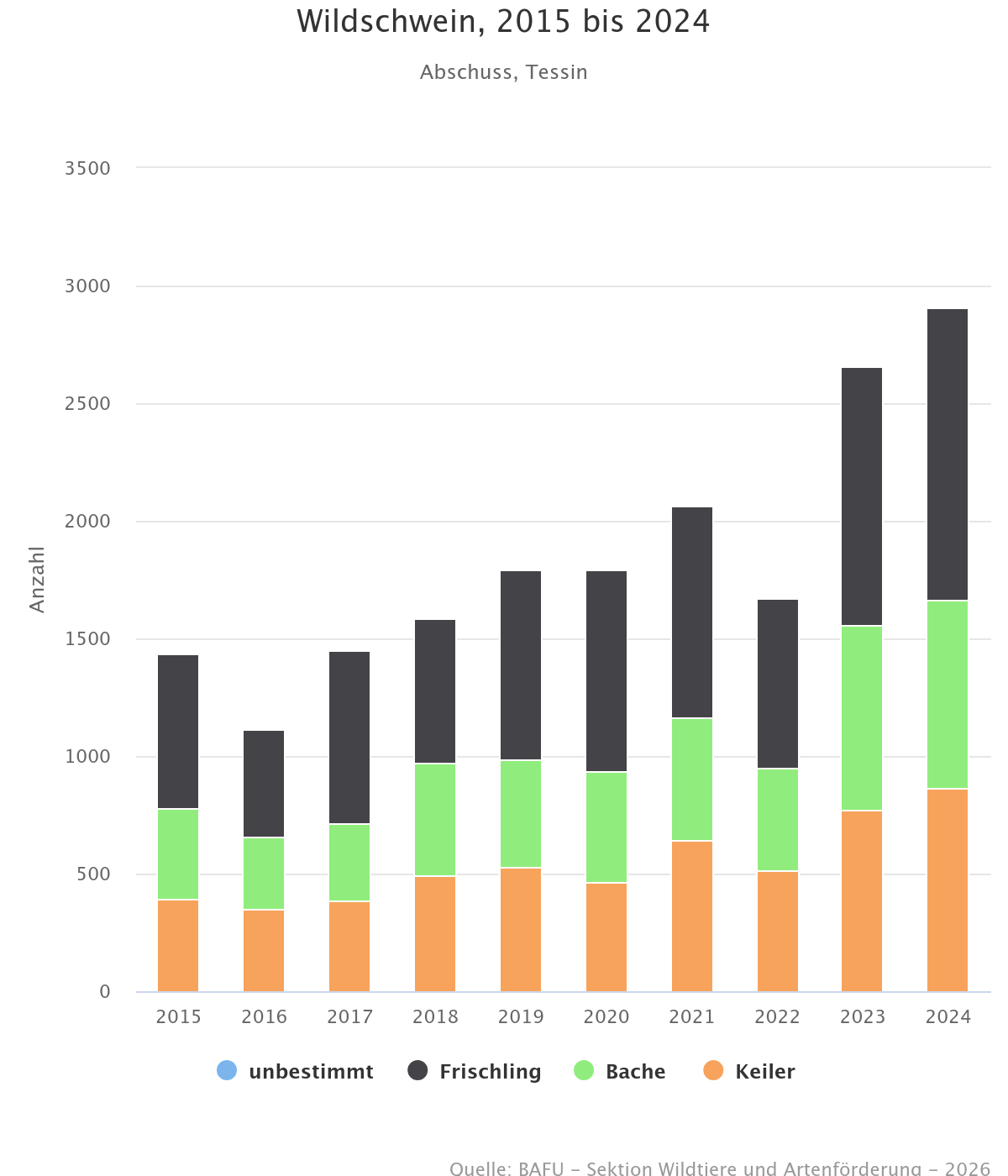
Recreational hunting in the canton of Ticino exemplifies how recreational hunting has evolved from a claimed management tool to a self-referential system. This becomes particularly clear with wild boar hunting. Despite massive expansion of culling, extension of hunting seasons and increasing intensity, the wild boar population does not decrease but increases. This development is not coincidental and not a natural phenomenon. It is the result of scientifically refuted assumptions, political interests and psychological defense mechanisms.
The culling figures of recent years speak clearly: More and more wild boar are being killed, including increasingly young boar and reproductive animals. At the same time, the total population continues to rise. This is precisely where the actual analytical question begins: What is going wrong here?
Recreational hunting of wild boar as illusion of control
Wild boar hunting in Ticino follows a simple but false premise: more kills lead to fewer animals. This logic is intuitive, emotionally satisfying and politically easy to communicate. However, it has been scientifically disproven in practice for decades and described in many studies.
Wild boar do not respond to hunting pressure with population decline, but with biological compensation. High hunting pressure leads to earlier sexual maturity, larger litter sizes and increased reproduction rates. Particularly problematic is the killing of leading sows and young boar. This destroys social structures and releases precisely those reproductive mechanisms that make populations grow.
What is marketed in Ticino as 'systematic control' is in reality an amplifier of the problem.
Killing young boar as a systemic error
The data from recent years shows a particularly alarming trend: the proportion of killed young boar is increasing significantly. From a scientific perspective, this is fatal. Young boar are not 'surplus' but part of stable family units. Killing them increases the reproductive performance of the remaining sows. At the same time, the social structure is destabilized, leading to increased mobility, dispersal and conflicts.
These findings have been known in wildlife biology for a long time. That they are ignored in Ticino is not a knowledge problem, but a structural problem. Recreational hunting is not adjusted when it fails. It is intensified.
Summer hunting and permanent intervention
Extending wild boar hunting to additional months further amplifies this effect. Permanent intervention prevents natural regulation. It ensures that wild boar are permanently under stress, change location more frequently, develop new habitats and adapt their reproduction.
Psychologically, permanent hunting nevertheless has a calming effect. It conveys activity and control. This is precisely what makes it politically attractive. That it is counterproductive in the long term is ignored. This pattern is called action bias: intervening feels better than doing nothing, even when the intervention causes harm.
Why science is ignored
The failure of wild boar hunting in Ticino is not coincidental, but systemic. Scientific findings are inconvenient. They question the legitimacy of recreational hunting. If one were to accept that recreational hunting exacerbates the problem, one would have to discuss alternatives: habitat management, feeding bans, prevention, acceptance of wildlife.
This directly contradicts the self-image of recreational hunters and the political narratives that support them. Instead, science is used selectively or completely ignored. Studies that present recreational hunting as a solution are cited. The rest disappears.
The hunting association as a knowledge filter
In Ticino, the hunting association takes on a central filtering function. It effectively decides which findings are considered relevant and which are not. Criticism is dismissed as ideological, scientific objections as impractical. This creates a closed system that confirms itself.
This mechanism is not new. It was already visible in the prevention of national parks and is now evident again with wild boar hunting. Protection and restraint are perceived as threats. Killing is considered action.
Political responsibility and structural blockades
The expansion of wild boar hunting is politically desired. It is supported by actors who are closely intertwined with the hunting lobby. Names like Fabio Regazzi stand as examples of a politics that systematically places hunting interests above scientific findings and wildlife protection.
This responsibility is not abstract. It manifests concretely in legislative adjustments, enforcement practices and public communication. The rising kill numbers are not an operational accident. They are the result of political decisions.
The actual paradox
The more recreational hunting fails, the more aggressively it is defended. Rising wild boar populations do not serve as proof of recreational hunting's failure, but as justification for even more recreational hunting. This paradox is psychologically explainable, but ecologically fatal.
Recreational hunting creates its own problem and subsequently legitimizes itself through its existence.
Wild boar hunting in Canton Ticino is not a success model, but a case study in the illusion of control, scientific ignorance and political entanglement. The rising populations despite massive culls are not a mystery. They are the logical consequence of a system that wants to dominate rather than regulate.
Those who truly want to stabilize wild boar populations must stop reflexively shooting and begin thinking scientifically. As long as recreational hunting functions as an identity and power system, however, this insight remains politically undesirable.
Why reforms in Ticino are particularly difficult
The psychology of recreational hunting in Ticino explains why reforms repeatedly fail. As long as recreational hunting remains identity-forming, the hunters' association claims moral interpretive authority, and political actors like Fabio Regazzi support these structures, facts remain secondary.
Change would be possible, but only through transparency, external oversight and a clear separation of recreational hunting, power and political status. Without these steps, wildlife protection in Ticino remains lip service.
The psychology of recreational hunting in Canton Ticino is characterized by possessive thinking, self-staging and political blockade. National parks are prevented, predators instrumentalized and criticism fought, not discussed. Wild boar hunting shows exemplarily: The problem is not the animals.
The problem is a hunting system that protects itself instead of protecting wildlife.
Those who want to advance wildlife protection in Ticino must expose these psychological mechanisms. Only then can something move.
More on this in the dossier: Psychology of hunting
Cantonal psychology analyses:
- Psychology of recreational hunting in Canton Glarus
- Psychology of recreational hunting in Canton Zug
- Psychology of recreational hunting in Canton Basel-Stadt
- Psychology of recreational hunting in Canton Schaffhausen
- Psychology of recreational hunting in Canton Appenzell Ausserrhoden
- Psychology of recreational hunting in Canton Appenzell Innerrhoden
- Psychology of recreational hunting in Canton Neuchâtel
- Psychology of recreational hunting in Canton Thurgau
- Psychology of recreational hunting in Canton Nidwalden
- Psychology of recreational hunting in Canton Uri
- Psychology of recreational hunting in Canton Obwalden
- Psychology of recreational hunting in Canton Schwyz
- Psychology of recreational hunting in Canton Jura
- Psychology of recreational hunting in Canton Basel-Landschaft
- Psychology of recreational hunting in Canton Zurich
- Psychology of recreational hunting in Canton Geneva
- Psychology of recreational hunting in Canton Bern
- Psychology of recreational hunting in Canton Solothurn
- Psychology of recreational hunting in Canton Aargau
- Psychology of recreational hunting in Canton Ticino
- Psychology of recreational hunting in Canton Valais
- Psychology of recreational hunting in Canton Graubünden
- Psychology of recreational hunting in Canton St. Gallen
- Psychology of recreational hunting in Canton Fribourg
- Psychology of recreational hunting in Canton Vaud
- Psychology of recreational hunting in Canton Lucerne
Support our work
With your donation you help protect animals and give voice to their concerns.
Donate now →