Migratory Birds Facing Major Challenges
Migratory birds are directly affected by environmental changes in various parts of the world during their annual journeys. Their protection will therefore only be possible if global interconnections are taken into account together in climate impact assessments, as a study by the Swiss Federal Institute for Forest, Snow and Landscape Research WSL and Humboldt University Berlin now shows.


Migratory birds are directly affected by environmental changes in various parts of the world during their annual journeys. Their protection will therefore only be possible if global interconnections are taken into account together in climate impact assessments, as a study by the Swiss Federal Institute for Forest, Snow and Landscape Research WSL and Humboldt University Berlin now shows.
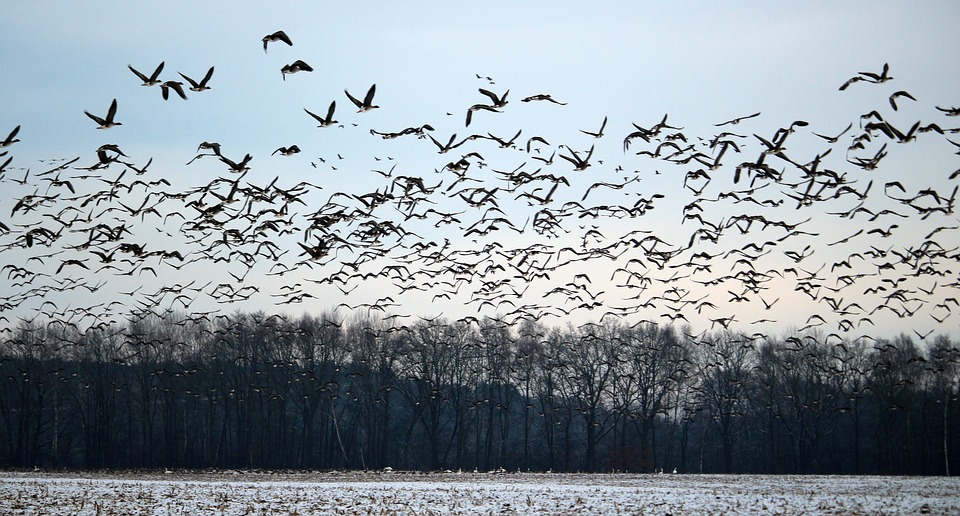
Every year, millions of birds fly from their summer breeding grounds to their wintering grounds and back, often covering several thousand kilometres. The breeding success and population development of native long-distance migrants therefore depend not only on environmental conditions in Central Europe.
Fewer breeding sites, longer migration routes
Researchers led by Damaris Zurell from WSL have investigated the possible impacts of climate and land-use change on migratory birds. In total, they examined more than 700 species of long-distance migratory birds that breed in North America, Europe and Asia. They report on this in the specialist journal Nature Climate Change.
"By focusing too narrowly on breeding grounds, not all factors of risk are captured," says Niklaus Zimmermann from the Dynamic Macroecology group at WSL.
Number of threatened species underestimated?
The researchers calculated that impact assessments focused on breeding grounds could underestimate the number of potentially threatened bird species by 18 to 49 percent and the magnitude of possible risks for 17 to 50 percent of species.
"Long-distance migrants are particularly strongly affected by global changes such as climate and land-use change," says Zimmermann. "For species conservation, it is therefore absolutely essential to take into account the entire, long journey of migratory birds." More on biodiversity and on wildlife.