Hunting weapons in the wardrobe: the silent threat in recreational hunter households
When the gun safe is missing and the law stays silent.
In Switzerland, a woman is killed by her partner or ex-partner every two weeks.
What almost never appears in these reports: whether the perpetrator was a recreational hunter. Whether a hunting weapon stood in the wardrobe. Whether the law helped make the death possible.
No safe, no problem
Swiss weapons law stipulates that weapons must be stored «carefully». However, the law does not in itself require a lockable gun safe for long guns – and no official inspection visits are carried out. For safe storage, a locked gun safe is recommended, official information leaflets state. A recommendation, not an obligation. For the woman who lives with a recreational hunter, that difference is not a theoretical one.
There is a weapon in every third household in Switzerland. In many cases of domestic violence, firearms are used by men as a means of intimidation.
30’000 recreational hunters, at least twice as many weapons
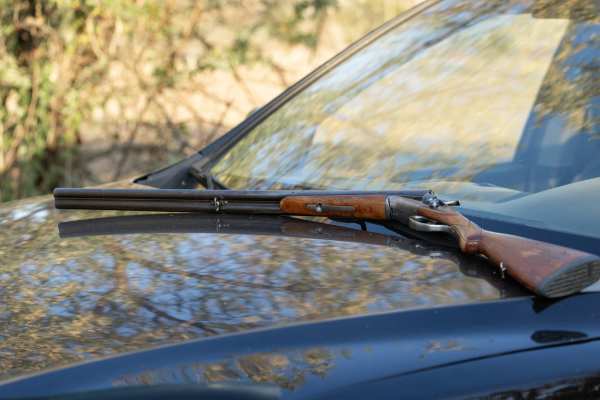
The number of recreational hunters in Switzerland is estimated at around 30’000. Anyone who practises recreational hunting usually owns several weapons: a rifle for cloven-hoofed game, a shotgun for feathered game, often a pistol as well. Conservatively calculated, recreational hunter households alone store 60’000 to 100’000 hunting weapons in Swiss homes – most of them without compulsory securing.
That is what fundamentally distinguishes the recreational hunter household from a civilian household where a forgotten army weapon lies somewhere in the attic. Since 2010, members of the army have been able to deposit their service weapon voluntarily at the armoury. Across Switzerland, just 789 people make use of this. So the army weapon also stays at home – but it lies unused in a case. The recreational hunter's hunting rifle is regularly cleaned, loaded and used.
Killing every day – that is the practice
The Swiss soldier never goes to war. Neutral Switzerland conducts no combat operations. The weapon in the military household is an artefact, a symbol of a militia obligation. The recreational hunter, by contrast, kills routinely. He knows his weapon as a killing tool from daily practice. He knows how it works, how it feels, what it can do. This is no minor aspect — it is the core of a structural threat situation.
The mere presence of the weapon in the living space takes over the communication. No spoken word is needed. The woman knows where the weapon is. The man knows that she knows.
The perpetrator profile fits
The average age of perpetrators in firearm killings in the domestic sphere is 63 years, around 86 per cent are Swiss. Exclusively male suspects use a weapon. This is exactly the demographic profile that coincides with the typical Swiss recreational hunter: older Swiss man, anchored in a rural tradition, the weapon a self-evident part of the household for decades.
In international comparison, firearms are used disproportionately often in femicides in Switzerland. More than half of all homicides occur in the family or partner environment — in over 90 per cent of cases the victims are women. In Switzerland, firearms have most frequently been used as the means of the crime in partner femicides over the past 30 years.
The women’s shelters do not know — and are not asked
The umbrella organisation of women’s shelters in Switzerland and Liechtenstein (DAO) compiles annual statistics on the women admitted: nationality, forms of violence, length of stay. About the perpetrators, however, hardly anything is recorded systematically. No occupation, no leisure activities, no weapon ownership. The women’s shelters care for the victims — the perpetrator is not their client. A question such as «Does your partner have a hunting licence?» is not asked today, and if it is, it is evaluated nowhere.
This is not a failing of the women’s shelters. It is a structural failure of the entire system. The passing on of perpetrator and victim data to counselling or contact points is regulated differently from canton to canton — in some cantons it does not happen at all. Even if a women’s shelter wanted to, it could not gather complete perpetrator information.
Those who don't ask whether the perpetrator was a recreational hunter never have to make the answer public. The data gap is no coincidence – it is politically convenient.
The Silence of the System
Depending on the canton, whether a weapon used in a crime was legal, where it came from, or whether the perpetrator was already known for threats or violence is documented differently or not at all. No one asks whether the perpetrator was a recreational hunter. No one analyses how many femicides took place in households where hunting weapons were stored legally and uncontrolled.
The gun lobby and the hunting lobby overlap considerably in Switzerland. Both have successfully prevented storage requirements from being tightened. Left-wing and Green politicians have repeatedly tried to abolish the home distribution of weapons – but always failed against bourgeois resistance.
Current: Counselling sessions continue to rise
The problem is growing, not shrinking. According to the Federal Statistical Office, Swiss victim support centres recorded a total of 55’260 counselling sessions in 2025 – seven percent more than the previous year. 72 percent of these were taken up by female victims or relatives. The compensation and reparations paid out rose by ten percent to 7.3 million francs. The most common counselling topics: bodily harm, assault and threats. These are not abstract figures. These are women who sought help – after something happened. Not before. (Source: SRF, 9 June 2026)
What should be demanded
A certified, lockable gun cabinet as a legal requirement for every household with hunting weapons. A systematic record of whether perpetrators of domestic violence had hunting weapons in the household. The possibility for threatened partners to request the official confiscation of hunting weapons – without having to file a report themselves. And a uniform obligation for women's shelters and the police to record and evaluate the perpetrator's weapon ownership.
As long as the wardrobe counts as a gun cabinet and no one asks whether the perpetrator was a recreational hunter, the threatening backdrop in the recreational hunter household is legally secured – and statistically invisible.
More on this topic: Crime & Hunting | Hunting Act | Psychology & Hunting
More on the subject of recreational hunting: In the dossier Psychology of recreational hunting we put research, motives and social consequences into perspective. What the research says about this is shown by Hunting fact-checked: the state of research.
The position of IG Wild beim Wild: IG Wild beim Wild rejects recreational hunting. Our model is the canton of Geneva, which has managed without recreational hunting since 1974: without hunting seasons, without hunting dogs, without driven hunts, without high seats, without the animal cruelty and crime that go hand in hand with hunting season elsewhere. What has worked there for over fifty years disproves every position paper by JagdSchweiz. An association that bases its policy on claims it refutes in its own documents is not a professional organisation, but a factory for misinformation.
Support our work
With your donation, you help protect animals and give their voice a hearing.
Donate now →