Grey squirrel, raccoon and nutria: Not the problem
Grey squirrels, nutria and raccoons are perfect projection screens for a hunting policy that likes to disguise itself as “species protection.” All three originate from America, all three appear on the EU list of invasive species of Union concern, and all three serve in Europe as justification for ever new killing programmes.

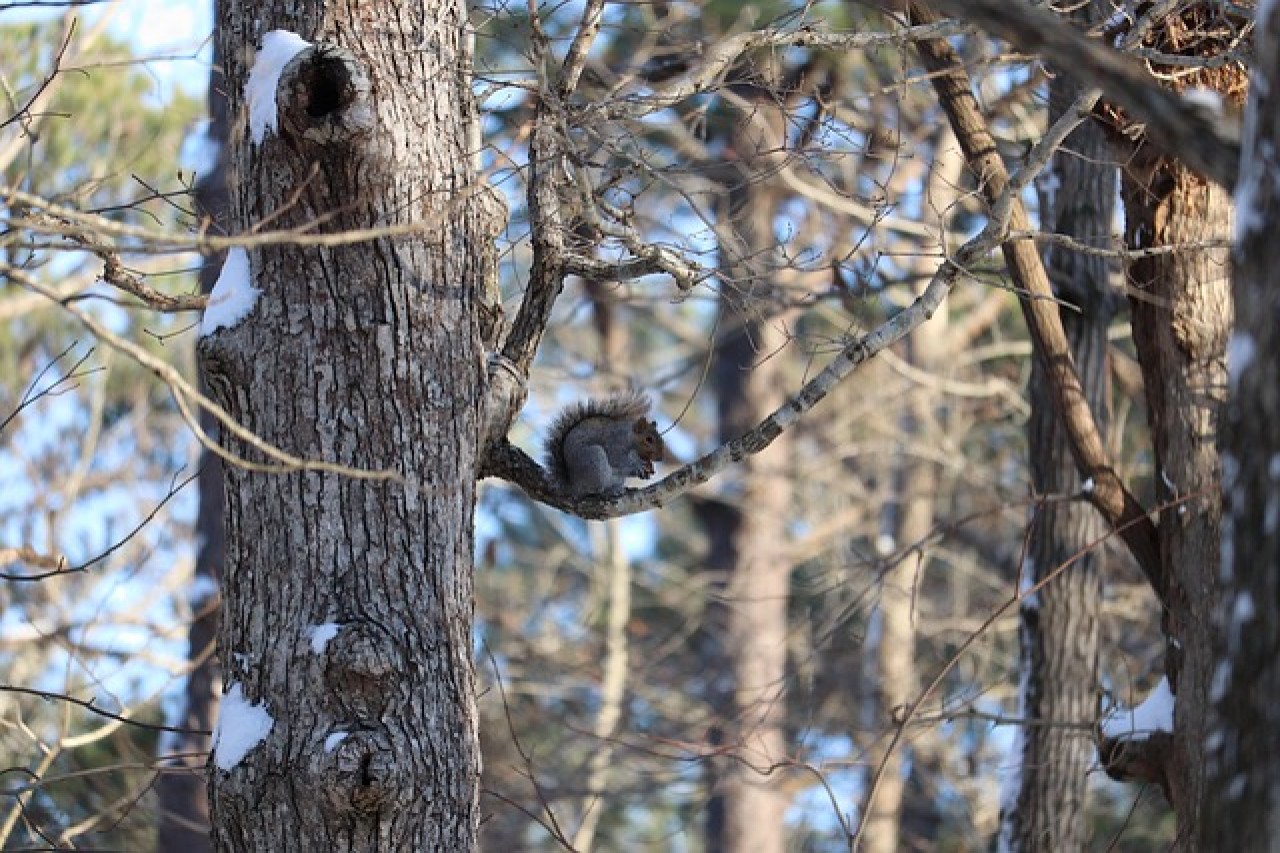
With the grey squirrel, the script is just as transparent as with the raccoon or nutria.
First, exotic animals are imported, sold, kept, released. When they then adapt, appear in greater numbers and cause damage, the hunting lobby's hour strikes. Suddenly “invasive species” become a welcome enemy image, with which one can legitimise trap hunting, year-round suspension of closed seasons and special powers for shooters. That grey squirrels genuinely threaten the native red squirrel through food competition and viruses is well documented, above all in Great Britain. Yet from the ecological problem description, politically a free pass for the shotgun quickly emerges.
With the raccoon, one can observe where this logic leads. For years, shooting figures in Germany have been rising; at the same time, the animals continue to spread. A current analysis of hunting bag data shows how the species is advancing into more and more areas, even though recreational hunting has been intensified.
Estimates now put the number of raccoons in Germany at well over one million; more recent studies speak of approximately 1.6 to 2 million animals. The message is uncomfortable for those who sell recreational hunting as “regulation”: hundreds of thousands of animals killed do not automatically mean control, but often only that one is shooting reactively in an open system.
Nevertheless, the public is told the same story as with the grey squirrel. Official brochures and EU documents warn of “ecological, health-related and economic damage” caused by invasive species. Media outlets eagerly pick this up, illustrating their reports with raccoons in henhouses and grey squirrels in forests, painting a picture of a nature spiralling out of control without the use of weapons. In Switzerland, warnings have been issued for years about the approaching grey squirrel from northern Italy, while those same institutions simultaneously concede that the overall number of non-native species is primarily linked to our trade, transport and land use.
Human responsibility disappears behind the drama of “villainous neozoa versus virtuous natives.” This is convenient, but professionally dishonest. Grey squirrels, nutria and raccoons did not swim to Europe of their own accord. They are products of a system that has treated wild animals for decades as decoration, objects of exploitation, pets, hunting targets or tourist attractions. It is precisely this system that today calls most loudly for their eradication.
There have long been alternatives to simply recruiting ever more animal species for “detention with a rifle.” For the grey squirrel, research into oral immunocontraception has been underway in Great Britain for years. The goal is a vaccine administered via specially designed bait stations that reduces fertility without the need to kill animals directly. Studies show that grey squirrels reliably adapt to species-specific bait stations, enabling targeted administration.
This is precisely where the issue becomes compelling from an animal welfare perspective. If it is technically feasible to reduce populations over the long term through fertility control, then the claim that hunting is “without alternative” loses considerable persuasive force. Nevertheless, the lion’s share of funding continues to flow into conventional control methods: traps, culling and bounty schemes. The development of non-lethal methods, by contrast, is advanced with comparatively modest budgets. This has little to do with biology, but a great deal to do with power structures and lobbying.
EU law is actually more advanced here than many national debates. Regulation 1143/2014 obliges member states to act against invasive species, but also emphasizes that animal suffering must be minimized as far as possible and that management measures should be proportionate and scientifically justified. In practice and communication, this passage is rarely mentioned. On posters and in hunting magazines, the martial vocabulary of “eradication” and “extermination” dominates, rather than the sober question of what the genuinely best solution might be.
For Switzerland, the situation regarding the grey squirrel is still relatively calm. There are officially no established populations; so far this remains a border scenario. That is precisely why now would be the moment to learn from the raccoon disaster. Rather than waiting until the animal has been built up into a media bogeyman and the familiar spiral of demands for “radical control” begins to spin, a consistent focus on prevention, keeping bans, trade controls, and early non-lethal options would be possible.
In Switzerland, nutria are today officially classified as a neozoon as well — not protected — and are listed as a problem species due to damage to riverbanks and embankments. The hunting response is again remarkably similar. In Germany, recreational hunters have been shooting increasing numbers of nutria for years. Hunting statistics show sharply rising kill figures. As with the raccoon, recreational hunting serves primarily as a visible activity, not as a demonstrably effective solution.
In Italy, free-living nutria were sedated in the field in order to carry out surgical reproductive control — that is, to sterilize the animals rather than kill them. The major European review on fertility control in wild animals explicitly names nutria as a candidate for future contraception projects, alongside other conflict-prone species. In parallel, studies are underway on the animal welfare implications of live traps and the handling of bycatch, aimed at introducing at least a minimum standard of animal protection into existing management plans.
Anyone who genuinely considers grey squirrels, nutria, and raccoons to be a problem should first adjust the levers that are actually within our control. No trade in exotic wild animals for the pet market. No “private zoos” where animals are simply released at the first sign of being overwhelmed. Clear guidelines for municipalities and cantons on how to respond to initial sightings, from monitoring to the question of whether pilot projects on fertility control should be introduced. All of this would come far closer to genuine responsibility than the reflexive expansion of trap networks in forests.
Instead, recreational hunting is frequently staged as a fire brigade cleaning up what others have made a mess of. The problem: the fire brigade would rather not put out the fire. What has long been visible with the raccoon would repeat itself with the grey squirrel. Ever new record kill figures, ever new appeals for “ethical pest control,” while populations adapt and continue to establish themselves. In recent decades, nature has impressively demonstrated how quickly it fills the gaps that humans shoot open.
The real question, therefore, is not whether grey squirrels, nutria, and raccoons are “nice” or “bad.” The question is what kind of human-animal relationship we find acceptable in the future. A model in which every ecological shift is ultimately answered with bullets, or one in which we place the focus on tackling root causes, precaution, and modern, wherever possible non-lethal, regulation.
From a hunting-critical perspective, the parallel is clear: invasive species are real, and their effects can be severe. But they are not a blank cheque for a permanent hunting exemption regime; rather, they are further evidence that a system which treats animals as tools will endlessly produce new “culprits.” Grey squirrels, nutria, and raccoons are not the problem. They are the symptom. The real problem lies in the way humans treat wild animals — and that cannot be hunted away.
- Keeping raccoons away in an animal-friendly manner
- Raccoons too have a right to life
- The treatment of “invasive” species — a critical analysis from a biological and legal perspective
- Neozoa
- Basel wants to kill raccoons
- Raccoons are not a danger
- Open letter to Katrin Schneeberger of the FOEN
- Removal of the raccoon from the lists of so-called invasive species
- Facts rather than hunters’ tales about raccoons
- Office for Hunting and Nonsense in the Canton of Aargau wants to shoot raccoons
More on the subject of recreational hunting: In our dossiers on recreational hunting gather fact-checks, analyses and background reports. What the research says about this is shown by Hunting fact-checked: the state of research.
The position of IG Wild beim Wild: IG Wild beim Wild rejects recreational hunting. Our model is the canton of Geneva, which has managed without recreational hunting since 1974: without hunting seasons, without hunting dogs, without driven hunts, without high seats, without the animal cruelty and crime that go hand in hand with hunting season elsewhere. What has worked there for over fifty years disproves every position paper by JagdSchweiz. An association that bases its policy on claims it refutes in its own documents is not a professional organisation, but a factory for misinformation.