
Forest-Wildlife Conflict in Switzerland: Why the browsing narrative does not justify recreational hunting
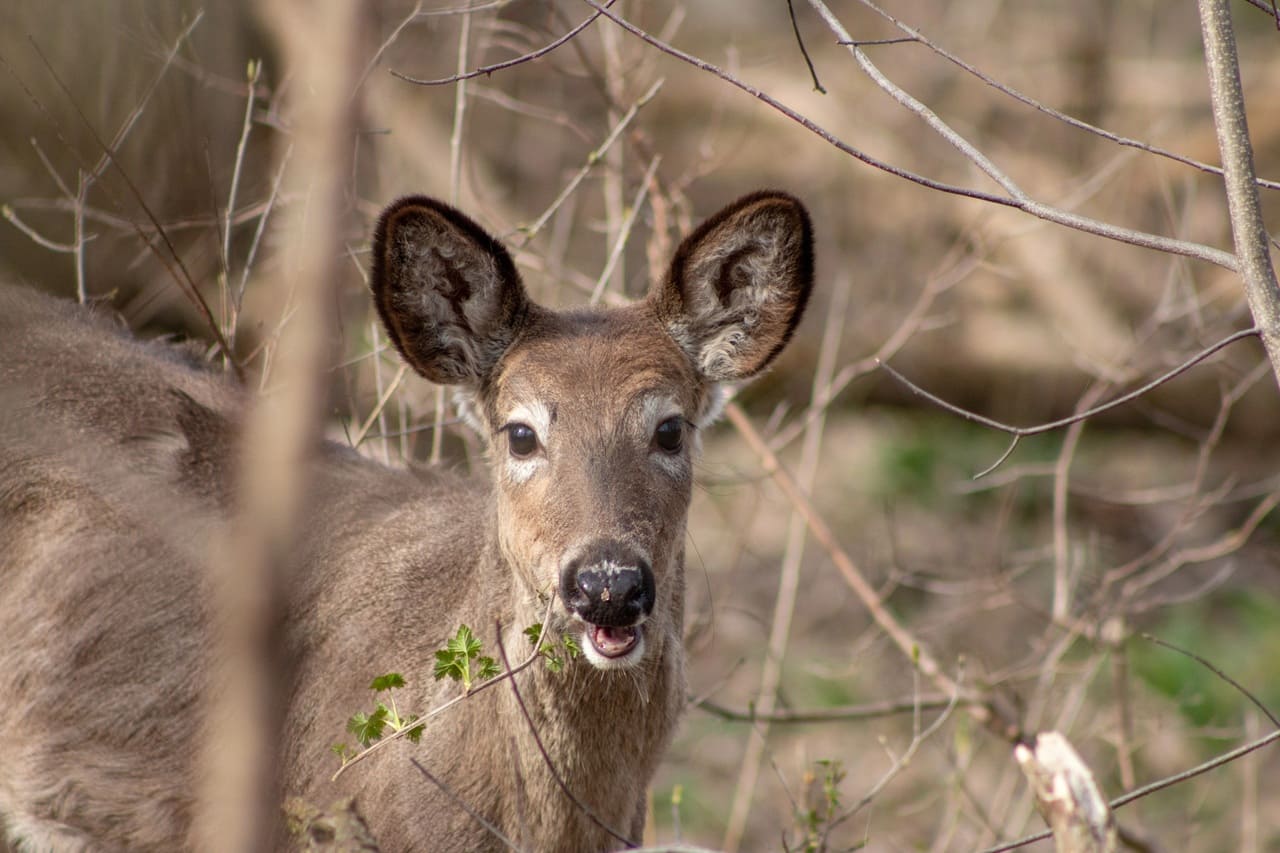
The so-called forest-wildlife conflict is the most effective justification narrative of recreational hunters in Switzerland. The argument follows a simple scheme: wildlife browse young trees, the forest cannot regenerate, therefore hunting is necessary. This dossier shows why this equation doesn't add up, which factors the browsing narrative ignores and why recreational hunting doesn't solve the problem but contributes to it.
The Forest Report 2025, published by the Federal Office for the Environment (FOEN) and the Swiss Federal Institute for Forest, Snow and Landscape Research (WSL), documents real browsing problems in certain regions. At the same time, the data shows: the forest is primarily under climate stress, not wildlife stress. And the crucial question is not whether wildlife browse trees, but why decades of hunting by around 30,000 recreational hunters in Switzerland has not solved this problem.
Current status: What the data actually shows
Forest Report 2025 and National Forest Inventory
The 2025 Forest Report by FOEN and WSL provides the most current national assessment. It confirms that regionally excessive wildlife populations impair natural regeneration and the natural adaptation potential of forests. At the same time, the report makes unambiguously clear: The greatest burdens on Swiss forests are extreme events such as heat, drought, storms, harmful organisms and high nitrogen inputs.
WSL researcher Andrea Kupferschmid and colleagues show in a nationwide overview that forestry professionals assess wildlife impact as low or insignificant on approximately 68 percent of evaluated forest area. 27 percent fall into a medium category, only 5 percent are assessed as silviculturally intolerable. The narrative of a widespread browsing collapse is not supported by this data.
The Swiss Forestry Association arrives at a more differentiated but concerning finding in its report based on cantonal data from 2020 to 2024: The proportion of forest area with tolerable wildlife impact has fallen from more than two-thirds in 2015 to less than half. Silver fir and deciduous trees are particularly affected. Important, however: The Forestry Association itself warns of an interpretation problem because cantonal categories are defined inconsistently and statements about actual significance often remain imprecise.
Protection forests under pressure
In protection forests, which comprise around half of Swiss forest and protect people as well as infrastructure from natural hazards, the situation has worsened. The proportion of protection forest with very little regeneration (under 5 percent regeneration coverage) has risen to 30 percent of protection forest area according to the 2025 Forest Report. Regional differences are marked: in the Jura and Central Plateau around 12 percent, in the Pre-Alps 19 percent, in the Alps 34 percent and on the south side of the Alps 41 percent.
The Forest Report cites as causes insufficient light in increasingly dense stands and persistently high browsing by roe deer, red deer and chamois. Both are factors that could also be addressed with silvicultural interventions and habitat improvement, not only with culling.
What the browsing narrative obscures
It is not a forest-wildlife conflict, but a human-human conflict
WSL researcher Andrea Kupferschmid gets to the point in an interview: In principle, this is not a conflict between forest and wildlife, but a conflict between people who work in the forest sector and people who hunt or work as game wardens. Roe deer, red deer and chamois have no conflict with the forest. Browsing is a natural process that has been part of forest dynamics for millennia. The problem only arises when humans place economic expectations on the forest: timber yield, specific tree species composition, rapid reforestation.
Human disturbance drives wildlife into forests
The research clearly shows that human disturbances are a central driver of browsing. Red deer and chamois would preferably graze in open land but are increasingly displaced into forests by recreational activities, traffic and urban sprawl. There they browse trees because less food is available. A Bernese game warden describes the problem plainly: In the round-the-clock society, even at night there are still joggers or bikers out with headlamps. Wildlife remains in the forest and feeds on young tree shoots.
The most commonly used hunting method, stand hunting, exacerbates this effect. With an average of ten sits for one shot, wildlife is kept under constant stress, disrupting biorhythms and driving animals deeper into the forest. Studies from hunting areas show that concepts with short, intensive hunting periods achieve significantly better results for forest regeneration than the continuous hunting that predominates in Switzerland.
Silvicultural failures
Browse damage alone does not explain the regeneration deficit. Clear-cut areas, soils compacted by heavy machinery, lack of light management, and spruce monocultures create conditions under which natural regeneration can fail even without wildlife influence. The Research Institute for Forest Ecology in Baden-Württemberg makes clear: To achieve regeneration goals, focusing solely on hunting is insufficient in most cases. The type of silviculture determines food availability for herbivores and is an important factor in vulnerability to wildlife damage.
Climate change as primary stressor
The Forest Report 2025 leaves no doubt: the greatest challenge for Swiss forests is adaptation to climate change. More frequent droughts, storms, forest fires, and harmful organisms have massively weakened the forest over the past ten years. In the Jura, the condition is already classified as 'critical.' Those who view the browse problem in isolation and instrumentalize it as the main justification for hobby hunting are diverting attention from the structural causes.
Legal situation in Switzerland
Federal Law on Hunting (JSG) and Forest Law (WaG)
The Federal Forest Law (WaG) and Federal Hunting Law (JSG) stipulate that wildlife populations must be regulated to ensure natural forest regeneration with site-appropriate tree species without protective measures (individual protection, fencing, etc.). If this is not the case, a concept for preventing wildlife damage must be developed according to the Forest Ordinance (WaV).
This legal requirement has existed for decades. That it has not been met in many areas to this day, despite hobby hunting being actively practiced in 25 of 26 cantons, is the strongest argument against the claim that hobby hunters protect the forest. In cantons with patent hunting, where 65 percent of Swiss cantons organize their hunting without territorial responsibility, there is also no structural obligation for recreational hunters to preserve the forest as habitat.
Postulate Reichmuth 23.3129
In June 2023, the Council of States accepted the postulate by Othmar Reichmuth (Center, SZ). It calls on the federal government to examine how it can take more responsibility in the forest-wildlife area, how wildlife influence can be reduced to a sustainable level, and how national monitoring with clear target values can be introduced. It is telling that JagdSchweiz recommended rejecting the postulate and argued that the climate change problem should not be blamed on free-living wildlife. This argument reveals a pattern: the hobby hunting lobby systematically deflects responsibility for browse damage, even though regulating wildlife populations is supposed to be hunting's declared core task.
Implementation Guide Forest and Wildlife (FOEN 2010)
The FOEN implementation guide defines damage and concept thresholds and describes procedures for forest-wildlife problems. It explicitly emphasizes that wildlife and forest management must enable coexistence of forest and wildlife. Wildlife influence is one factor among many, though often a decisive one. The implementation guide also names non-hunting measures: forest edge management, open areas, ecological compensation areas, wildlife bridges, and wildlife quiet zones.
The role of predators: lynx and wolf as natural regulators
Scientific evidence
The return of wolves and lynx to Switzerland provides empirical data on natural population regulation. A WSL study by Kupferschmid and Bollmann (2016) shows that the equation 'wolf = less game = less browsing' only applies conditionally, revealing a more nuanced picture: wolves significantly alter the spatial behavior of ungulates. In the Calanda region, where Switzerland's first wolf pack emerged, browsing on fir, maple and rowan trees declined markedly in the pack's core territory.
For lynx, the effect is even more clearly scientifically documented. The master's thesis by Jasmin Schnyder (University of Natural Resources and Life Sciences Vienna, in cooperation with the Canton of St. Gallen) shows that silver firs were significantly less browsed after lynx reintroduction in the core area. Martin Kreiliger, a forest engineer from Disentis, confirms from thirty years of professional experience: in forests with the presence of wolves or lynx, the regeneration situation improves markedly.
However, an international study (Journal of Applied Ecology, 2023, 492 sites in 28 countries) puts expectations into perspective: in Europe's cultural landscapes, human hunting and land use determine red deer population density far more strongly than predators. Only where wolves, lynx and bears occur together and human influence is minimal does deer density measurably decline.
The paradoxical logic of the hunting lobby
The recreational hunting lobby finds itself in an argumentative contradiction: on one hand, it justifies the necessity of recreational hunting with the browsing problem. On the other hand, it opposes the return of natural predators that demonstrably reduce browsing pressure. The revised hunting ordinance even permits regulation of lynx if they reduce prey populations to such an extent that the 'hunting opportunities of the cantons are excessively restricted.' This means in plain terms: lynx may be regulated if they take too much game away from recreational hunters. The interests of forest regeneration play no role in this logic.
The Geneva model and the Swiss National Park
Canton Geneva: 50 years without recreational hunting
In the Canton of Geneva, recreational hunting (militia hunting) was abolished by popular vote in 1974. Since then, wildlife management has been conducted exclusively by professional game wardens. The results for forest regeneration refute the browsing narrative of the recreational hunting lobby:
The roe deer population has stabilized at 10 to 15 animals per square kilometer of forest. Fauna inspector Gottlieb Dandliker makes clear: roe deer do not threaten the forest. In the predominant oak forests, few damages are recorded. It is striking that practically no forestry damages are reported. The damage figures in Canton Geneva are comparable to those of Schaffhausen, although recreational hunting is permitted in Schaffhausen.
The costs for professional wildlife management amount to around one million francs per year. This corresponds to one cup of coffee per inhabitant. For comparison: in other cantons, thousands of recreational hunters must be managed with license sales, hunting supervision, tracking services, damage regulation, shooting plans and administrative apparatus, and the external costs from browsing pressure, wildlife accidents and biodiversity loss are not factored in.
However, analysis of the Geneva model provides a nuanced point: significant forest damage by ungulates necessitated the creation of a forest-wildlife concept according to BAFU implementation guidelines. Countermeasures included increased construction of wildlife fences and targeted culling of roe deer. The Geneva model is therefore not a model without any regulation, but a model without recreational hunting: professional interventions instead of armed leisure entertainment.
More on this: Dossier: Geneva and the hunting ban
Swiss National Park
A hunting ban has been in effect in the Swiss National Park since 1914. WSL studies on wildlife browsing found that deer contribute to forest regeneration and biodiversity: significantly more tree seedlings grow along wildlife corridors. This shows that browsing is not inherently a forest problem, but part of a natural dynamic that forests have known for millennia.
Why recreational hunting does not solve the browsing problem
The numbers speak for themselves
Around 30,000 hobby hunters hunt in Switzerland. Despite this, the browsing situation in many areas has not improved over decades and has even worsened in certain locations. The proportion of forest area with tolerable wildlife impact fell from over two-thirds to less than half between 2015 and 2024. This deterioration occurred while recreational hunting was practiced continuously.
Structural reasons for failure
Recreational hunting fails at browsing reduction for several systemic reasons:
First: Patent hunting, practiced in 65 percent of Swiss cantons, creates no territorial responsibility. Hobby hunters buy a patent and hunt according to personal interest, not forestry requirements. There is no structural incentive to reduce wildlife populations where the forest needs it most urgently.
Second: The predominant stand hunting creates permanent disturbance with low efficiency. Constant hunting pressure drives wildlife deeper into the forest and increases browsing on regeneration.
Third: The trophy orientation of many hobby hunters contradicts forest-friendly hunting. Where strong male animals are to be spared and female animals specifically shot, hunting interests collide with forestry necessities.
Fourth: Recreational hunting creates an economic interest in high wildlife populations. Where there is abundant wildlife, hunting is more enjoyable and patent revenues are higher. Reducing wildlife populations to a silviculturally sustainable level contradicts the self-interest of recreational hunters.
The 'public service' myth
The recreational hunting lobby regularly describes its activity as 'public service' for the general public. Reality looks different: hobby hunters pay for their patents to pursue a hobby that provides them personal satisfaction. A public service for which one must buy a patent, in which one may collect trophies, and whose results after decades do not meet legal requirements, does not deserve this designation.
Alternatives to recreational hunting
Professional wildlife management
The Canton of Geneva has demonstrated for 50 years that professional game wardens conduct wildlife regulation more efficiently, cost-effectively, and in a more animal welfare-compliant manner than recreational hunting. The costs of around one million francs per year are a fraction of the hidden total costs of the recreational hunting system in other cantons.
Silvicultural measures
Research shows clearly: forest regeneration is not only a question of wildlife density, but also of silviculture. Light management through targeted thinning, promotion of mixed stands, creation of feeding areas outside the forest, and avoidance of soil compaction are levers that work independently of hunting methods.
Wildlife refuge zones and habitat improvement
Wildlife refuge zones reduce stress for wild animals and thus their retreat into forest regeneration. The FOEN implementation guide names them as a central instrument. In practice, however, they are often implemented against resistance from recreational hunters who fear restrictions on their hunting territory.
Natural regulation by predators
The return of wolves and lynx offers a long-term, natural solution to the browsing problem. Scientific evidence shows that predators reduce browsing locally and regionally by changing both wildlife populations and the spatial behavior of ungulates. This solution is actively opposed by the hobby hunting lobby.
Arguments
«Without hobby hunting, no forest can regenerate anymore.»
False. The canton of Geneva, the Swiss National Park, and Gran Paradiso National Park (Italy, hunting-free since 1922) demonstrate that forests regenerate without hobby hunting. In Geneva, forest damage is comparable to cantons where hobby hunting is permitted. WSL data also shows that on approximately 68 percent of Swiss forest area, wildlife impact is minimal to insignificant. The Swiss National Park even proved that more seedlings grow on wildlife trails than on undisturbed areas.
Counter-argument from the hobby hunting lobby:«Geneva is too small and too urban, the model is not transferable.»Assessment:Geneva is densely populated, has intensive viticulture, an international airport, and direct cross-border traffic. If professional wildlife management functions in this context, there is no structural argument against it working equally well in larger, less densely populated cantons.
«Hobby hunting regulates wildlife populations to a forest-compatible level.»
The data refutes this. Despite uninterrupted hobby hunting in 25 cantons, the proportion of forest area with tolerable wildlife impact has dropped massively in the last ten years. In the cantons of Glarus, Graubünden, and Wallis, even spruce trees are heavily browsed. For decades, hobby hunting has failed to achieve the legally mandated condition of ensuring natural forest regeneration without protective measures.
Counter-argument from the hobby hunting lobby:«There is too little hunting, not too much.»Assessment:If 30,000 hobby hunters cannot fulfill the legal requirement over decades, this is not an argument for more hobby hunting, but for a different system.
«Browsing is the main problem of Swiss forests.»
No. The Forest Report 2025 identifies climate change as the greatest challenge. Heat, drought, storms, harmful organisms, and nitrogen inputs burden forests far more than wildlife browsing. Browsing is a regional factor that can be significant locally, but does not represent the dominant problem of Swiss forests.
Counter-argument from the hobby hunting lobby:«Precisely because of climate change, we need climate-resistant tree species, which are particularly susceptible to browsing.»Assessment:It is correct that silver fir and deciduous trees are important for forest conversion and susceptible to browsing. The conclusion that hobby hunting is the solution is wrong. The data shows that hobby hunting has not solved precisely this problem for decades. Silvicultural measures and professional wildlife management are the more effective instruments.
«Without hobby hunters, browsing endangers the protection forest.»
The protection forest is indeed under pressure: 30 percent of protection forest area shows very little regeneration. But the forest report cites as causes not only browsing, but also insufficient light in dense stands, thus a silvicultural problem. Moreover, the current situation shows that protection forest has deteriorated under the hobby hunting regime, not improved. The logical consequence is not more hobby hunting, but professional management.
Counter-argument from the hobby hunting lobby:«Game wardens alone cannot achieve the culling numbers.»Assessment: In Geneva, around twelve professional wildlife wardens manage wildlife for a canton with 500,000 inhabitants. The costs are documented and transparent. The hobby hunting lobby has never presented a comparable full-cost accounting for their own system.
«Hobby hunting is a public service for the community.»
This claim is unsupported by evidence. Recreational hunters pay for permits that enable them a leisure activity. They bear no territorial responsibility (permit hunting), their activity has demonstrably failed to fulfill the legal mandate of forest regeneration, and the external costs of their hobby (wildlife accidents, biodiversity losses, administrative burden, lead ammunition) are imposed on the general public. A professional wildlife warden system following the Geneva model would be more efficient, transparent and cost-effective.
Quicklinks
Related Dossiers
- Geneva and the Hunting Ban
- Red Deer in Switzerland
- Roe Deer in Switzerland
- Chamois in Switzerland
- Hunting Myths: What Research Really Says
- Hunting and Biodiversity
Additional Resources
- Why Hobby Hunting Fails as Population Control
- Animal Welfare Problem of Hobby Hunting
- Studies on the Impact of Hunting on Wildlife
References
- BAFU / WSL (2025): Forest Report 2025. Federal Office for the Environment and Swiss Federal Research Institute for Forest, Snow and Landscape Research.
- BAFU (2010): Implementation Guide Forest and Wildlife. Integral management of roe deer, chamois, red deer and their habitat. Environmental Implementation No. 1012.
- Kupferschmid, A. D.; Frei, M. (2025): Analysis of cantonal data on wildlife impact on forest regeneration 2020–2024. Swiss Forestry Journal.
- Kupferschmid, A. D.; Abegg, M. (2025): Time series analyzes on browsing in the regeneration context of the Swiss National Forest Inventory. WSL.
- Kupferschmid, A. D.; Bollmann, K. (2016): Direct, indirect and combined effects of wolves on forest regeneration. Swiss Forestry Journal 167(1): 3–12.
- Kupferschmid, A. D. (2024): Methodological comparison and time series analyzes on browsing in the regeneration context of the NFI: Final report. WSL.
- Schnyder, J. (2016): Influence of lynx on browsing and forest regeneration in Canton St. Gallen. Master's thesis, University of Natural Resources and Life Sciences Vienna.
- Gehring, E. et al. (2025): Influence of wildlife browsing on forest regeneration. Swiss Forestry Journal.
- Swiss Forestry Association (2025): Wildlife impact on forest regeneration continues to increase in Switzerland. Swiss J. For. 176(3): 132–135.
- University of Freiburg et al. (2023): Determinants of red deer density across Europe. Journal of Applied Ecology. 492 sites in 28 countries.
- Postulate Reichmuth 23.3129: «Future-viable forests are only possible with legally compliant wildlife browsing!» Adopted in the Council of States on June 8, 2023.
- Dandliker, G. (2013): Hunting ban: scientifically possible and practically proven. Lecture at the University of Basel, October 15, 2013.
- Reimoser, F.; Stock, R. et al. (2022): Does Ungulate Herbivory Translate into Diversity of Woody Plants? A Long-Term Study in a Montane Forest Ecosystem in Austria.
- Gordon, I. J.; Prins, H. H. T. (2008): The Ecology of Browsing and Grazing. Ecological Studies No. 195. Springer.
- Pro Natura: «Understanding the wolf as an opportunity». Pro Natura Magazine.
- Bebi, P. et al. (2023): Technical publication on the forest-wildlife problem.
- Position paper GWG/SFV/BWB/WaldSchweiz (2024): Excessive wildlife impact threatens forest services.
- Federal Act on Hunting and the Protection of Wild Mammals and Birds (JSG), SR 922.0.
- Federal Forest Act (WaG), SR 921.0.
- Forest Ordinance (WaV), SR 921.01.
- Animal Welfare Act (TSchG), SR 455.
Our Standards
The browsing damage narrative is the heart of hobby hunting justification: Without us, the forest would be destroyed. The data tells a different story. 30,000 recreational hunters have failed for decades to fulfill their legal mandate to ensure forest regeneration without protective measures. Between 2015 and 2024, the situation has even worsened. In the same period, the Canton of Geneva has demonstrated for 50 years that professional wildlife management is more efficient, cost-effective and animal welfare compliant.
WSL researcher Andrea Kupferschmid states it clearly: It is not a conflict between forest and wildlife. It is a conflict between humans. And it is a conflict that hobby hunting, despite all its self-portrayal as 'public service,' does not solve, but systematically contributes to through constant disturbance, lack of territorial responsibility and trophy orientation.
The alternatives are on the table: professional wildlife management according to the Geneva Model, silvicultural measures, wildlife rest zones and the return of natural predators. All these instruments are scientifically proven and practically tested. That they are not implemented across the board is not due to lack of evidence, but to the political influence of the hunting lobby.
This dossier is continuously updated when new figures, studies or political developments require it.
More on the topic of hobby hunting: In our Hunting Dossier we compile fact-checks, analyses and background reports.