
The Grey Partridge in Switzerland: Extinct because pesticides were more important than biodiversity
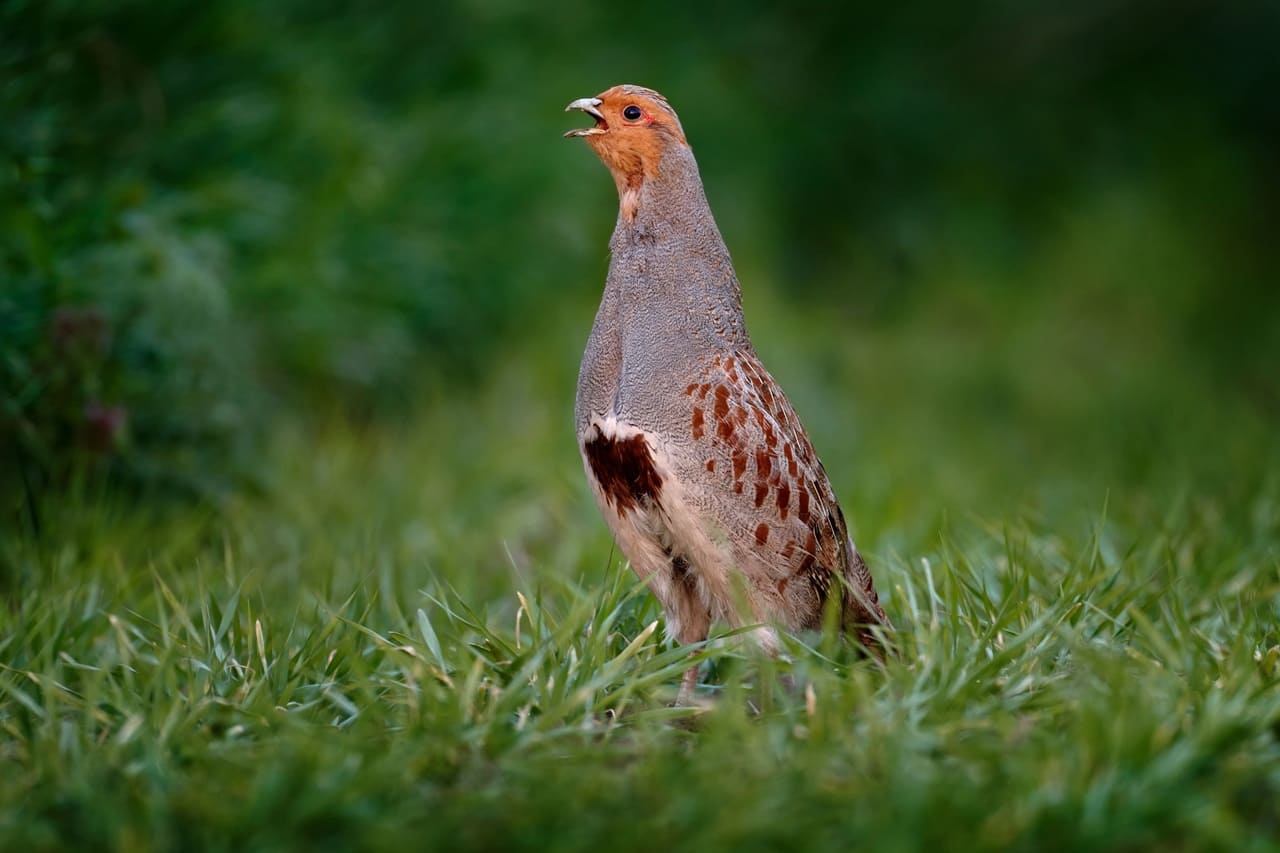
In the mid-20th century, around 10,000 grey partridges still lived in Swiss arable farming areas. In Graubünden, breeding pairs were found up to 1,300 metres above sea level. Then came agricultural intensification: pesticides, herbicides, land consolidation, monocultures. The insects disappeared, the wild herbs disappeared, the fallow land disappeared. And with them, the grey partridge. Since 2020, the species has been classified as extinct (RE) in Switzerland. The Sempach Bird Observatory calls it a 'distressing witness to the impoverishment of cultivated land'. In Germany, the population has collapsed by 94 percent since 1980. The grey partridge was named Bird of the Year 2026, a final cry for help. This dossier documents what happened, why reintroduction attempts failed and what the grey partridge reveals about the state of our agriculture.
Profile and biology
Characteristics
The grey partridge (Perdix perdix) belongs to the order Galliformes and the family Phasianidae. It measures around 30 centimetres and weighs 290 to 470 grams. The predominantly brown-grey plumage makes it a master of camouflage. Adult birds display orange-brown head markings and a black-brown, horseshoe-shaped belly patch. The grey partridge ranges from Western Europe to western Central Siberia, mainly in lowland areas below 600 metres. Its original habitat consists of steppes and forest-steppes; agriculture made it a follower of human cultivation.
Behaviour and diet
Grey partridges live in pairs or in so-called 'coveys' (family groups with young birds). They are ground-dwelling, shy animals that rarely fly. Adults feed on grass stalks, wild herbs and seeds. The chicks are completely dependent on insects and spiders in their first weeks of life. This is precisely where the problem lies: where pesticides kill the insects and herbicides eliminate the wild herbs, the chicks starve. Chick mortality rose from around 50 percent in the 1930s to over 70 percent, the central mechanism of population collapse.
Red List Status
In Switzerland: RE (extinct in Switzerland) since the 2021 Red List. In Germany: severely endangered (Category 2), fewer than 50,000 breeding pairs, population decline of over 90 percent since 1980. European: 94 percent population decline since 1980. Bird of the Year 2026 in Germany (NABU/LBV).
Why the grey partridge is extinct in Switzerland
Intensive agriculture as the main cause
The collapse of the grey partridge population in Switzerland began in the second half of the 20th century, parallel to the intensification of agriculture. Pesticides destroyed the insects on which the chicks live. Herbicides eliminated the wild herbs that provided food and cover for the adult animals. Land consolidation eliminated hedges, field margins and fallow land that served as breeding sites. Early mowing transformed meadows into ecological traps for ground-dwelling species. The size of fields increased, the diversity of crops decreased. The result: a habitat in which the grey partridge could no longer survive.
Failed reintroduction
In 1991, the FOEN commissioned the Swiss Ornithological Institute in Sempach with a conservation project. In the Klettgau (SH) and in the Champagne genevoise, habitats were enhanced in close cooperation with farmers: wildflower strips, low hedges, extensive meadows. From 1998, the first grey partridges were reintroduced in the Klettgau. Between 2002 and 2004, the population reached 15 to 20 pairs. Then the population collapsed due to weather conditions and persistently high chick mortality. The releases were discontinued in 2008. In the Champagne genevoise, in the canton of Geneva with a hunting ban but without predator control, the project also failed. The reason was not the lack of fox hunting, but the lack of habitat: too few insects, too little structure, too much pesticide.
The grey partridge as a symptom
The Swiss Ornithological Institute categorizes the disappearance of the grey partridge among a series of farmland species that can no longer survive in Switzerland: Lesser Grey Shrike, Crested Lark, Great Grey Shrike, Red-backed Shrike, Ortolan Bunting and now Grey Partridge. The 2021 Red List of breeding birds warns: After the disappearance of Grey Partridge and Ortolan Bunting, Turtle Dove and Corn Bunting are also increasingly endangered. Their survival in Switzerland is in question. The grey partridge is not an isolated case, but an indicator of the systematic collapse of biodiversity in farmland.
More on this: Dossier: Hunting and Biodiversity
The situation in Europe: 94 percent loss
Germany: Bird of the Year 2026
An estimated fewer than 50,000 breeding pairs live in Germany. Since 1980, the population has shrunk by over 90 percent. The grey partridge now occurs in only around 16 percent of hunting grounds. NABU and LBV have chosen it as Bird of the Year 2026. NABU has also filed a complaint with the EU Commission against Germany because the federal government and states have been violating the EU Birds Directive for decades. In Germany, the grey partridge continues to be hunted in many federal states despite its dramatic decline.
Europe: A continent losing its farmland birds
A study published in 'Proceedings of the National Academy of Sciences' in 2023 analyzed observational data from 170 bird species at over 20,000 sites across 28 European countries. The result: The primary cause of bird species extinction is intensive agriculture with synthetic pesticides. The connection between pesticide use and insect decline on one hand, and population collapse of insectivorous birds on the other, is scientifically proven. Three-quarters of flying insects have disappeared in protected areas. Of the approximately 600 wild bee species in Germany, about half are considered endangered or extinct.
The Role of Recreational Hunting
Hunting Despite Collapse
In Switzerland, the partridge was huntable until its disappearance. In Germany too, it continues to be hunted in several federal states despite its population having collapsed by over 90 percent. NABU explicitly demands that hunting be discontinued. The recreational hunters are not solely responsible for the partridge's disappearance, but they failed to remove the species from the list of huntable species in time. In Switzerland, woodcock, alpine ptarmigan, and brown hare are additional Red List species that continue to be hunted.
The Hunting Alibi: 'Predators Are to Blame'
The hunting lobby argues that the partridge disappeared due to lack of 'predator hunting.' The failure of the reintroduction project in the Champagne genevoise without predator hunting is cited as proof. But the facts contradict this: Even in Klettgau, where predators were hunted, the project failed. Chick mortality is primarily due to insect shortage caused by pesticides, not predation. The fox was never the main reason for the partridge's disappearance in Switzerland. Industrial agriculture was.
More on this: Dossier: Hunting Myths
What Would Need to Change
- Pesticide Reduction as Priority: The EU pesticide reduction directive must be consistently implemented. In Switzerland, binding reduction targets for synthetic pesticides and herbicides in agricultural areas are needed, not as recommendations, but as law.
- 10 Percent Ecological Priority Areas: On every farm, at least 10 percent of the area must be taken out of production and returned to nature as fallows, flower strips, hedgerows, or field margins. Fallows are the most important habitat for partridges and hundreds of other species.
- Remove All Endangered Species from Hunting Lists: In Switzerland, woodcock, alpine ptarmigan, brown hare, and other Red List species continue to be hunted. This is incompatible with species protection. Endangered species belong on protection lists, not shooting lists.
- Measure Agricultural Policy Against Biodiversity: Swiss agricultural policy (AP) must establish binding biodiversity goals. Direct payments must be more strongly linked to ecological services, not production quantity.
- Long-term Monitoring and Reintroduction Projects: New reintroduction attempts only make sense if habitats are restored beforehand. Without insects, without fallows, without wild herbs, there are no partridges.
Arguments
'The partridge disappeared due to lack of fox hunting.' Even in Klettgau, where foxes were hunted, reintroduction failed. The main cause of partridge decline is insect shortage from pesticides, not predation. Throughout Europe, populations have collapsed by 94 percent, equally in countries with and without fox hunting. Making the fox a scapegoat distracts from the real cause: industrial agriculture.
'The partridge can be reestablished through release programs.' Two decades of reintroduction attempts in Switzerland (Klettgau SH, Champagne genevoise) have failed. Releases do not work when the habitat is not suitable. Without insects, the chicks starve. Without fallow land, there are no breeding sites. The habitat must first be restored, then reintroduction can be considered.
«The grey partridge was always rare in Switzerland.» False. In the mid-20th century, the population was estimated at around 10,000 individuals. In earlier centuries, the grey partridge was even more widespread. Only the intensification of agriculture after 1950 systematically destroyed its habitat.
«The disappearance of the grey partridge is a local problem.» The population has collapsed by 94 percent across Europe. Extinct in Switzerland, severely endangered in Germany. The grey partridge is an indicator species: where it disappears, skylark, whinchat, lapwing and corn bunting also disappear. The problem is systemic and directly linked to EU agricultural policy and Swiss agricultural policy.
«Agriculture cannot afford the required measures.» The EU spends 35 percent of its budget on agricultural subsidies. Switzerland pays billions in direct payments. There is no lack of money, but a lack of political will to take biodiversity goals seriously. 10 percent priority areas and pesticide reduction are not luxury demands, but survival conditions for hundreds of species.
Quicklinks
Articles on Wild beim Wild
- Studies on the impact of hobby hunting on wildlife
- Why hobby hunting fails as population control
- Hunting myths: 12 claims critically examined
Related dossiers:
- Introduction to hunting criticism: What hobby hunting really is – and why it has no future
- The hunting license
- Hunting in Switzerland: Numbers, systems and the end of a narrative
- Hunters: Role, power, training and criticism
- Hunting myths: 12 claims you should critically examine
- Hunting and biodiversity: Does hunting really protect nature?
- Game meat in Switzerland
- Hunting ban Switzerland
- Arguments for professional wildlife wardens
- Hunting and human rights
Sources
- Swiss Ornithological Institute Sempach (2020): Grey partridge – another farmland species disappeared. Status report
- BAFU / Swiss Ornithological Institute (2021): Red List of breeding birds in Switzerland
- NABU (2025): Speaking up for the grey partridge! Campaign for Bird of the Year 2026
- NABU: EU complaint against Germany regarding Bird Protection Directive (grey partridge)
- Rigal, S., Devictor, V. et al. (2023): Farmland practices are driving bird population decline across Europe. Proceedings of the National Academy of Sciences
- German Wildlife Foundation: How can the grey partridge be saved? PARTRIDGE project
- Environmental Institute Munich (2025): Bird of the Year 2026. Why the grey partridge is a symbol of species extinction
- Swiss Ornithological Institute: Breeding population index grey partridge from 1990, reintroduction projects Klettgau SH and Champagne genevoise
- Federal Act on Hunting and the Protection of Wild Mammals and Birds (JSG, SR 922.0)
Our commitment
The grey partridge did not die of old age. It was eradicated by an agricultural policy that prioritized production quantity over species diversity. 10,000 grey partridges disappeared because pesticides were cheaper than biodiversity. What has already happened in Switzerland threatens Germany and all of Europe: the systematic loss of farmland birds. The grey partridge represents skylark, whinchat, lapwing and corn bunting. Its disappearance is a warning signal that no one may ignore. The fact that endangered species like woodcock, alpine ptarmigan and brown hare may still be hunted in Switzerland shows that politics has learned nothing from the grey partridge disaster. This dossier is continuously updated.
More on hobby hunting: In our hunting dossier we compile fact-checks, analyses and background reports.