Game Management and Hunting: Thoughts on Recreational Hunters
How many recreational hunters would continue to pretend they have an interest in nature if they were no longer allowed to kill? No recreational hunter would do anything for nature or the general public if they were not permitted to kill. That is the sad truth.


Thoughts on hunting
«Management»
There are supporters of recreational hunting, opponents of recreational hunting, and people who know nothing about recreational hunting and do not care about it.
Too many tend to align themselves with the arguments of recreational hunters and their game management and stewardship when asked for their opinion. This is partly due to the unfortunately widespread tendency to defer to self-proclaimed experts: if someone claims to be an expert in something, they are usually believed in everything they say — and who would be a greater hunting expert than a recreational hunter?
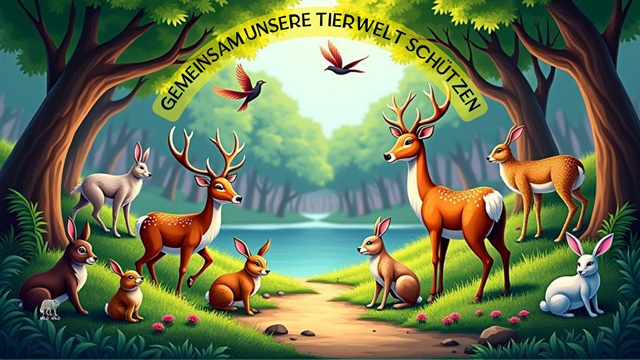
On the other hand, there are centuries of hunters’ propaganda, which portrays the harmless wolf as an evil, savage beast, while casting the recreational hunter as a brave and upright man who protects Little Red Riding Hood from the monster. Added to this are the modern-day fairy tales of the recreational hunter as a conservationist, a steward and caretaker of the forests and their inhabitants. Which dog owner does not know the signs put up by recreational hunters demanding that dogs be kept on a leash in the forest, lest they attack the depicted fawns — those wicked dogs.
The fact that these fawns will themselves eventually become targets of the “protector” is wisely kept quiet, just as all negative aspects of recreational hunting are kept quiet. Positive aspects are consistently emphasised strongly, while negative aspects are downplayed, described as a necessary evil, or in extreme cases reframed as something positive. When any of this reaches the public, it is invariably presented as a regrettable isolated incident that “unfairly casts the hunting community in a bad light” — usually in a whining, aggrieved tone, given how much they otherwise do for nature, the environment, and animal welfare.
The arguments of recreational hunters in favour of hunting and against hunting opponents:
Recreational hunters typically begin by challenging their opponent’s general competence with the following argument:
- They claim their critics harbour prejudices against recreational hunters but have no idea what really goes on in the forest..
As the name suggests, prejudices are judgements made before one has informed oneself about a topic or issue. The reality, however, is that many hunting opponents have been engaging with the subject of “hunting” for years and — for this is one of the ways one becomes a hunting opponent — are well acquainted with many negative aspects of hunting and have had many negative experiences with recreational hunters. The recreational hunter is decidedly not the only one who knows their way around the forest. Spending a few hours on Saturday and Sunday mornings perched on one of the many raised hides does not make a person a supreme expert on all matters of forestry, least of all when it is not done for research purposes. Recreational hunters are, as a rule, not biologists but tradespeople and farmers — hardly the people one would consult for their opinion on complex interrelationships.
When this argument fails to gain traction, decades-old myths are served up:
- Hunting is necessary to maintain the balance of nature..
One need not even argue against this — one can simply let the argument speak for itself. If a single man is supposed to be capable of maintaining the natural balance of a forest, or even a large forested area, through the sporadic culling of fallow deer, red deer, foxes, and hares, then this ought to solve all of the world’s ecological problems in one fell swoop. It couldn’t be simpler.
On one hand, the argument is made for a massive, forestry-damaging overpopulation that must somehow be kept in check, while on the other hand they shoot “only very few animals per year” so as not to be seen as the trigger-happy gunslinger they actually are. Or some “plagues” are cited that must be prevented or reduced through culling. When pressed, however, recreational hunters must almost always admit that they can neither prevent nor reduce the “plague” and that the tool of “culling” is useless for any kind of regulation (whatever that is supposed to look like). So bang, bang, bang — much ado about nothing.
Particularly following announcements of hunting reforms, hunters are fond of threatening that if “stewardship” and “wildlife management” were to cease, apocalyptic conditions would set in almost immediately. Rabid foxes would overrun the cities and infect us all with rabies, roe deer and wild boar would immediately invade the suburbs and devour all the maize fields, and deer struck by vehicles would lie rotting at the roadside, triggering epidemics. This is of course only hinted at, because it is absurd. We will address the foxes shortly; the problem of crop damage is self-inflicted, and most animals struck by vehicles are collected by road maintenance services anyway. The real message from recreational hunters is that they do not want to stop killing.
What is striking is that there is no evidence for the potential dangers of discontinuing recreational hunting, nor is there any research to support such claims, nor has it ever been put to the test. We have only the word of recreational hunters — which, unfortunately (and not only in this case), is worth nothing, since every statement is made purely out of self-interest. The core of all hunters’ arguments is as follows: they want to carry on as before, and therefore they cannot and must not stop. “Stewardship” serves as a pure alibi. This, unfortunately, often works, because most people genuinely do not know what problems actually exist, how they arise, or that the recreational hunter is one of those responsible for creating them.
- Everyone will get rabies if recreational hunters do not kill the dangerous, rabid foxes.
Rabies has been considered eradicated in this country for years (through vaccination, incidentally, not through shooting). Since virtually all foxes killed have no rabies — a fact the recreational hunter is well aware of — this is no argument for shooting these small predators. It is the competitive mindset, namely that no animal may contest the recreational hunter's quarry. Anyone who has seen a rabid fox in the last five or ten years is welcome to come forward. The 20 annually reported cases of fox tapeworm infection among at-risk groups (recreational hunters) fall into the same category: possible, but extremely unlikely.
- One eats meat or wears leather shoes, after all.
A typical, supposedly knock-down argument. Difficult for most non-vegans to deny.
What all non-hunters can deny, however, is the following:
- They do not kill animals for fun and as a hobby.
- They do not deliberately torment animals — for example, they do not use live animals to train their hunting dogs.
- One can eat meat and wear leather shoes without having personally killed animals and experienced an unnatural pleasure in doing so. The reflexively produced argument that slaughterhouses are so cruel and that wild animals actually have it good when they are killed and feel nothing apart from the small sting caused by the impacting bullet is unparalleled in its absurdity. Sentences like the following actually do get uttered (quote): “But the buck out there had a good life. He grew up with his mother, was able to mate, witnessed many sunrises and sunsets, and then suddenly the lights went out. ‘Quick and painless.’” The faction of “You just have a Bambi mentality” counter-arguers have no shame in selling the shooting of a healthy, harmless animal as a beautiful end to a fulfilled animal life. One is essentially doing the animal a favour. The claim that the “buck” truly feels nothing does, however, presuppose that every recreational hunter kills every animal instantly with the first shot. Unfortunately, this is by no means the case, and the stories told about heart or shoulder shots are mostly pure hunters’ tales. In their imagination, all recreational hunters are sharpshooters who never need more than one shot. Unfortunately, most recreational hunters genuinely cannot see particularly well, let alone shoot accurately, and — as has occurred in recent times — a person has even been mistaken for a wild boar and shot dead. Since typical recreational hunters are generally over 60, correspondingly unsteady and visually impaired, and are allegedly, according to persistent rumours, frequently under the influence of alcohol, wild animals are often only wounded and are by no means killed instantly. A wounded hare can scream in such pain that anyone who has heard it and yet continues to shoot at animals thereafter can readily be placed in the category of “unfeeling monster.” One cannot ask a deer, of course, but I would wager considerable sums that it would actually prefer to go on living rather than end up in a recreational hunter’s freezer. Furthermore, this argument fails on its own terms anyway, because recreational hunters do not merely kill animals themselves but also continue to eat steaks and schnitzel — something that is, of course, once again conveniently left unmentioned. Nor is it mentioned that not everyone — even if they genuinely wanted to — could actually supply themselves with meat through hunting, because this simply cannot work in practical terms. One need only imagine every meat buyer at the butcher’s, at the supermarket counter, or at the freezer aisle instead out in the woods on a Saturday morning with a shotgun. As previously discussed: it simply does not work. And yet this gives the recreational hunter a brief opportunity to appear to occupy the moral high ground over the non-hunter.
- One does not take pleasure in violence and death. Studies have shown that recreational hunters are not motivated by nature or wildlife conservation, but that they derive pleasure exclusively from violence and death. In brief: they love the feeling of omnipotence that operating a weapon gives them — the fleeting power over life and death. From this feeling also grows the desire to control or regulate nature, whether such intervention is necessary or not. A god need not justify himself.
Point 1 cannot be repeated often enough, for it is at the very core of what separates the recreational hunter from other human beings (and, of course, the fact that he belongs to an evolutionary precursor of modern humanity — and finds that perfectly acceptable). The readiness and the will to kill, wound, and torment a large, living animal for one's own amusement alone.
- Wild boars are overrunning our cities and causing damage to crops and fields.
A sensitive subject for every recreational hunter is the wild boar. Not only does he rarely catch sight of these cautious and clever animals — he is also unable to get the better of them. The individual recreational hunter is intellectually inferior even to the wild boar; he stands any chance of catching one only during driven hunts. Moreover, a wild boar is a rather formidable animal, commanding considerable respect from the would-be outdoorsman. After all, one would prefer not to suddenly become the prey oneself.
Looking at the self-perception of the recreational hunter, he sees himself as a strapping, virile, and highly intelligent (the hunting examination was so demanding) man of nature — practically a kind of superman compared to the soft-hearted, Bambi-loving, nature-estranged animal rights advocates — one who strides powerfully (rifle in hand) and tirelessly (in his off-road vehicle) through the forests, keeping things in order and only occasionally shooting a deer or two for personal use.
In hunting, anti-hunting, and other internet forums, one can also make the interesting observation that the participant who identifies as a recreational hunter is always right on all matters of animal and nature conservation, while everyone else — and especially opponents of recreational hunting — is “not looking at the whole thing properly,” studies questioning the usefulness of recreational hunting are nonsense anyway and ideologically biased, and the recreational hunter alone truly knows what he is talking about. Even more interesting than this fact is that most people believe all of this from the recreational hunter. The nimbus of the all-knowing, wise guardian of the forest is considerable, and the shaping of public opinion has been highly successful for a long time. The recreational hunter, on principle — much like the Pope — can do no wrong. If something does go wrong, or if a decades-long practice turns out to be fundamentally mistaken, others (forest owners, farmers) are to blame. The buck is passed so swiftly that anyone who does not constantly engage with these issues hardly notices that the hunting community briefly held it in their hands.
One is truly dealing here with deeply rooted (positive) prejudices that are difficult to dispel.
In fact, there are several types of recreational hunters, or rather several ways in which one comes to engage in the recreational killing of animals as a pastime:
- Certainly the most common type: weak, unintelligent character, latently violent, devoid of empathy. One arrives at the hobby through thoughtless imitation. Dad, grandpa, or uncle is/was an enthusiastic recreational hunter; one knows nothing other than the elder grabbing his shotgun on Saturdays and heading out to violate nature. This is tradition, and tradition is held in very, very high regard among recreational hunters. After all, it means one need not waste any thought on further development (except on the development of weapons, lures, or off-road vehicles). Most recreational hunters consider the hunting law in its unchanged form a greater achievement than the formulation of human rights. Initiation rites (hunting is full of rituals) are gladly celebrated; young son gets to hold the gun, take aim, and pull the trigger. Much like in the military, this breaks down inhibitions against killing and warps an already weak and unstable character until the pitiful remnants of his humanity have been driven out. Shedding this ballast requires far greater effort than this person is capable of, so he will never question what he does.
- Misguided conservation: The aspiring recreational hunter believes the nonsense spread by other recreational hunters about the supposedly necessary and beneficial aspects of hunting, and wishes to emulate it. Often in conjunction with type 1. Since apparently many recreational hunters believe this themselves, contrary to all factual arguments, they can be quite convincing to uninformed people when holding forth about the importance and usefulness of hunting.
- Peer pressure: There is a certain likelihood that the individual is not truly convinced of the matter, given that a large portion of the non-hunting population — those not indoctrinated by recreational hunters — rejects this activity.
- Humanity is thoroughly corrupt, possesses an extremely violent and aggressive character, and is furthermore evolutionarily retarded — a condition which humans themselves tend to mistake for a deep connection with nature. In discussions, hunters quickly feel cornered due to their weak moral position and are swift to resort to threats, often including threats of physical violence. The typical arguments “Humans have always hunted!” or “Humans are hunters!” — “proven” by jaw characteristics — are certainly valid. But only if one happens to be a Neanderthal. For any non-Neanderthal, a person of the 21st century has absolutely no necessity to kill animals themselves, unless they simply want to. The question of motivation is then typically evaded by pointing out that wild game meat (mildly radioactive as it is) is so much healthier, and that one only wants the best for one’s family — family being a reassuring detail, as it suggests some semblance of humanity.
Most recreational hunters are a combination of 1 and 4.
Particularly relevant in this context is criminological research — more specifically, research into the causes of crime and why certain individuals are extremely violent (“violence-prone repeat offenders”). Individuals who lack empathy for other human beings are referred to as “psychopaths.” These psychopaths, devoid of any compassion or sympathy, are capable of inflicting unimaginably terrible harm upon others without displaying any emotional reaction. Outwardly, such psychopaths can appear entirely normal and even charming and empathetic, to the point of effortlessly deceiving trained psychologists. Notably, these psychopaths frequently exhibit an urge to kill, rape, and torture other human beings — even though, logically speaking, a mere lack of empathy need not automatically entail such impulses; other people could simply be irrelevant to the psychopath. However one chooses to evaluate this: clear parallels to the recreational hunter are unmistakable.
In violence research, it is assumed that this behavior of merciless violence against the innocent is an inherited-learned behavior. This means that it is partly innate and partly learned through imitation of one's parents. Most recreational hunters have one or more recreational hunters in the family, usually a long family tradition of hunting. The exercise of violence against animals and animal cruelty is perceived as normal as riding a bicycle. As is the killing of animals. One could now — as science also tends to do — absolve the individual of responsibility for their actions on the grounds that they “cannot help it.” However, this is only half the truth, because as mentioned above, the psychopath feels no negative emotions when torturing or killing a person, yet on the other hand nobody forces them to do so, and even the psychopath generally knows that one should not do such things. Likewise, the recreational hunter knows that it is not really good behavior to senselessly shoot animals dead, which is evident from the fact that they neither wish to be observed doing so, nor do they broadcast this behavior or describe it truthfully to third parties (hit rate). They feel comfortable only among their own kind, because there they can talk about the very positive feelings that killing triggers in them. And even there only heavily veiled through the expressions of hunting jargon, which avoids any reference to killing and uses strangely neutral terms. Even the words “hunter,” “hunting” or “to hunt” are not fitting, because it involves killing from a distance. The word “wildlife killer” is far more apt. But of course it is not used, precisely because it contains the word “killer.”
Fundamentally, one can assume that in the mind of the recreational hunter, the word “kill!” pulses urgently and demandingly, glowing red and accompanied by a thumping bass. He aligns his entire life around this urge, subordinates every other urge to it, and only feels truly at ease (“Free!”, “One with nature!”) when he is able to kill. Anyone who stands in the way of this is an enemy to be fought, by force of arms if necessary.
Even the extremely vehement reactions to harmless and reasonable things such as “hunting law reforms” or simply questioning the usefulness, validity, and legality of his actions cause him to virtually lose control and lash out wildly.
As befits true p sychopaths, many recreational hunters can also play the “gentle sage of the forest,” looking mildly upon the ignorant opponents of their cruel activities and engaging in discussion in a very measured and friendly manner. This stems from the fact that he essentially has no human emotions, whereas the hunting opponent, whose genuine concern is the protection of animals, may at times lose self-control. One should not take this too much to heart — psychopaths simply have the advantage here. One can at least be certain of having identified one of that kind.
- The recreational hunter derives deep satisfaction from killing wildlife and forest animals. Were that not the case, he would not hunt.
- A recreational hunter is someone who spends tens of thousands of francs on courses, membership fees, rifles, carbines, shotguns, handguns, knives, permits, off-road vehicles, leases, and other hunting equipment, all so that he may, with a certain degree of legitimacy, enter the forest and shoot animals. This is clearly his absolute primary concern. For if it were merely about shooting — which certainly holds a certain appeal for many people — he could join a shooting club and satisfy his desire on paper targets.
- If it were about tending to the forest: grab a chainsaw, rake, and rubbish bag and get on with it.
- One can also collect road-killed animals without a firearm, if one wishes.
- If it were about the animals, or about establishing some kind of balance — which allegedly would not be possible without the predators he has helped exterminate — he should simply stop hauling hundredweights of feed into the forests every winter. Nature will then ensure that population numbers decline on their own.
- If the animals themselves meant anything to him, he would not be able to shoot them. But he does. Again and again and again — and each year he prepares for the next.
One will never hear a recreational hunter with even a moderately clear mind admit that he goes to all this trouble because killing brings him so much pleasure. Even the regressed brain of the recreational hunter knows that his actions are incompatible with all social, moral, and human norms — those things that have evolved from a long history of violence.
Some will repeatedly claim that hunting is merely a minor side aspect of so-called «stewardship», and will put forward altruistic motives, saying that one would not do all this terribly expensive and exhausting work just for a bit of shooting, and that their concern is for nature. Certainly many would like to believe that, just as many would surely like to believe in God or Father Christmas. One simply does not want to know that the man, the father, the neighbour, the colleague is a murder-obsessed monster — since stewardship serves entirely and solely the purpose of maintaining wildlife populations at a level suitable for hunting.
The so-called «stewardship» is the recreational hunter's justification before the world for being able to indulge his destructive impulses. He is so obsessed with killing that he will do anything for it, including expensive and sometimes strenuous things. He would do none of it if he were no longer permitted to kill.
Hunting always comes down to killing and to the gratification of archaic drives — whereby some even consider this natural and desirable, and gladly pretend as though neither compassion nor morality existed.
Further articles
- Are recreational hunters psychopaths?
- Recreational hunters on the psychological seesaw
- Aggression: Understanding recreational hunters better
- Sadism: Understanding recreational hunters better
- Trophies: The pleasure hunt
- Alcohol: Recreational hunters and the drinking problem
- Hunting and hunters: Psychoanalysis
- Recreational hunters and violence in our society
Support our work
With your donation you help protect animals and give voice to their cause.
Donate now→More on the subject of recreational hunting: The scientific evidence is presented in the overview Studies on the Effects of Recreational Hunting.
The position of IG Wild beim Wild: IG Wild beim Wild rejects recreational hunting. Our model is the canton of Geneva, which has managed without recreational hunting since 1974: without hunting seasons, without hunting dogs, without driven hunts, without high seats, without the animal cruelty and crime that go hand in hand with hunting season elsewhere. What has worked there for over fifty years disproves every position paper by JagdSchweiz. An association that bases its policy on claims it refutes in its own documents is not a professional organisation, but a factory for misinformation.