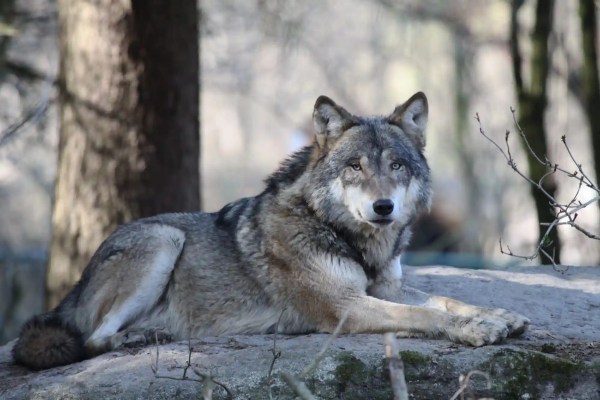
In the Chablais pack, mother and daughter reproduce with the same male
KORA annual report 2025: double reproduction demonstrated in Switzerland for the first time – and what research has long known
In 2025, two female wolves in the Valais Chablais pack reproduced in the same year for the first time in Switzerland.
The KORA foundation demonstrated this through genetic analysis and communicated it at the end of May 2026 in the KORA annual report 2025. The case is documented in precise biological detail and casts a spotlight on a wolf policy that has for years set itself against the state of international science.
What KORA demonstrated
In wolves, reproduction is normally carried out by a single pair within the pack. Occasionally, however, two females within the same group reproduce in the same year: in this case one speaks of «double reproduction». This phenomenon is known in wolves and documented in various regions, including in Europe and North America.
In the Chablais pack, KORA was able to establish the following through kinship analyses by the Laboratoire de Biologie de la Conservation at the University of Lausanne: a new male had reproduced both with F43, the reproducing female of this pack since 2019, and with a daughter of this female. A total of eight pups were recorded.
The trigger: a male was shot
The case has a concrete administrative trigger, which KORA names in the report. After the reproducing male M88 was legally killed in January 2024, no reproduction could be established that year. In the summer of 2025, the cantonal monitoring again showed reproduction with eight pups.
A new male migrated into the now vacant territory and mated with both females. The killing of M88 thus set in motion exactly the mechanism that international research has for years described as «compensatory reproduction».
What science has long documented
KORA's wording that the effects of lethal management have «not yet been conclusively assessed» applies to a narrow sub-area. The fundamental mechanism is well documented.
Lethal management of wolves has numerous unintended consequences: simplification of the social structure, dissolution of packs and short-term declines in reproduction. At the same time, the removal of wolves can increase future livestock kills. The decisive mechanism behind this: non-reproducing females begin to reproduce as soon as the lead female or lead male is missing. This is exactly what happened in the Chablais pack.
In a widely cited study in 2014, Wielgus and Peebles analysed 25 years of data from Idaho, Montana and Wyoming. Their finding: at kill rates below 25 per cent of the population, livestock kills actually increased, possibly because of a compensatory rise in the number of breeding pairs. Mortality rates above 25 per cent are not sustainable in the long term. This study was challenged on methodological grounds, but even the counter-study by Poudyal et al. (2016) holds that: killing a wolf leads to a 2.2 per cent increase in sheep kills in the same year, and thus has at least a short-term counterproductive effect.
There is also another, often underestimated factor: hunting pressure on wolves leads to hormonal changes that can unintentionally increase the reproduction rate and alter the genetic structure of the population.
A recent study from Wisconsin (Scientific Reports, 2024) also shows: the loss of a pack member can lead to the dissolution of the pack, especially when reproductively active individuals are removed and the population is small. In stable, large populations, incoming animals can take over the role of the removed member and maintain the social functions. The Swiss wolf population is a recolonising, not yet stable population in which this buffering effect only takes hold to a limited extent.
43 packs, 350 wolves, 89 shot
The individual case in the Chablais stands in the context of an overall assessment that casts Swiss wolf management in a contradictory light. In the monitoring year 2025/26, 43 packs were confirmed in Switzerland, two more than the previous year. Of these, 32 live entirely in Switzerland, while 11 also use areas in neighbouring countries. Three packs are already considered dissolved again.
In the regulation period from September 2025 to January 2026, a total of 89 wolves were killed, including problem wolves and injured animals. A total of 153 wolf pups were recorded. The population grew nonetheless. KORA warned against premature conclusions: the first reliable results on the effectiveness of the hunting would only be available in 2027.
In the canton of Valais, where the Chablais pack lives, the balance is as follows: 75 wolves were formally identified, including 57 new individuals. Eleven packs were confirmed, ten of them with reproduction. In 81 attacks, 318 farm animals were killed. As part of the proactive regulation, 24 wolves were removed.
New packs, new genetics
In parallel with the double reproduction in Valais, KORA reports geographical expansion: for the first time a pack established itself in the canton of Obwalden, and another emerged in the canton of Neuchatel.
Genetically relevant is a finding from the canton of Bern: for the first time, a female from the Central European population was registered in Switzerland. This population is genetically more diverse than the dominant Alpine population and contributes to the long-term stability of the population. That this genetic gain was detected via a poached, i.e. illegally killed, animal is a bitter footnote to the current recreational hunting policy.
What the Chablais pack shows
The Chablais pack is not a special case. It is a textbook example. The shooting of M88 did not weaken the pack, it restructured it, attracted a new male and triggered double reproduction for the first time. Eight pups, two litters, a single intervention.
International research described this dynamic long before Switzerland made its shooting practice the rule. That KORA, in the very annual report in which this case is documented, describes the effectiveness of the regulation as «not yet conclusively assessed», is scientific caution. But it must not be regarded as a free pass to carry on as before.
Anyone who has wolves shot in packs is not regulating the population. They are regulating the social structure, and the consequences have long been documented.
More on the subject of recreational hunting: In our dossiers on recreational hunting gather fact-checks, analyses and background reports. What the research says about this is shown by Hunting fact-checked: the state of research.
The position of IG Wild beim Wild: IG Wild beim Wild rejects recreational hunting. Our model is the canton of Geneva, which has managed without recreational hunting since 1974: without hunting seasons, without hunting dogs, without driven hunts, without high seats, without the animal cruelty and crime that go hand in hand with hunting season elsewhere. What has worked there for over fifty years disproves every position paper by JagdSchweiz. An association that bases its policy on claims it refutes in its own documents is not a professional organisation, but a factory for misinformation.
Support our work
With your donation you help to protect animals and give their voice a hearing.
Donate now →