Canton of Valais once again lacks authority to issue shooting permit
Pro Natura and WWF Switzerland are contesting the shooting permit issued by the Canton of Valais for a wolf. The canton does not have the authority to act unilaterally, as the formation of Switzerland's third wolf pack must be anticipated. More on law and legislation.

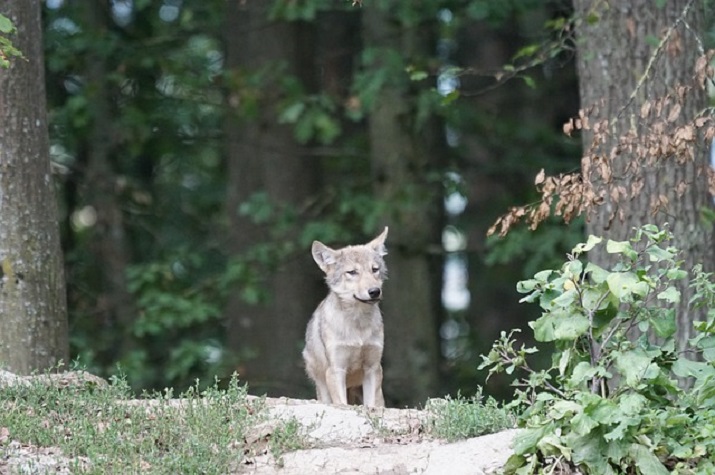
Pro Natura and WWF Switzerland consider the shooting permit issued by the Canton of Valais for a wolf to be unlawful.
17.6.2016 – In this case, the canton is not permitted to issue a permit unilaterally, as it is highly likely that pups are expected and, with them, Switzerland's third wolf pack. The killing of a parent animal during this critical phase would not be survived by the young. The two conservation organisations are therefore lodging an appeal against the existing shooting permit and requesting suspensory effect.
On Tuesday, the Canton of Valais ordered the culling of a lone wolf. However, it is highly probable that the wolves F14 and M59, who have been living as a pair since last year, have formed a pack. Under the current wolf concept, this would mean that the Federal Office for the Environment (FOEN) — not the Canton of Valais — would be responsible for issuing the shooting permit. The Canton of Valais itself has confirmed the presence of two females in heat and one male in the Augstbord region.
The wolf concept recommends that during the period from 1 April to 31 July, culling should “in principle [be refrained from].” This is for biological reasons: during this period, wolf pups are still in the den, and detecting them without causing disturbance is impossible. Killing the mother or father wolf during this time would mean certain death for the young. Pro Natura and WWF Switzerland demand that this fact be taken into account given such clear signs of pack formation.
Pro Natura and WWF are therefore lodging an appeal today against the shooting permit for a wolf and are requesting the reinstatement of suspensory effect.
The wolf population in Switzerland is still on shaky ground. The possible third pack in Valais is important for the survival of wolves in Switzerland. Furthermore, the example of the Calandra pack shows that pack formation does not lead to an increase in damage, as hunting success for wild animals is greater within a pack. Pro Natura and WWF Switzerland are calling on the canton of Valais to focus on implementing herd protection measures, and are demanding that State Councillor Melly refrain from ordering the shooting of any wolf during this critical period.
Herd protection is slow to get off the ground
Last year, Pro Natura and WWF Switzerland had already filed a complaint against a culling permit under similar circumstances. That case is still pending. The Federal Office for the Environment (FOEN) had also filed a complaint at the time, as it found that the herd protection guidelines had not been implemented. While the environmental organisations acknowledge that progress has been made in herd protection in the Augstbord region since last year, the high number of non-attributable kills shows that the majority of livestock remains unprotected. Livestock kills are classified as non-attributable when herd protection measures have not been sufficiently implemented. This continues to encourage wolves to specialise in preying on livestock — a specialisation that in turn undermines herd protection.
16.6.2016 – CVP politician Jacques Melly of the Valais cantonal government has once again issued a questionable culling permit for a wolf in the Augstbord region.
As of this morning, 16 June 2016, hunters in the Augstbord region are authorised to carry out the shooting order for a wolf.
The wolf may only be targeted in locations where one of the predators attempts to attack a flock of sheep that is protected in accordance with federal and cantonal guidelines.
WWF regrets and criticizes the canton's decision. “There is a strong likelihood that the wolf pair in the Augstbord region recently had offspring. In that case, the canton has no authority whatsoever to issue a culling permit. In addition, a closed season for females is provided for during the reproductive period.”
The Gruppe Wolf Schweiz considers the culling permit issued by the Valais cantonal authorities for a wolf in the Augstbord region to be unlawful. In the organisation's view, Valais is ignoring the likely formation of a pack in the region.
The behavior of the wolves provides strong indications that pups have by now been born, the group Groupe Loup Suisse (GWS) announced. A male of the wolf pair has been hunting alone for several weeks, as camera trap images would prove.
A culling at this point in time would in all likelihood target the father animal M59. As recently as late April and early May, both animals were jointly killing livestock.
In the first weeks after birth, the mother animal spends most of her time in the den to care for the offspring. During this time, the wolf family depends on the father to provide them with food.
Appeal still pending
A culling would therefore be a death sentence for the pups, the group writes. The possible pack prohibits a wolf culling at the current time. Under federal law, a regulation of the pack in winter would at most be permissible.
Because the Groupe Loup Suisse does not have the right to lodge an associational appeal, the criticism expressed against the culling permit is all that remains.
The conservation organizations WWF and Pro Natura, which do have the right to appeal, had not yet decided on a possible appeal, as was stated on Wednesday when asked. Valais had granted the culling permit on Tuesday, after a total of 50 sheep and goats had been killed between April and early June.
Quality of protective measures
The WWF now wants to examine the dossier submitted by the canton — which provides information on the various measures on the affected pastures — over the coming days. “According to our information, the quality of the protective measures on the spring pastures varied greatly,” said Schmid. Only then does the WWF want to make a final decision on an appeal, as in the previous summer with a similar situation.
“The two culling orders are comparable in many respects. Last year too, it was not clear whether these were individual animals or a possible pack. The FOEN therefore also took the view that the canton was not permitted to authorize a culling. In that case, the environmental organizations and the FOEN took the appeals to the cantonal court, where they are still pending. It is somewhat incomprehensible to us that the canton is once again acting in the same way (Wild beim Wild reported) even though much suggests that the Augstbord wolves recently had young,” writes 1815.ch.
The federal hunting ordinance stipulates that an individual wolf may be approved for shooting if it has killed at least 15 livestock animals and damage caused by wolves was already recorded in the previous year. Only those livestock animals killed by wolves are taken into account for the granting of a shooting permit if herd protection measures have been implemented in the relevant area.
Dossier: The Wolf in Switzerland: Facts, Policy, and the Limits of Hunting