Botswana wants to process elephants into pet food
Botswana is considering processing elephants into pet food. The proposal has drawn sharp international criticism from animal welfare organisations.


Botswana has the world’s largest elephant population. Estimates suggest there are more than 130’000 of these plant-eating animals.
But that number could soon decline. The government of the southern African country is considering lifting the ban on big game hunting, citing growing conflict between smallholder farmers and wildlife.
Since 2014, hunting elephants and other endangered animals has been banned in Botswana.However, the new government last year commissioned a committee to review the law. The committee has now recommended overturning the hunting ban and allowing limited elephant hunting once again. Among other uses, the meat would be processed into canned pet food. The government is now deliberating on the committee’s recommendation.
Animal welfare advocates have reacted with outrage. They describe it as a catastrophe and warn of major losses to the tourism industry. Botswana is a popular safari destination for international tourists.Tourism is the second largest source of foreign revenue in Botswana, after diamond mining.
Former President Ian Khama has publicly spoken out against lifting the ban. Poaching in Botswana has reached an «unprecedented» level, according to a study by the conservation organisation Elephants Without Borders, published in September (Wild beim Wild reported). This is directly linked to the current government’s disarmament of Botswana’s anti-poaching unit.
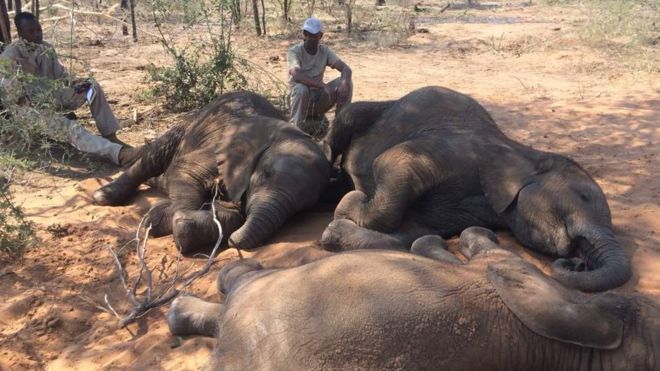
Before European colonisation, up to 20 million elephants may have lived in Africa, scientists say. By 1979, only 1.3 million remained. Surveys of the continent’s savanna elephants found that between 2007 and 2014, elephant numbers had declined by at least 30% or 144,000 animals.
Why is there an increasing conflict between humans and elephants?
Surveys have shown that the range of elephants – how far the elephants travel – has expanded.
The Director of the Department of Wildlife and National Parks, Otisitwe Tiroyamodimo, saidthat many factors were involved, including climate change."We began to see the vegetation deteriorating as soon as the rain stopped, and the elephants then naturally wandered outside their natural range because they found very little water and very little food," he said.
"We began to see the vegetation deteriorating as soon as the rain stopped, and the elephants then naturally wandered outside their natural range because they found very little water and very little food," he said.
Otisitwe Tiroyamodimo
«The number of elephants has increased – at the same time the population has also grown and there is a need for more land. The development of infrastructure has also caused the elephants to migrate.»
However, the most recent wildlife surveys in northern Botswana suggest that their numbers are not increasing, as many rural residents suspect.
Those who live near elephants support the reintroduction of hunting, as the number of conflicts has increased since the ban was introduced.
Elephants can be very destructive when they encroach on farmland and pass through villages – destroying crops and sometimes killing people.
Civilised development aid
With elections in October, the government must weigh lifting the hunting ban to win rural votes without provoking negative repercussions for Botswana's standing as a luxury safari destination on the international stage.
In 2013, hunting revenues of $20 million were dwarfed by $350 million in photo safari income. In Botswana, no lion dies so that a hunter can satisfy his ego. Yet the big cats don't have to face extinction there either. This makes the country a problem for the hunting lobby. The governments of the time cited declining populations of many hunted species as the reason for the hunting ban introduced in 2014, along with their intention to focus on nature-compatible photo tourism in the future. In Botswana's Okavango Delta, photo tourism creates 39 times more jobs than hunting. Photo tourism generates billions in revenue and creates a large number of jobs for local people across Africa.
The claim that trophy hunting serves species conservation and development aid quickly reveals itself, on closer inspection, as hypocritical propaganda from the squalid hunting milieu.
More on the subject of recreational hunting: In our dossiers on recreational hunting gather fact-checks, analyses and background reports. What the research says about this is shown by Hunting fact-checked: the state of research.
The position of IG Wild beim Wild: IG Wild beim Wild rejects recreational hunting. Our model is the canton of Geneva, which has managed without recreational hunting since 1974: without hunting seasons, without hunting dogs, without driven hunts, without high seats, without the animal cruelty and crime that go hand in hand with hunting season elsewhere. What has worked there for over fifty years disproves every position paper by JagdSchweiz. An association that bases its policy on claims it refutes in its own documents is not a professional organisation, but a factory for misinformation.