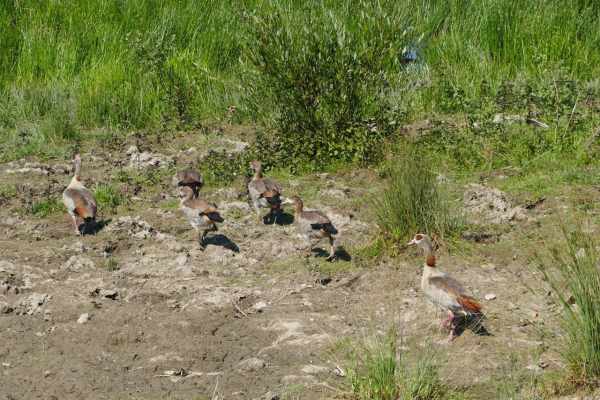
Non-native animals are granted no protection: they are unwanted and “worthless,” even though they too have long ceased to be regarded as mere objects.
Speciesism by law
Their right to life is denied to them by law on the basis of their origin and in the name of an ecological balance dictated by humans. This is lived “speciesism”: through its attitude towards non-native wildlife, humanity once again demonstrates its conviction that it is superior to all other species and may therefore treat them as it pleases. This attitude is more than reprehensible and can no longer be accepted.
In an article in the Basler Zeitung of 4 September 2021, wildlife expert Darius Weber also sheds light on raccoons: “They are neither useful nor harmful nor dramatic».
There would be other options — non-lethal measures for controlling the raccoon population, as also provided for under EU regulation — but these are not applied because the recreational hunters prefer to take matters into their own hands by invoking EU law. The EU regulation does not necessarily require killing. Militant recreational hunters are by their very nature lacking in ethical, sustainable approaches to solutions.
Between 30 and 40 raccoons live in the canton of Basel-Landschaft alone — at least according to an estimate cited by Basel-Landschaft hunting warden Rolf Wirz. He adds immediately, however: “I think the actual number is much higher and there are far more raccoons among us.” This is the case even though the animal is not actually native to Europe. No figures exist for Switzerland as a whole.
In Basel-Landschaft, raccoons are now being trapped in order to stop their spread. “I am not trapping them in order to release them afterwards,” says Wirz. The captured animals would be killed. Since 2016, raccoons have been classified in Europe as an invasive species that is approved for culling.
Everywhere except Ticino
Raccoons were first detected in Switzerland in 1975, according to biologist Sarah Hummel from Info Fauna. They are now likely present throughout Switzerland, with the exception of Ticino. The cantons of Basel-City, Basel-Country, Aargau, Solothurn, Schaffhausen and Zurich are particularly affected.
What alarmed authorities in northwestern Switzerland, however, was not only the comparatively high number of sightings, but also the discovery of the first so-called proof of reproduction in the region. In 2020, young raccoons were spotted in Kaiseraugst (AG), in 2021 in Gelterkinden and Lausen (both BL), and in 2022 in Schinznach (AG), as reported by SRF.ch.
| You can help all animals and our planet with compassion. Choose empathy on your plate and in your glass. Go vegan. |
More on the subject of recreational hunting: In our dossiers on the criticism of recreational hunting gather fact-checks, analyses and background reports. The scientific evidence is presented in the overview Studies on the Effects of Recreational Hunting.
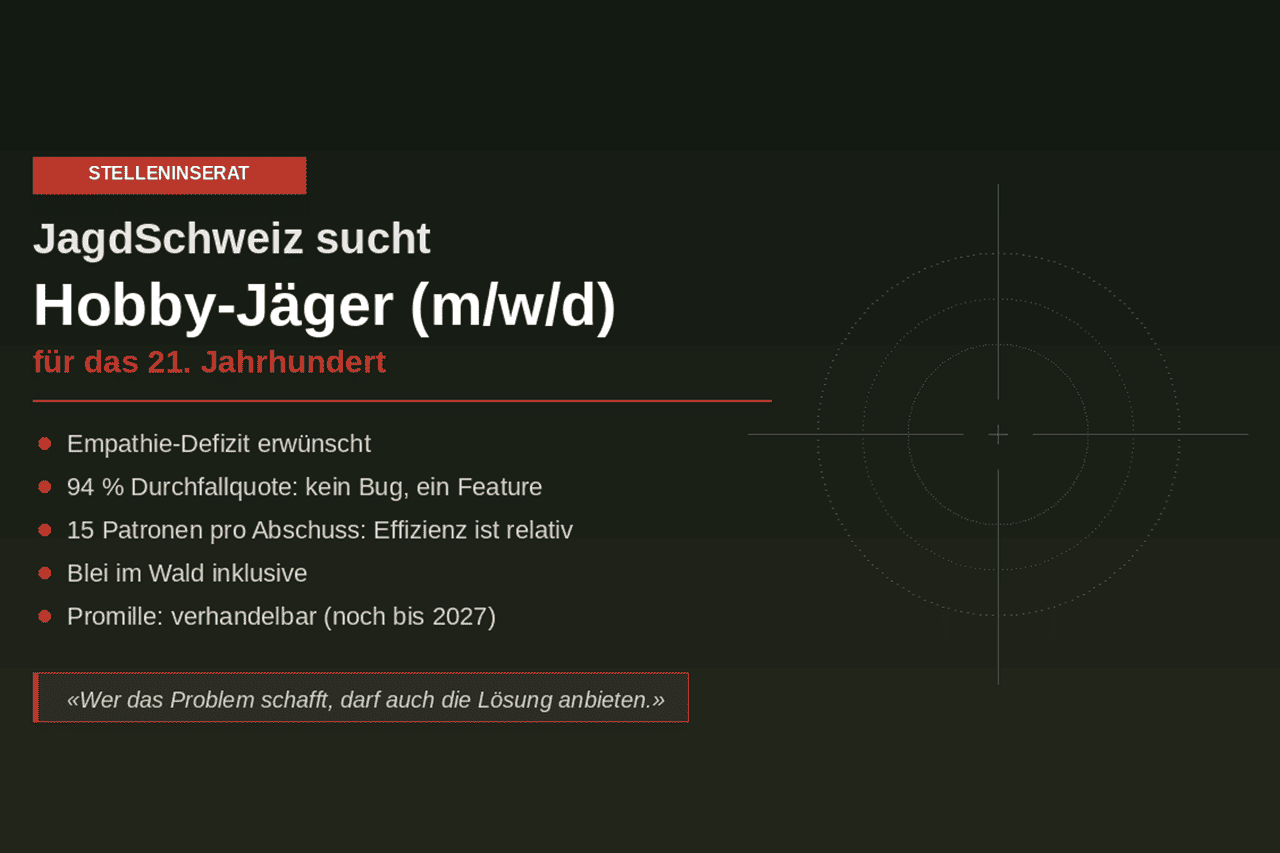
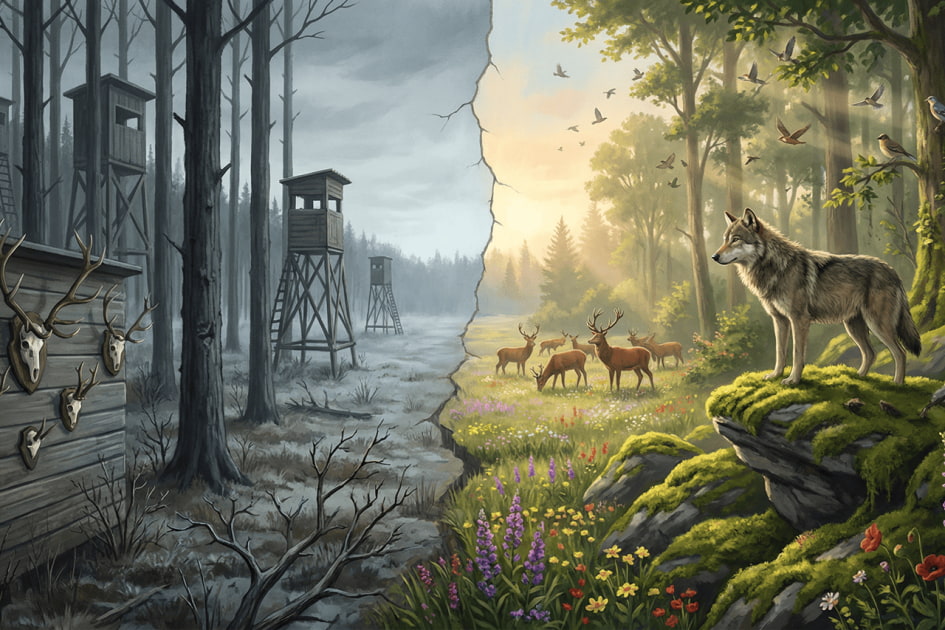
The position of IG Wild beim Wild: IG Wild beim Wild rejects recreational hunting. Our model is the canton of Geneva, which has managed without recreational hunting since 1974: without hunting seasons, without hunting dogs, without driven hunts, without high seats, without the animal cruelty and crime that go hand in hand with hunting season elsewhere. What has worked there for over fifty years disproves every position paper by JagdSchweiz. An association that bases its policy on claims it refutes in its own documents is not a professional organisation, but a factory for misinformation.