Animal Welfare Criticism of Sechseläuten
Shortly before the Böögg burning in Heiden (AR) on 22 June, the Foundation for the Animal in Law and the Zurich Animal Protection Society publish an animal welfare report on the use of horses at Sechseläuten. Since 2015, they have been monitoring the event critically. After six joint reports with suggestions for improvements to the welfare of the horses, the two organisations conclude that the guilds lack the will to address the animal welfare deficiencies.

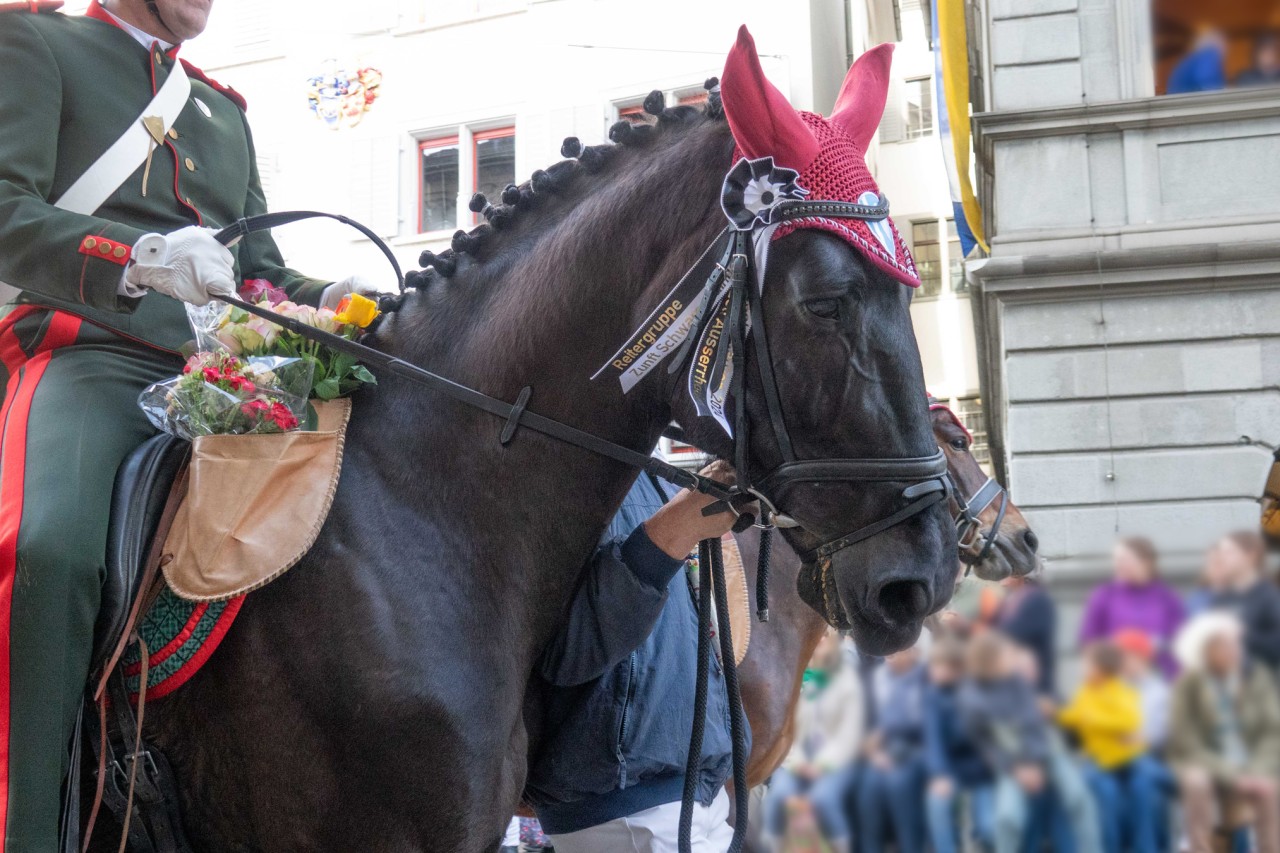
In spring 2024, the Foundation for the Animal in Law (TIR) and the Zurich Animal Protection Society (ZT) once again attended Sechseläuten with four observation teams to document the treatment of riding and carriage horses as well as signs of stress placed upon them.
For the first time, the animal welfare report compiled below is now also being made public.
Many horses signal fear, pain and stress
As in previous years, clear signs of stress and being overwhelmed were documented with photographs and video recordings in numerous horses at several locations. Sudden noise (drums and banging), threatening crowding and stimuli (umbrellas, waving flags), unfamiliar people and unaccustomed ambient sounds caused many horses to become fearful (e.g. attempts to flee, whites of eyes visible). The two organisations further criticise the painful overbending of horses with a forcibly tight neck position (hyperflexion, “rollkur”), which is expressly prohibited under the Animal Welfare Ordinance, as well as incorrectly or too tightly buckled riding halters and the use of harshly acting bits such as curb bits. These quickly lead to painful effects in the horse's mouth when rider experience is lacking, something that was observed repeatedly.
Sedated horses illustrate the problem
According to statements by the Central Committee of the Guilds of Zurich (ZZZ), around half of the horses at Sechseläuten are sedated with medication. Many of the horses are rented animals that have no established relationship with their riders. Furthermore, many animals are insufficiently trained for the sensory stimuli and noise levels present at Sechseläuten. From an animal welfare perspective, the matter is clear: horses that cannot participate in the event without sedation must remain in the stable. A selection process is needed that permits only suitable, well-prepared horses and riders. The Swiss Council and Observatory of the Equine Industry (COFICHEV) also recommends that, at public events, only specifically selected horses and only stable human-horse pairs be used. At sporting events, the administration of any medication is expressly prohibited, whereas at cultural events it is not. This is deeply concerning, particularly since sedation impairs the sure-footedness of horses, thereby increasing the risk of danger to both humans and animals. In addition, painful swelling of the penis and contrary side effects such as excessive sensitivity to noise and rapid movement may occur.
Recommendations Are Not Enough
It is encouraging that the ZZZ and its currently serving ZZZ riding director are genuinely open to animal welfare criticism and have introduced improvements over the years. The riding certificate has been declared mandatory, veterinary care in the waiting area before the parade has been strengthened, and watering of the horses has been introduced. In addition, the ZZZ riding director has tightened the guidelines for the protection of humans and animals. While this is commendable, these remain merely recommendations. As long as the ZZZ has neither the means to monitor compliance nor to impose sanctions, its capacity to improve the animal welfare situation at Sechseläuten remains limited.
Unwillingness, Not Ignorance
The responsibility for compliance with animal welfare regulations lies primarily with the individual guilds that bring horses along. In their detailed observation reports, the two organizations have consistently documented animal welfare deficiencies and attributed them to the respective guild. These reports were made available to the ZZZ and the individual guilds. Yet most guilds appear resistant to advice: Over several years, the same animal welfare deficiencies — often the very same individuals, horses, and teams — were criticized. The two organizations are therefore now going public and explain: “The facts and the demands are on the table; it is now up to the individual guilds to act.”
Vision of a Sechseläuten free from animal suffering
The two animal welfare organizations make clear that rough treatment of horses has no place in today's world. “From a legal perspective, the use of painful aids, rough handling of horses, as well as hyperflexion and sedation must be clearly classified as relevant to animal welfare,” says Christine Künzli (TIR). Nadja Brodmann (ZT) adds: “Such treatment of horses is no longer appropriate for our times. Growing societal criticism is therefore justified. The guilds must make greater efforts for animal welfare if horses are to remain part of Sechseläuten in the future.” At the Fasnacht in Stans, for example, horse-drawn carriages have been replaced by “electric carriages” since 2020 — a gain for the animals and for public safety. The two organizations therefore call for strict inspection of every horse and a selection process for the participation of riding and carriage horses, as well as the exclusion of offending individuals. This will massively reduce the number of horses, but will significantly increase the quality and enjoyment of Sechseläuten for the public.
Further information