200 dead foxes and badgers: Recreational hunting in Austria
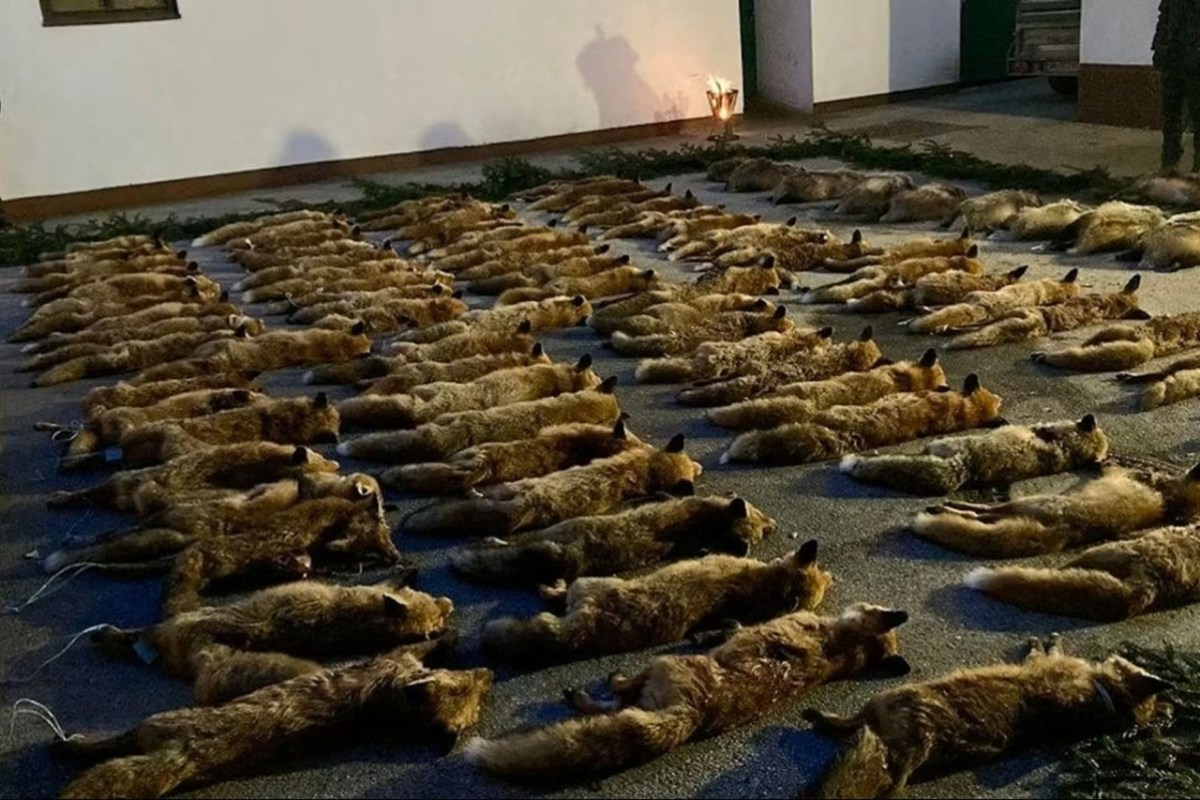
Nearly 200 dead foxes, badgers and martens – spread out on asphalt, carted up in wheelbarrows, photographed and celebrated. This is how the 'bag presentation' looked in early March 2026 after a drive hunt in Uttendorf, Salzburg. Many of the killed females were already pregnant at this time. Unborn young died with them.

«In the old den»
What the recreational hunting lobby calls 'final honor' and 'reverence,' animal welfare advocates call by its name: a scientifically disproven massacre with political backing and an image that the recreational hunting lobby would actually prefer not to see in public.
What happened in Uttendorf
The incident occurred shortly after the beginning of the closed season on March 1, 2026. The recreational hunting community of the Braunau am Inn district jointly presented the bag from several weeks of recreational hunting. 'Jagd Österreich' Vice President Lutz Molter defended the action to media as 'monitoring' and emphasized that normally such a bag presentation takes place on a meadow, as if the location were the actual problem.
VGT Chairman DDr. Martin Balluch put it succinctly:
How can one hate these animals so much that one kills them with pleasure and joy?
The question remains unanswered, along with the demand for fundamental rethinking in Austrian hunting policy.
What science says and what recreational hunters claim
The fox tapeworm argument is the classic hunting justification: It does not withstand scientific scrutiny. Where foxes have not been hunted for decades, in Canton Geneva, in Luxembourg, in the city of Vienna, neither disease outbreaks nor measurable deterioration in ground-nesting birds have been documented. On the contrary: Intensive recreational fox hunting demonstrably leads to younger, immunocompromised populations with higher potential for disease transmission (Comte et al. 2017; Ewald & Eckert 1993; Rushton et al. 2006). As the fox hunting analysis by wildbeimwild.com shows, the same lobby arguments are used unchanged in Switzerland, Austria and Germany, despite clear evidence to the contrary.
The ground-nesting bird argument: The alleged protective function for partridges, lapwings and skylarks also does not hold up. The populations of these species are not declining because of foxes, but because of habitat loss due to intensive agriculture. Shooting foxes does not save skylarks. It simply shoots a fox.
The badger enjoys protection under Annex III of the Bern Convention: Hunting is only permissible as long as the population is not endangered. Austria's badger population recovered only slowly after the widespread den gassing of the 1970s for rabies control. Mass killing as in Uttendorf directly contradicts this conservation spirit and the obligations Austria has entered into internationally.
Tradition as protective claim
'Tradition' is the most frequently used argument of the recreational hunting lobby when factual justifications are lacking. That this tradition is celebrated in 2026 on an asphalt parking lot with wheelbarrows and mobile phone pictures shows how far the ritual has removed itself from any ecological context.
Opposite to this stands the legal reality: Austrian animal welfare law requires a 'reasonable cause' for killing animals. According to current scientific knowledge, this does not exist for predator hunting. Tradition alone is not a reasonable cause, as courts have already clarified in other areas.
Austria's structural problem
Uttendorf is not an isolated case, it is a symptom of a sick system. Austria lacks, unlike the city of Vienna or Luxembourg, coherent, science-based regulation of predator hunting. The Austrian Animal Protection Association documents that under current hunting law, even domestic animals may be shot as soon as they move more than 300 meters from the residence.
A similar control failure is also evident in big game shootings: As wildbeimwild.com recently reported, a recreational hunter in St. Wolfgang shot a stag during the closed season, a case that stands as an example of a structural enforcement deficit in Austrian hunting administration. Control effectively does not take place. Consequences do not either.
What is needed now
Animal welfare organizations demand a ban on recreational hunting of small predators. A demand that has been systematically ignored in state hunting legislation for years. What is missing is political courage: a science-based moratorium on recreational predator hunting, as Vienna, Geneva and Luxembourg have long demonstrated.
Those who want to understand how deeply the problem is anchored in hunting structures will find in our dossier 'Hunting in Switzerland: Numbers, Systems and the End of a Narrative' a fact-based analysis. The mechanisms are the same in Austria.
Uttendorf will return. As long as hunting laws are co-written by lobbies and 'tradition' serves as a free pass, it's only a matter of time.
Dossiers: Fox in Switzerland: Most hunted predator without a lobby | Fox hunting without facts: How JagdSchweiz invents problems
Sources:
- Comte, S. et al. (2017): Echinococcus multilocularis management by fox culling: An inappropriate paradigm, Preventive Veterinary Medicine, 147, 178–185.
- Ewald, D. & Eckert, J. (1993): Distribution and frequency of E. multilocularis in red foxes in Switzerland, Zeitschrift für Jagdwissenschaften.
- Rushton, S. P. et al. (2006): Effects of Culling Fox Populations at the Landscape Scale, Journal of Wildlife Management, 70(4), 1102–1110.
More on the subject of recreational hunting: In our dossiers on the criticism of recreational hunting gather fact-checks, analyses and background reports. The scientific evidence is presented in the overview Studies on the Effects of Recreational Hunting.
The position of IG Wild beim Wild: IG Wild beim Wild rejects recreational hunting. Our model is the canton of Geneva, which has managed without recreational hunting since 1974: without hunting seasons, without hunting dogs, without driven hunts, without high seats, without the animal cruelty and crime that go hand in hand with hunting season elsewhere. What has worked there for over fifty years disproves every position paper by JagdSchweiz. An association that bases its policy on claims it refutes in its own documents is not a professional organisation, but a factory for misinformation.
Support our work
With your donation you help protect animals and give voice to their concerns.
Donate now →