Smiling Next to the Carcass
What hobby hunters' photos with dead wildlife reveal about us as a society.

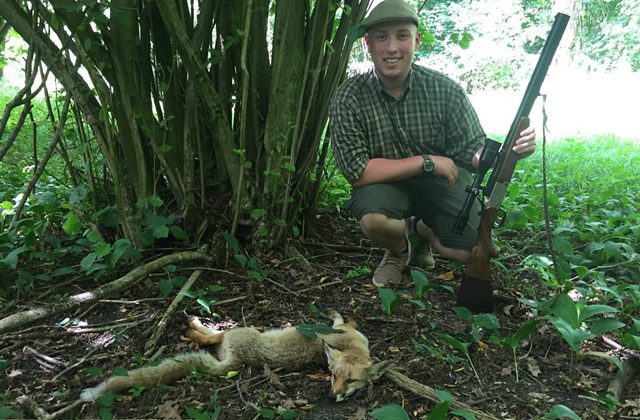
These are images that instinctively shock many people: a hobby hunter, grinning broadly, hand buried in bloody fur, boot planted on the body of an animal, with a neatly arranged rifle beside them.
For some, this is “tradition” and “hunting honour.” For others, it looks as though someone has arranged a selfie with a victim of violence purely to boast.
The question is obvious: what does it say about a person who has themselves photographed alongside a killed wild animal — and what does it say about a society that considers such images normal?
When the Dead Become a Backdrop
In almost every culture, there are unwritten rules governing how we treat the dead. One is quiet, respectful, restrained. No one would think of positioning themselves next to their deceased grandfather in an open coffin, laughing, for Instagram.
This is precisely the discomfort that strikes many people when they see trophy photos from recreational hunting.
The dynamic is similar in both cases:
- A living being was killed.
- Its body is staged for display.
- The perpetrator presents themselves as the victor.
The crucial difference: in the case of wild animals, this staging is not only legal — in parts of the hunting community it is explicitly expected and celebrated. Whereas a police officer or soldier who poses grinning alongside people they have killed would rightly be regarded as unconscionable and dangerous, the hobby hunter with their “bag” is considered by many to be “sportsmanlike” and “successful.”
Power, Identity, and the Image of the Victor
Trophy photos are more than private mementos. They are messages. Anyone who poses with a dead animal is always communicating:
I have conquered this living being. I am stronger. I have prevailed.
The image reinforces one's own identity. The hobby hunter presents himself as master over life and death, as someone who “has what it takes.” At a time when traditional male role models are being called into question, recreational hunting offers many a clear stage: here there are hierarchies, here nothing is debated, here decisions are made.
The dead animal serves as both backdrop and proof. The romantic hunt with spear and campfire is history. The modern hobby hunter operates efficiently — the wild animal is not supposed to have a chance to miss the appointment.
Useful tools include, for example:
- Telescopic sights that outperform many an amateur astronomer.
- Night-vision devices, thermal imaging cameras, decoy-call apps, GPS collars, wildlife cameras.
- Off-road vehicles that look as though they are headed to war — or at least to the next off-road commercial.
And yet, in the end, there is still talk of “fair hunting” and “connection with nature.” Fair, in this context, means: one side has everything, the other has fur.
Selective empathy and the language of hunting
Psychologically, a mechanism that experts call selective empathy can be observed in such images. One and the same person can idolize their dog and have tears in their eyes when it suffers, while the deer in the forest is reduced to a “piece,” a “bag,” or a “stock.”
The language reveals a great deal:
- Wild boar, fox, or deer become “cause of damage.”
- Kill numbers are called “bag statistics.”
- The killed animal becomes a “trophy.”
When a living being is linguistically reduced to an object, it becomes easier to switch off empathy. This is no coincidence, but a psychological defense mechanism. Those who want to — or must — kill cannot afford to engage too deeply with the victim’s perspective. The camera then becomes not only a documentation tool, but also a machine for creating distance.
Recognition within the bubble
In the parallel world of hunting, trophy images function like a currency. They bring:
- Recognition within the hunting group
- Status (“Not everyone shoots a specimen like that”)
- “Waidmannsheil” in forums and chat groups
Where applause awaits, shame rarely develops. Those socialized within this bubble learn early on: it is not only permitted to stage oneself with carcasses — it is even something to be proud of.
The outside perspective is a different one. For large parts of the population, the aestheticization of the dead animal has come to seem strange, even repulsive. The gap between the internal moral code of hunting and the general shift in values is growing. Trophy photos are a visible symptom of this rift.
The silent training in desensitization
Those who kill animals must at least situationally suppress their empathy. That is part of the craft of hobby hunting. It becomes critical when this suppression turns into a habit, into an attitude.
The sequence is usually similar:
- Aim at the target
- Fire the shot
- Ignore or downplay the animal's suffering
- Arrange the body
- Pose
This sequence is not only technical, but also emotional. It trains distance. Those who repeatedly learn to block out suffering become hardened. This is not a law of nature, but it is a risk.
It becomes particularly problematic when children are drawn into this practice at an early age. They learn: suffering is incidental, what matters is the kill and the praise of adults. Whether this is a form of character-building that an empathetic society should embrace is, at the very least, questionable.
The double standards of our morality
Let us mentally place the trophy photo from hobby hunting into a different context:
- A soldier, smiling alongside killed prisoners.
- A police officer, posing with shot civilians.
- An animal abuser, photographing themselves with deliberately injured pets.
In all of these cases, the outrage would be enormous. There would be criminal proceedings, disciplinary measures, and psychological assessments.
Why? Because in the case of humans and pets, we intuitively recognize that they are individuals with a claim to respect. Those who adorn themselves with their death are regarded not merely as tasteless, but as morally deeply problematic.
With wild animals, it is often different. Here, the same pattern still appears “normal,” “traditional,” or even “romantic” to many. The question is whether this is an expression of a healthy tradition or of a blind spot in our morality.
A legal perspective: the dignity of animals and the protection of children
The Swiss legal system protects not only “useful” animals. The Animal Welfare Act expressly recognizes the dignity of the animal. It acknowledges the intrinsic value of the animal, which must be respected.
This dignity is violated not only when an animal must endure pain or suffering, but also when it is degraded or instrumentalized purely as an object for self-promotion. Trophy images that turn the killed animal into a backdrop for one's own triumph touch precisely this domain: the body serves as a prop so that the human can stage themselves as the victor.
Children as an Audience: Protection from Violence Against Animals
Under international law, the situation is clearer than many realize. The UN Convention on the Rights of the Child protects children from physical and psychological violence. The responsible committee reaffirmed in 2023 that children must also be protected from violence inflicted upon animals that they witness or consume as media content.
States such as Switzerland therefore bear a clear duty of protection: they must shield children from harmful experiences of violence. This includes exposure to real violence against animals.
Article 135 of the Criminal Code on depictions of violence pursues precisely this objective. It is intended in particular to protect minors from cruel or apparently cruel scenes of violence that can cause desensitization, psychological distress, or anxiety.
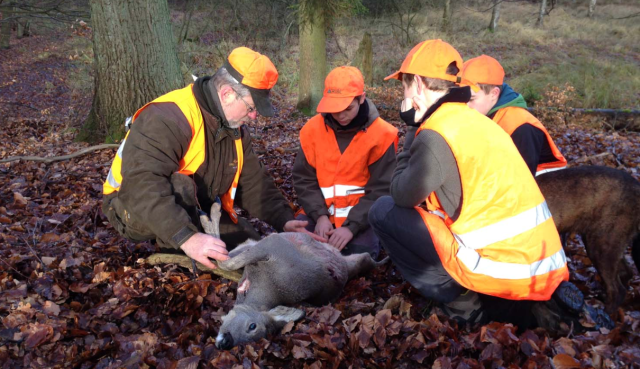
The constitutional protection of children and young people is additionally enshrined in Article 11 of the Federal Constitution. It obliges the Confederation and the cantons to protect and promote the welfare of children to a special degree. In light of these norms, it seems contradictory that brutal hunting and trophy images depicting real violence against real living beings circulate largely unregulated online, while youth protection standards for film, television, and video games are continuously tightened.
Children as Extras: Personality Rights and the Right to One's Own Image
The situation becomes even more serious when children appear not merely as passive spectators but as extras in such staged killings.
When minors appear on club websites or social media with blood-smeared hands and dead animals in their arms, this is not merely a matter of taste. Children have a right to their own image and a right of personality that protects them from degrading depictions. They cannot appreciate what it means to be linked for life to such scenes on the internet because their parents or a club made that decision for them.
It is difficult to justify using children of this age as decoration in images of violence whose purpose is to celebrate hunting success and the power to kill.
Assessment from the perspective of IG Wild beim Wild
From the perspective of IG Wild beim Wild, trophy photos posted online are anything but harmless hunting folklore. Association websites and social media are used daily by children and young people, usually without age verification or warning notices.
Those who, in this environment, stage bloody images of killed animals as personal triumphs and actively solicit further submissions are, in the view of IG Wild beim Wild, systematically accepting the following risks:
- Desensitisation towards violence against animals
- Damage to children's capacity for empathy
- Normalisation of an approach to wildlife that degrades animals to objects of amusement, power and prestige
The legal framework concerning the dignity of animals, children's rights and the protection of minors makes clear: this is not merely a matter of taste, but of fundamental values and duties of protection.
What research shows about trophy photographs
Society's rejection of trophy photographs is not a gut-feeling assertion. A representative study published in 2024 on the perception of so-called trophy photographs in social media by the non-hunting Generation Z surveyed 1,050 adults online.
The findings:
- Between 96.1 and 98.5 percent of evaluations of the trophy photographs shown were negative; only 1.5 to 3.9 percent were positive.
- 69 percent of respondents stated that they fundamentally did not wish to see trophy photographs on social networks.
- 73.3 percent supported the labelling of such images with a warning notice.
- Spontaneous terms used by participants included “contempt”, “trophy-obsessed people”, “lacking empathy” and “violence”.
These results demonstrate that the public display of trophy photographs causes lasting damage to the image of hobby hunting. Those who believe that carcass photos strengthen public acceptance of hunting achieve, according to this data, precisely the opposite.
(Source: Christine Fischer, «Representative study: Trophy photographs on social media harm the reputation of hunting!», Blog HIRSCH&CO, 2 November 2024)
Time to change perspective
One need not pathologise every trophy photograph to recognise what it expresses. Such images reveal:
- a strong orientation towards dominance and control
- a willingness to blank out the suffering and fear of the animal
- a value system in which wildlife are primarily a resource and a status object
- a community that rewards precisely this kind of staging
Whether one finds this acceptable is ultimately a social decision. Those who criticize such images are not merely attacking individual hobby hunters, but an entire moral worldview.
Perhaps it is time to ask the simple question that children often pose with complete candor:
Why are you laughing when someone is dead?
This question exposes a great deal. It cuts through folklore, hunting romanticism, and technical jargon. It forces one to be honest: Is this really about conservation, population regulation, and responsibility, or is it ultimately about the thrill of killing and the satisfaction of standing before the camera as a victor?
A modern, empathetic society should not be content with the fact that the carcass in the image is “merely” a wild animal. Those who celebrate death always send a message about their own relationship to life and suffering.
The crucial question is: Do we want this very message to define our image of “tradition,” or is it time to bring this tradition to an end?
More on this in the dossier: Psychology of Hunting