Wind turbines cause exactly what they were meant to prevent
Wind farms are being expanded worldwide because they are a lucrative business for those involved. The justification used is the claim that CO2-free energy will prevent global warming. However, wind farms are doing exactly what they are supposed to prevent.

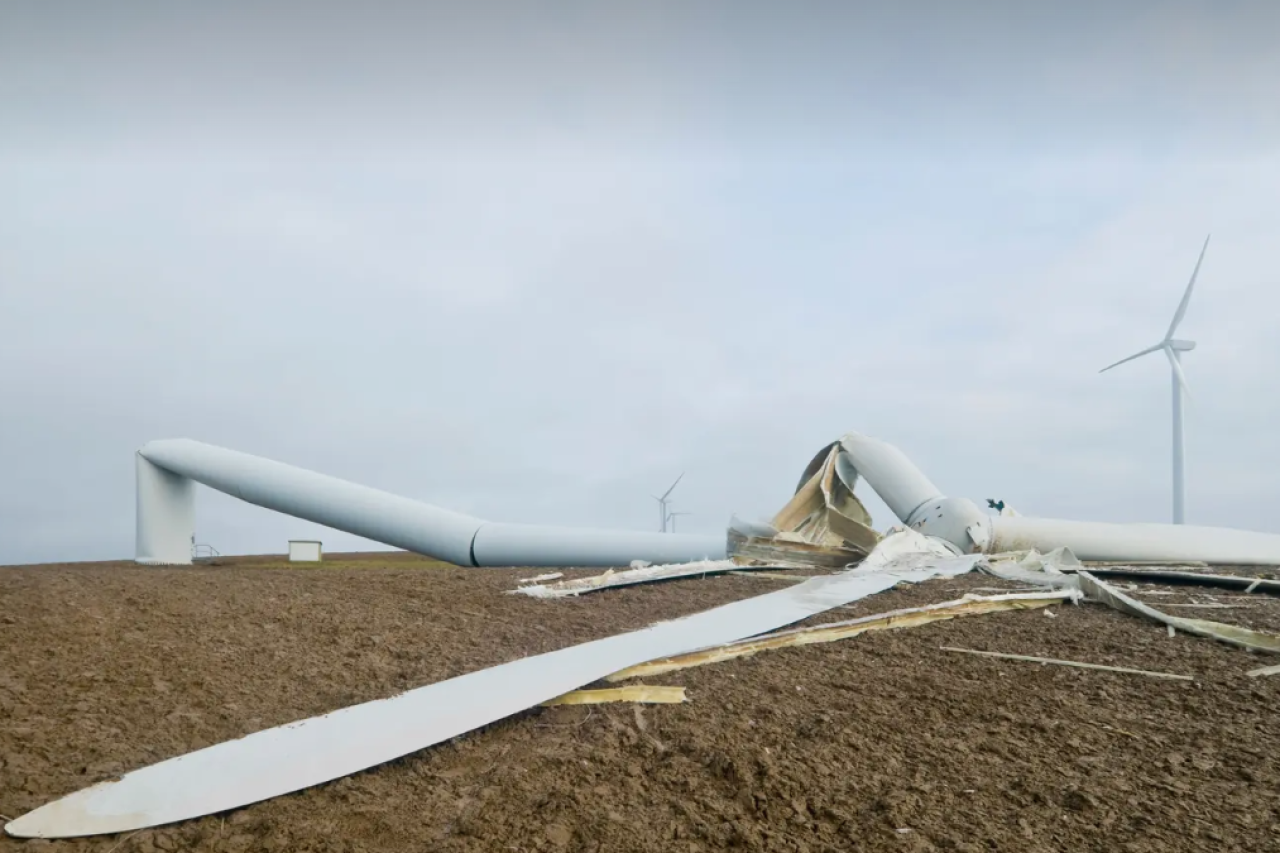
Scientists warn: The excessive use of wind power influences air currents in a region and leads to reduced precipitation.
There is a clear trend: when a country expands wind and solar energy extensively, there are often prolonged drought periods. In countries with little rainfall, such as Kenya, millions of people felt the consequences after the construction of the Turkana Wind Park in 2019. Four rainy seasons failed to materialise, and the current rainy season brought insufficient precipitation. Similar problems exist in Ethiopia and southern Somalia.
A study based on measurements in Texas also finds significant warming: the land surface temperature around wind farms in west-central Texas warmed by 0.72 degrees Celsius per decade during the study period compared to nearby regions without wind farms. The same can be observed with large solar installations.
Following the push for alternative energy sources, California is suffering from the worst droughts in living memory, accompanied by catastrophic fires that cannot be explained by natural fluctuations.
In Europe, particularly in northwestern, western, and southwestern Europe, drought and low precipitation have been causing problems for years. The soil remains dry, and extreme weather conditions recur repeatedly. In 2022, England experienced its warmest and sunniest days since weather records began. Accordingly, the annual average temperature exceeded 10 degrees Celsius for the first time. Notably, all four nations of the United Kingdom recorded temperature records in 2022. Temperatures in Germany are rising significantly faster than the global average. The global average temperature reached 15.1°C in 2024, standing 0.72°C above the 1991–2020 average. Many regions of the world recorded their warmest year on record. New annual records were reported in particular by the United States, Brazil, India, South Korea, and Japan. The climate crisis is intensifying worldwide.
The daily drumbeat of the buzzword “climate change” blinds even sharp minds to the fact that our experiment of large-scale artificial removal of wind currents from the atmosphere is disrupting the pressure equalization that is needed for the formation of low-pressure systems — without which rainfall ceases and all life is condemned to perish from thirst. Added to this is the fact that the dynamics of the North Atlantic wind systems, the foundation of our existential livelihoods, are also being affected. With unprecedented stubbornness, the coalition of politics, the EU Commission, and the international wind industry nevertheless demands ever more “green energy,” even as, in the course of this expansion, the color brown ironically dominates in an increasing number of countries and regions as a result of water scarcity.
The situation in Spain is becoming serious
In Spain and Portugal, the drought has already lasted three years, particularly in the south since 2015, and there are regional extreme rainfall events. Winter now brings hardly any rain, which is driving people to despair. Energy consultant Jürgen Weigl points out that the massive deployment of alternative energy sources is significantly altering our climate systems. In Catalonia, there has already been a 32-month-long drought. The effects are also being felt in other regions of Spain where many wind farms have been built. Nevertheless, the connection between the drought and the expansion of wind energy is barely discussed. Many seem to forget that wind energy is not infinite and that its use can influence air pressure conditions, leading to less rainfall.
The demand for “green energy” continues to grow louder despite the negative consequences, while water supplies in many regions suffer. There are more and more wind farms in Spain; in 2021 there were already over 27’000 megawatts. The expansion is set to increase substantially again in the coming years. Despite studies documenting the negative ecological impacts, there is little discussion about it.
According to the Spanish government, almost half of the country is affected by drought. For nearly one third of the territory, a drought emergency or drought warning is in effect. Croplands of more than 3.5 million hectares are said to have been lost. Throughout the entire northeast, water scarcity is a top-priority problem. Spain is the vegetable and fruit garden of Europe.
Turning a blind eye to the consequences is dangerous. Experienced scientists such as Gerhard Kramm warn that the extraction of wind energy reduces wind speeds and can cause temperatures to rise.
Ecological concerns
Wind turbines influence the regional climate by altering air temperatures and increasing atmospheric mixing. Studies show that wind power in large quantities can even contribute to global warming and cause temperatures to rise. Soil moisture is also significantly reduced by wind farms.
The operation of wind farms has measurable negative effects on wind, air temperature, soil surface temperature, land surface temperature, soil moisture and evapotranspiration. Wind farms fuel climate warming, which can be documented beyond doubt through satellite imagery. In China, new desert landscapes with altered climates have emerged in the vicinity of large wind farms as a result of their microclimate.
Wind power generates more CO₂ than no wind power. This initially seems illogical, but on closer inspection it makes sense. Behind every wind and solar industrial facility there must be a shadow power plant that runs continuously on standby and must be ready for use at any time. No conventional power plants can be decommissioned without causing a power outage, unless electricity is sourced from abroad (nuclear power, etc.). Added to this is the high energy expenditure (CO₂) involved in the production and disposal of wind and solar industrial installations.
In Germany, the negative consequences are already clearly apparent. Electricity prices in Germany are among the highest in Europe, as a high share of renewable energy in the energy mix increases overall system costs (due to backup, storage, and so forth). And to ensure security of supply, weather-independent energy sources are required, which is why coal and gas still account for a large proportion of the electricity mix, particularly in winter.
Many people living in the vicinity of these rotating giants are falling ill. The fine dust abrasion from wind turbines releases enormous quantities of microplastics and carbon fibres that contaminate air, soil and groundwater. Once nearby drinking water sources have been contaminated with carbon fibres, they must be shut down and will remain contaminated for decades. Neither the abrasion from wind turbines can be prevented, nor can the contamination of soil and groundwater be reversed. The taller and larger the installations become, the more dangerous they are.
In the haste and excitement of our transition to alternative energies, we must not forget that environmental destruction takes many forms — and we must learn to look beyond the short-term gains of clean energy if we do not wish to replace one form of environmental destruction with another.
The vast majority of solar and wind energy is produced, maintained, and disposed of in a highly CO₂-intensive, climate-damaging manner. Added to this is the immense energy expenditure required for raw material extraction and the production of the installations, as well as the multiple transport stages in the supply chains for raw materials and semi-finished products across several continents. Resources in third-world countries are being exploited in a colonialist fashion in order to give a green veneer to operations here. Copper mining produces the largest quantities of toxic waste on this planet, as is rightly noted in the NZZ. The technologies of the energy transition are anything but green. The hazardous materials and chemicals generated during the construction of installations alone — such as lead, arsenic, mercury, and cadmium — cannot be recycled and cause lasting damage to the environment.
What is more environmentally and climate-friendly: wind and solar energy or nuclear power? Most people would naturally say alternative energies. That is wrong — at least when CO₂ emissions are also taken into account. Nuclear power plants perform better in this regard.
The well-known axiom “The flap of a butterfly's wings in the Amazon can trigger a tornado in Texas” is more than just a metaphor. This idea — that small changes in one part of the world can have far-reaching effects on the environment, climate, and weather conditions — plays a central role in discussions about ecological interactions.
Further articles
- Wildlife in Switzerland is contaminated with plastic
- Environmental impacts of wind turbines: The dangers of PFAS for wildlife
- Study on the influence of wind turbines on weather
- Offshore wind farms could pose significant risks to ecosystems, the economy, and human health
- The effects of wind farms on soil moisture and local climate
- Wind turbines cause precisely what they were supposed to prevent
- Solar module waste: The disposal problem
- The effects of wind turbines on wildlife and the debate around clean energy
- “Two new large nuclear power plants are sufficient for Switzerland”
- Wind power and marine fauna: No harmonious coexistence
- Scandalous secret contracts between wind energy promoters and Bernese municipalities