Wildlife Rest Zones: Showing Consideration for Wild Animals
During the winter months, wild animals need rest. Wildlife rest zones protect them from disturbances caused by recreational sports and recreational hunters.

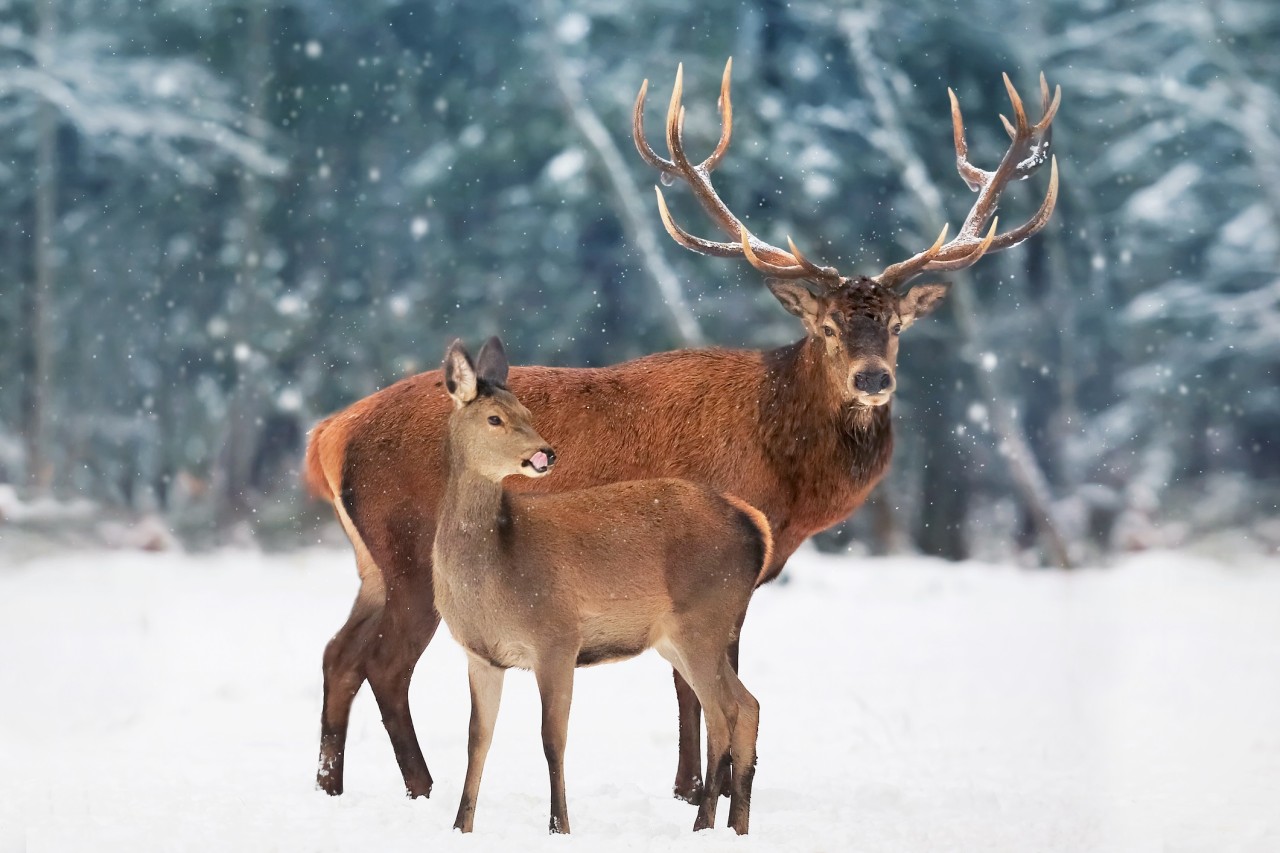
Animals that do not hibernate must cope during the winter months with cold temperatures, heavy snow, and scarce, nutrient-poor food.
This means they must conserve as much energy as possible in order to survive the winter. To do this, they employ various strategies: the most important of which is rest. To use as few vital reserves as possible, their heart rate and body temperature drop, and they remain for extended periods in sheltered spots, well insulated by their thick winter coat or plumage.
If a wild animal is startled by athletes or a dog, its heart rate accelerates. The resulting energy loss draws on fat reserves. If an animal is forced to flee repeatedly throughout the winter, the wild animal can become more susceptible to disease, experience reduced reproductive success, or may even die from exhaustion.
Some wild animals can become habituated to disturbances, for example along a marked, well-frequented trail. This occurs when disturbances are of a similar nature, consistent, and relatively frequent. Such disturbances are more predictable for animals, and once habituated, they are less likely to flee or experience stress.
The opposite of this is so-called sensitisation. It occurs when wild animals are repeatedly stressed in unpredictable ways. Recreational athletes who move quickly are particularly likely to trigger stronger reactions. Wild animals flee over increasingly greater distances or abandon certain areas altogether. Especially critical are unusual, unpredictable routes, surprise encounters, approaches from above, situations involving dogs, and loud noise. In valley areas, one should avoid zones with shrubs, windbreak hedges, or woodland; in mountain areas, also exposed patches of bare ground that are important for feeding.
Winter rest zones
Winter rest zones are areas where recreational activities are restricted through entry bans or designated path requirements, in order to protect wildlife. In this way, wild animals are protected — particularly during the winter months — from disturbances and are able to meet their greater need for rest.
Winter rest zones may not be entered during the periods from 15 December to 15 April (mountain areas) and 1 January to 31 March (valley slopes facing the Rhine), except via designated corridors. By establishing these corridors, the frequently used winter hiking trails, ski routes, and snowshoe routes remain accessible.
Winter rest zones are monitored by the wildlife warden service, the Office for the Environment with the support of the police, and also by hunting wardens. Violations of the winter rest zone ordinance can result in substantial fines.
Maps and further information
Anyone intending to venture off the official winter routes into unspoiled areas must in any case observe the signage on site. It is best to plan such tours by studying the route online in advance. This, along with checking weather and avalanche forecasts, is part of the preparation for any ski or snowshoe tour. While out, one should avoid wildlife wherever possible and choose one's activity times so that animals are not disturbed during dawn and dusk. For descents or downhill sections of tours, the so-called “funnel principle” is also recommended — named after the funnel-shaped narrowing of the range of movement that is used with decreasing altitude during the descent, without disturbing wildlife.
Respect your boundaries: Four rules
The information campaign “Respect Your Boundaries,” well known in German-speaking regions, has formulated four appropriate rules of conduct for snow sports with consideration for nature:
Observe winter rest zones: They provide wildlife with retreat areas.
Stay on paths and marked routes: On regularly used routes, wildlife can become accustomed to people.
Avoid forest edges, windbreaks, and snow-free areas: These are places where wildlife like to gather.
Keep dogs on a leash: Wildlife flee from dogs running freely.
Information is available online at: www.wildruhezonen.ch and www.respektiere-deine-grenzen.ch
More on the subject of recreational hunting: In our dossiers on recreational hunting gather fact-checks, analyses and background reports. The scientific evidence is presented in the overview Studies on the Effects of Recreational Hunting.
The position of IG Wild beim Wild: IG Wild beim Wild rejects recreational hunting. Our model is the canton of Geneva, which has managed without recreational hunting since 1974: without hunting seasons, without hunting dogs, without driven hunts, without high seats, without the animal cruelty and crime that go hand in hand with hunting season elsewhere. What has worked there for over fifty years disproves every position paper by JagdSchweiz. An association that bases its policy on claims it refutes in its own documents is not a professional organisation, but a factory for misinformation.