Zurich: Wild Boar Enclosure Planned in Elgg
The recreational hunters had previously developed an identical project in cooperation with the cantonal hunting authority of Aargau and submitted it to the canton's forestry division. However, the canton of Aargau decided, for good reason, that it would not approve this project.


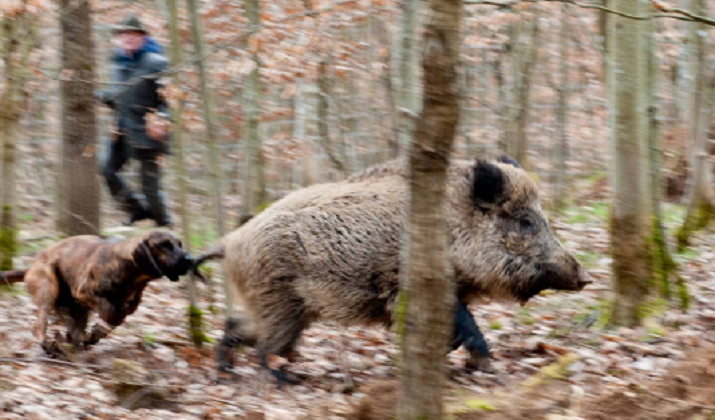
Hunting dogs used for wild boar hunting must now be specifically trained for this purpose.
This has been required by law since 2015. In Germany and Austria, this regulation has been in place for longer, and hunters can train with their animals in special training enclosures. This is now set to become possible in Switzerland as well — more specifically, in 8353 Elgg Heurüti.

All conditions are well-suited there, says Urs Philipp, head of the cantonal fisheries and hunting authority, speaking to the Landbote on 6 October 2017. Various cantons had been searched for suitable locations, but nowhere had things aligned as well as in Elgg in terms of transport links, topography, and land ownership.
The Wild Boar Guantanamo
The project envisions an enclosure of approximately 6.4 hectares in woodland, divided into four sections and housing wild boars. Specially trained enclosure keepers are responsible for the animals. “They must know the wild boars very well — the animals should practically eat out of their hands,” says Philipp. Only in this way can it be ensured that the animals can be caught if they fall ill and that escape reactions are avoided. Daily contact with humans will take place through feeding, fence checks, and training.

According to Philipp, the acclimatisation enclosure has been in planning for some time. “A great many agencies are involved”, says Philipp. The project is currently undergoing consultation with various cantonal authorities.Since the area in Elgg lies outside the building zone, the canton must also Consent give. However, the most important point of contact is the municipality of Elgg, which owns the property. "If they do not agree, nothing will happen at all."
Municipality retains the final say
There are two aspects to examine, says Municipal President Christoph Ziegler: "First, we will of course review the project from a building law perspective, and second, we will assess the impact on neighbours and the environment." A noise assessment that was commissioned returned positive results: no one will be disturbed. "The area is quite remote," says Ziegler. No negative reactions have been received from the public so far either. According to the concept, the canton must notify residents on a priority basis.
Once the canton has granted its approvals, the project will be placed on the agenda of the Elgg municipal council. "We reserve the right to set the framework conditions," says Ziegler. Should operations prove too noisy, they might intervene regarding opening hours or the number of training sessions. "We have a certain degree of leverage." The traffic situation in Heurüti — the hamlet is located around two kilometres from the village of Elgg — will also be monitored. The operating licence will ultimately be issued by the Veterinary Office.




The costs of the project have not yet been finalised, says Philipp. The most expensive element will likely be the fencing of the enclosure; he estimates between 150,000 and 200,000 francs. The Hunting Administrators' Conference has pledged a contribution of 120,000 francs. No costs are to be left with Zurich. Since this is a national project, other cantons are also expected to contribute.
Five to ten enclosure keepers
Farmer Jonas Küpfer will be responsible for managing the facility; his farm in Heurüti borders the area.

He is a recreational hunter himself and has completed the necessary training. Parking spaces and a toilet are available at the farm. The final decision will likely be made before the end of the year, says Philipp. However, there is still a great deal of work to be done before the facility opens next year.
Animal Welfare versus Recreational Hunters
From an animal welfare perspective, the use of wild boar enclosures and artificial earth facilities must be clearly rejected. These training methods involve living, hand-tame animals that have been taken from the wild or from zoos, spend their lives in an enclosure, and are killed once they are no longer useful or become unsuitable.
Animals in such facilities experience mortal fear and stress anew with every training session. What is meant by «species-appropriate care and animal welfare» in this context is something one would rather not imagine. In addition to the risk of injury from a cornered boar, there is also a considerable danger during wild boar hunts and training sessions in wild boar enclosures that dogs may become infected with the deadly Aujeszky’s disease virus (pseudorabies)! In 2016, new cases of this epidemic were reported in Germany. Wild boar enclosures really only attract trouble and problems.
Experience has shown that severe injuries to animals during work in the enclosure — analogous to artificial earth facilities used with foxes — occur time and again, or at the very latest during the hunt itself.
Those responsible in the municipality of Elgg would be well advised to properly consult experts such as wildlife biologists — rather than recreational hunters — for information. This applies in particular to the matter of foxes. Wherever foxes are heavily hunted, the greatest problems with overpopulation, disease, damage, and so on also arise. Just because recreational hunters claim something does not mean it is true or based on scientific fact. Nowhere is there more lying, scheming, trickery, cover-ups, and manipulation than among recreational hunters.
We have observed that vixen in areas where animals are hunted give birth to more young. While culling can provide localised relief, the vacated territories are quickly reoccupied. Nature regulates itself.
– Game Warden Fabian Kern City of Zurich
Upon closer analysis, the majority of recreational hunters simply want to indulge a perverse and bloody hobby at the expense of animal welfare and the general public. Titles such as «Head of a Cantonal Fisheries and Hunting Authority», «Hunting and Fisheries Administration Conference» or «Competence Group» change nothing about this. These recreational hunters are merely trying to preserve and promote what they and their ilk do best: terrorizing wildlife.
Contrary to the claim made by Urs Philipp, Head of the Cantonal Fisheries and Hunting Authority in the Canton of Zurich, («That he had consulted with local animal welfare organizations and had already found a veterinarian for the facility»),the Zurich Animal Protection organization does not support the facility either!
The Zurich Animal Protection organization rejects the facility because, firstly,stress and risk of injuryfor wild boar and dogs is involved, and secondly, because animal welfare advocates fundamentally consider the approach of such facilities to be wrong: Animal welfare advocates are convinced that driven/battue hunts causesignificantly more animal suffering due to the many missed shotsthan targeted kills through stalking hunts, and thirdly, such facilities areavailable in neighboring countries.
The fake news specialist and recreational hunter Simon Meier, from the Wildtier Schweiz association, also notoriously peddles untruths. The opposite of what he claims in public would be correct in this case: «Even the Swiss Animal Protection organization supports the training of hunting dogs on wild boar for animal welfare reasons.»Wrong!
Many of these recreational hunters have a level of knowledge about wildlife biology, animal welfare, ethics, ecology, etc. comparable to that of a special needs student at graduation.
What hundreds of recreational hunters in the Canton of Geneva used to do poorly in the past is today handled far more effectively by 3 full-time positions with a dozen wildlife wardens.
Wild boar regulate their own population — at least when they move around in intact family groups.
The recreational hunters themselves are responsible for the explosive increase in the wild boar population. The main cause of an alleged overpopulation and damage is always also attributable to misguided hunting practices, such as the recreational hunters’ practice of shooting lead sows.Recreational hunters have caused enough problems in the Canton of Zurich and have not solved a single one!
The Swiss Animal Protection organization (STS) recently published a position paper, which by the Training and Use of Hunting Dogs in Switzerland is to be maintained. Namely, absolutely nothing (except for tracking wounded game).
When confronted with dogs in the enclosure, the pigs are, according to a study under similarly severe stress as when they are forcibly separated from their sounder or their mother. They are exposed to this stress repeatedly and anew. Furthermore, accidents cannot be entirely avoided — the dogs then face a serious risk of not merely walking away with a scratch, but of being (fatally) injured! The Federal Office for the Environment FOEN therefore stipulates the presence of a veterinarian and «first aid equipment» at every training day)!
Background information on the study: Research into the stress levels of wild boar during dog training for behavioral adaptation in wild boar enclosures.
Prof. Dr. Hans Wunderlich, who is mentioned several times in the paper and co-manages the enclosure in Zehdenick, is a hunter, hunting dog breeder, and until recently was only! the animal welfare officer of the hunting dog breeders' association. He is a strict advocate of hunting dog training with live animals (duck, fox, etc.) and was later dismissed dishonorably from the hunting association, partly because of this work.
Dr. Ralf Erler, the author of the dissertation on hunting dog training in wild boar enclosures, is a veterinarian in the practice of this Prof. Dr. Hans Wunderlich. One would have to be naive not to see the conflict of interest. It is therefore unsurprising that the dissertation came out in favor of wild boar enclosures and that this training method was given a superficial animal welfare «all-clear».
The Institute for Wildlife Research at the TiHo Hannover was and continues to be co-managed by hunters. Prof. Dr. Klaus Pohlmeyer, who led the institute until May 2008, was simultaneously a former chairman of the Jägerschaft Niedersachsen.
The «scientific study» was therefore conducted by recreational hunters for recreational hunters and is far from being classified as an independent and professional study.
In this respect, the Canton of Geneva, with its modern wildlife management using game wardens, is decades ahead. There, driven hunts and battue hunts with baying hunting dogs are simply not needed, although very many wild animals from the surrounding areas flee into the canton of Geneva and remain there when drive hunts similar to those in the canton of Zurich are carried out in France or the canton of Vaud. The population of Geneva would never approve of a wild boar enclosure in the canton.
The IG Wild beim Wild recently published a comprehensive article «Wild Boar Enclosures, No Thank You» on the subject of animal cruelty and will fight the project in Elgg.
The dubious recreational hunters can, as usual, just as easily have their hunting dogs trained in a neighboring country.
Experience from Germany (where there are at least 19 enclosures distributed throughout the country) also shows that even with wild boar enclosures, neither the agricultural «damage» nor the wild boar population can be sustainably reduced to the desired extent. To this day, there is no scientific evidence that hunting wild boars with dogs could achieve the goal of «regulation» (more) effectively — even if hunting associations and authorities repeatedly claim otherwise! There is absolutely no necessity to hunt wild boars specifically with abnormally behaving dogs whose behavior is further encouraged through training.
Wild boar enclosures promote cruel and barbaric drive and pushed hunts, and thus the worst possible meat quality, animal cruelty, dog abuse, and so on.
The actions of recreational hunters in wild boar enclosures and during hunts are diametrically opposed to Swiss animal welfare laws, e.g. Art. 26 and Art. 4.
A wild boar Guantanamo is an effective way to ruin a community’s reputation. The municipality of Hefenhofen in the canton of Thurgau currently serves as a prime example. When one hears the name Hefenhofen today, one inevitably thinks of animal abusers, animal cruelty, and the failure of the municipality, the canton, and the veterinary office.
The wild boar Guantanamo project in Elgg is completely at odds with the current landscape, given that in the near future the popular initiative «Wildlife wardens instead of hunters» will come to a vote in the canton of Zurich.
It would be best if the residents of Elgg were to file an objection against this project, should the canton approve it at all. In municipal landscape protection zones, only facilities and structures that are operationally necessary and serve agricultural management are permitted.
Passion for hunting, however, is not a mandate of society or a legal right — nor can it be.
More on the subject of recreational hunting: In the dossier The Role and Criticism of Recreational Hunters we shed light on the training, power and self-image of recreational hunters. The scientific evidence is presented in the overview Studies on the Effects of Recreational Hunting.
The position of IG Wild beim Wild: IG Wild beim Wild rejects recreational hunting. Our model is the canton of Geneva, which has managed without recreational hunting since 1974: without hunting seasons, without hunting dogs, without driven hunts, without high seats, without the animal cruelty and crime that go hand in hand with hunting season elsewhere. What has worked there for over fifty years disproves every position paper by JagdSchweiz. An association that bases its policy on claims it refutes in its own documents is not a professional organisation, but a factory for misinformation.