Where Things Heat Up in Winter
In the fields, female hares are boxing with their prospective brown hare suitors to warm up for mating; in the forest, foxes are singing hoarse love songs to their beloved, and by February at the latest, even the shy wildcat is once again head over heels in love. The class of 2018 is being conceived right now across many species.

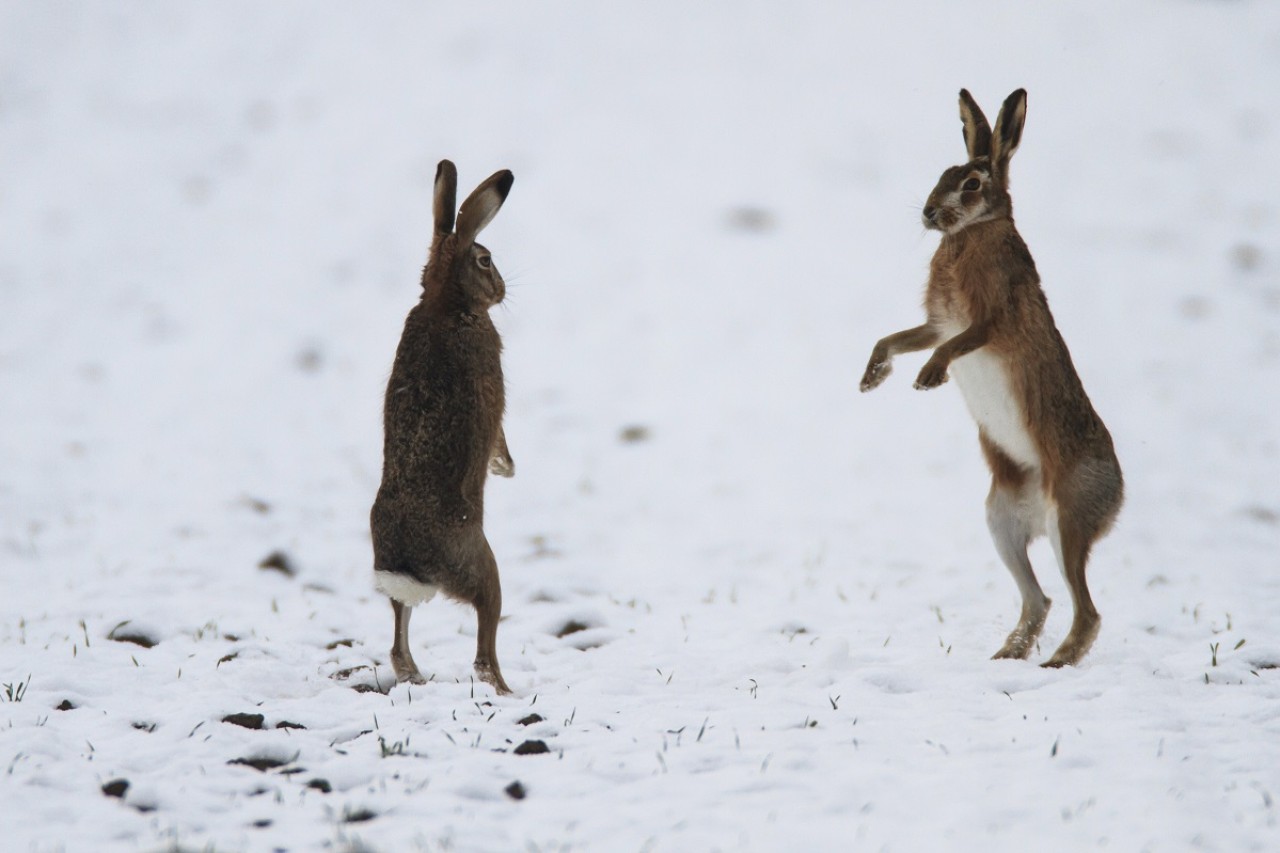
In the fields, female hares are boxing with their prospective brown hare suitors to warm up for mating; in the forest, foxes are singing hoarse love songs to their beloved, and by February at the latest, even the shy wildcat is once again head over heels in love. The class of 2018 is being conceived right now across many species.
Brown Hares: The Female Calls the Shots
When brown hares court, several does and bucks gather together in the field. During mating, the doe is firmly in charge. She chooses which bucks she mates with, testing their fitness through boxing matches. She then mates multiple times in quick succession, which is why her offspring can have different fathers. During the 40-day gestation period, a doe can become pregnant again. This means embryos at different stages of development can grow simultaneously in her womb — a phenomenon known as superfetation.
Wildcats: A Love Call in the Night
When wildcats court, the toms lure females with long, guttural meowing during their nightly wanderings. The love call during the mating season is impossible to miss. After mating, the pair immediately go their separate ways. In spring, the playful wildcat kittens are born, and “Mama Wildcat” must care for them entirely on her own. The father is long gone.
Wild Boar: Perfume Made from Urine
Among the wild boar in January, the focus is on reproduction. “Boars and sows are ready to mate throughout the year,” says Eva Goris, press spokesperson for the Deutsche Wildtier Stiftung, “but this is when the piglets are conceived.” The sows have no shortage of admirers: they are visited multiple times by the strongest boar in the territory. The suitor uses the typical wild boar perfume – his strongly scented urine – to attract attention. After a gestation period of approximately 115 days, up to ten piglets are then born in their farrowing nest.
Red Squirrels: Wild Chases Through the Trees
Red squirrels are not classic hibernators. Anyone observing these charming rodents now will either catch them on their way to their secret food caches or stumble upon the males in the middle of their courtship attempts. At the start of the mating season, squirrel behaviour can be quite playful. They chase each other – always up through the trees. Several males take part in the boisterous scramble. Their courtship of the female squirrels is not exactly charming: the female is often pursued and chased right up into the treetops. When she has had enough, a fight breaks out. The harassed female defends herself with aggressive calls and bites.

The mating season continues into February and is then repeated in late summer. After mating, the fun is over: the males are driven away, and raising the young is strictly the females' business. If she agrees to mate, running away is part of the foreplay. After a gestation period of 38 days, up to six young are born in the drey — the squirrel's nest. By then, the father has long since made himself scarce; raising the young is entirely the female's affair. The offspring are naked, blind, deaf, and weigh barely more than eight grams. The young nestlings are cosy in the drey. The nest is built from twigs and leaves, lined with moss and grass, and is nearly waterproof. The thick walls of the drey provide good insulation in winter. Squirrels maintain several dreys at once. One entrance always faces downward — this is essentially the front door to the nest. These hollow, spherical structures are typically placed in a fork of branches at a height of more than six metres. If you spot a squirrel outside its nest in this cold weather, it is either briefly interrupting its winter rest to feed — or it is out looking for a mate.
Beavers and Raccoons: Lifelong Loyalty and Speed Dating
Mr. Beaver is no one-night stand: he seeks a partner for life and remains faithful to her. The mating ritual takes place while swimming in shallow water — the cold water is no deterrent. “A beaver partnership can last up to 20 years,” says Eva Goris. At the end of the 100-day gestation period, an average of three young are born, which are nursed for two to three months. “After that, they can already swim and dive before long.”
With raccoons, HE really has to put in the effort. Like speed dating, potential partners meet at a gathering spot. SHE demands an intense courtship and then decides who gets to father her offspring. More about fascinating wildlife at wildbeimwild.com.