When Recreational Hunters See Red and Tear Apart a Cat
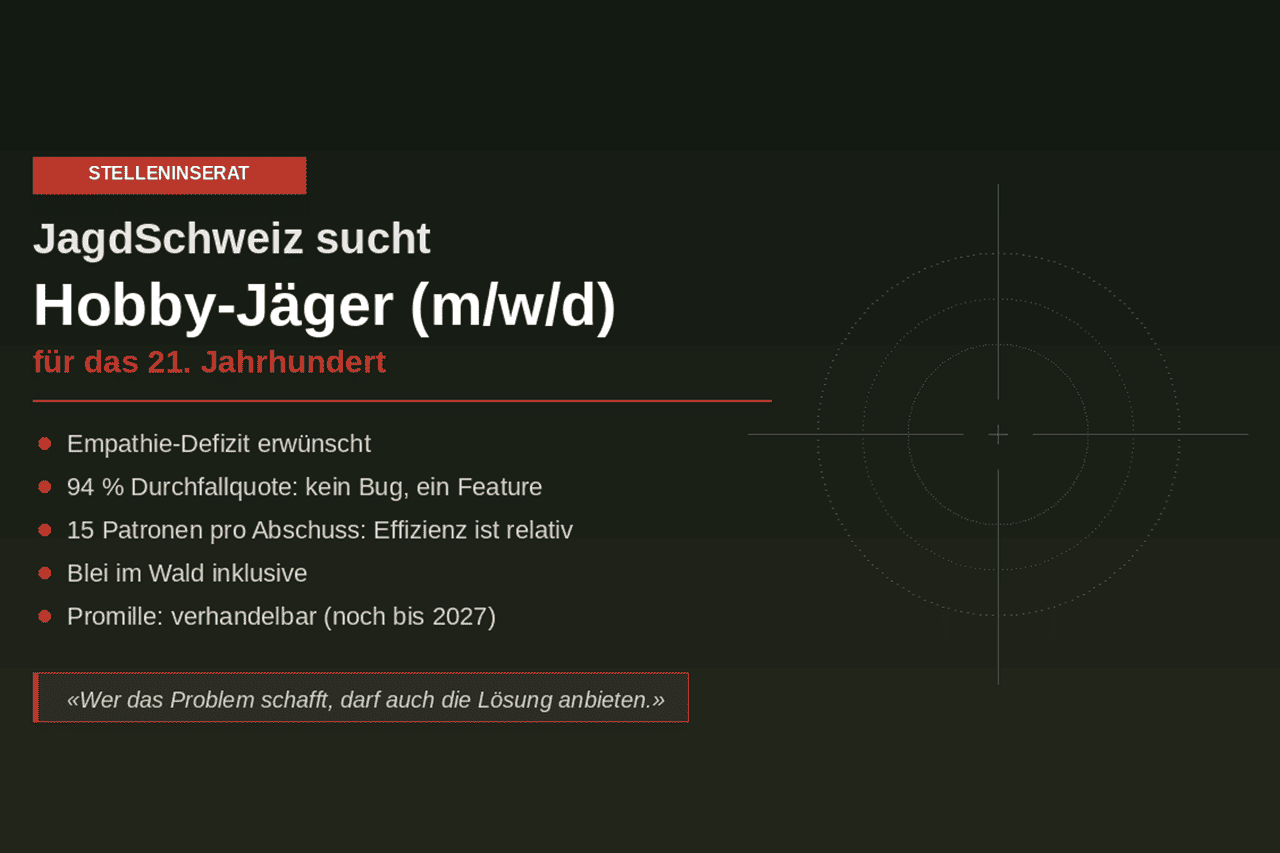
Recreational hunters are decent, fair, and comradely. Hunting has only a small part to do with shooting animals. Counting wildlife, rescuing fawns before mowing, installing roadside reflectors to prevent animals from being hit by vehicles, removing fences that have become obsolete, and practical nature conservation work are all part of the mandatory programme — even after the multi-year hunting course. In addition, recreational hunters must attend a shooting range at least once a year to obtain proof of marksmanship.


This, or something similar, is usually how it sounds in the press.
However, for many people who spend time in nature these days and come into contact with recreational hunters, it quickly becomes clear that these individuals typically have about as much knowledge of wildlife biology, animal welfare, ethics, and ecology as a special needs student at graduation. When it comes to hunters' jargon, they are well-versed. Or you only ever see recreational hunters during the hunt — and never doing nature conservation work. Recreational hunters also tend to present themselves accordingly: grinning unethically, with a foot on or beside a dead animal.
Even Hanspeter Egli, president of the Swiss Hunting Association, regularly espouses views — not only in the media — that rightly prompt the question: what kind of hunting courses are these, exactly? Where does all the nonsense come from? The bloodlust and glorification of violence? The lies?
Time and again, claims emerge from the recreational hunter milieu that, upon closer analysis, have their origins in half-baked ideas, wild fantasies, hunting literature, and similarly unscientific sources. This is due in large part to the frequently inadequate training in hunting licence courses, which are predominantly run by sometimes militant fanatics with a cult-like mindset and require no regular proof of qualification. After completing their training, recreational hunters move exclusively within the echo chamber of the hunting press, which endlessly repeats its skewed and often false portrayals.
Have you lost your cat?
The video was passed on to IG Wild beim Wild today. It originates from Germany. Hunting dogs are deliberately trained to attack a cat. The hunting dogs are then allowed to kill and tear apart the cat. The killing of cats is normal hunting practice. The name of the recreational hunter from Germany is known, and this seasoned recreational hunter will also be held legally accountable by our friends in animal welfare.
Unfortunately, such videos featuring psychopaths and sadists still reach the public far too rarely. Hunting dogs are like an extension of recreational hunters. Recreational hunters want to deploy their weapons of war and reward their dogs by letting them do what they enjoy. IG Wild beim Wild has already seen countless videos (including from Switzerland), with the identical pattern of hunting dogs attacking foxes, hares, roe deer, wild boar and more. The recreational hunters do not intervene, but instead encourage their dogs loudly or in silence. Recreational hunters breed abnormal dogs in order to abuse them later.
It is also well known that hunting dogs belonging to recreational hunters not infrequently spend the entire year living a miserable and bleak existence in a kennel, only able to run free during hunting season.
The Swiss Animal Protection organisation (STS) recently published a position paper on what to make of the training and use of hunting dogs in Switzerland — Absolutely nothing (except for tracking wounded game)!
Carl Sonnthal of IG Wild beim Wild repeatedly warns.
Hunting has never been, historically speaking, wildlife management, and produces more harm than benefit. Hunting statistics, media reports and so on have been sending a clear message for decades about who is responsible for animal cruelty, damage, overpopulation, environmental destruction, violence, abuse, disrespect, falsehoods, brutality, and so on.
IG Wild beim Wild has been demanding for years that recreational hunters be required to undergo regular medical and psychological character assessments.
The canton of Geneva is decades ahead with its modern wildlife management carried out by game wardens. There, no driven or pushed hunts with barking hunting dogs are needed, even though a great many wild animals from surrounding areas flee into the canton of Geneva (wild boar in particular) and remain there when driven hunts are practised in France or the canton of Vaud.
How depraved and cruel must a person be to set a pack of hunting dogs on a helpless cat? He is a recreational hunter.
More on the subject of recreational hunting: In the dossier The Role and Criticism of Recreational Hunters we shed light on the training, power and self-image of recreational hunters. What the research says about this is shown by Hunting fact-checked: the state of research.
The position of IG Wild beim Wild: IG Wild beim Wild rejects recreational hunting. Our model is the canton of Geneva, which has managed without recreational hunting since 1974: without hunting seasons, without hunting dogs, without driven hunts, without high seats, without the animal cruelty and crime that go hand in hand with hunting season elsewhere. What has worked there for over fifty years disproves every position paper by JagdSchweiz. An association that bases its policy on claims it refutes in its own documents is not a professional organisation, but a factory for misinformation.