What international psychology studies say about recreational hunters
What drives people, in a society with full refrigerators and legally enshrined animal welfare, to head into the forest regularly and kill animals? The hunting lobby's answer is: closeness to nature, tradition, responsibility. The answer from independent psychological research is a different one.
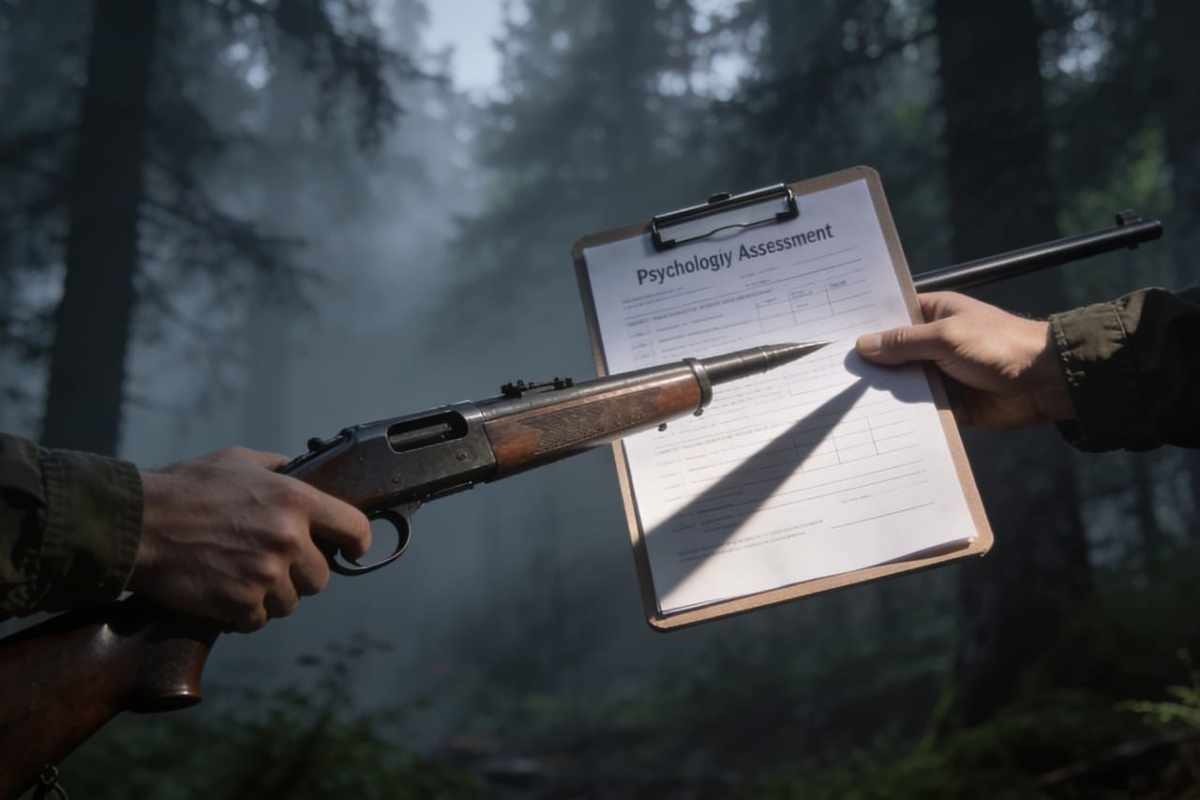
In survey studies, recreational hunters consistently cite four main motives: experiencing nature, tradition, obtaining meat, and wildlife management.
Several studies, including an analysis by Hinrichs et al. (2021) in Human Dimensions of Wildlife, examined these self-reports across several thousand respondents in the USA and confirmed this ranking. At first glance, this sounds harmless.
The problem lies in the method: self-reporting measures what people are willing to admit, not their actual or unconscious motives. Anyone primarily seeking to experience nature does not need a weapon. Anyone wanting to carry out wildlife management could instead fund professional game wardens. And anyone in Switzerland needing meat can find it at the nearest supermarket, without lead shot or stress hormones. Far more revealing, therefore, is research that does not ask about motives, but about personality traits.
The Dark Triad: the most uncomfortable finding in hunting psychology
Personality research offers one explanatory approach. Kavanagh, Signal & Taylor (2013, «Personality and Individual Differences») showed in an online survey of 227 people that higher scores on the so-called "Dark Triad" personality traits are associated with less positive attitudes towards animals and with more self-reported animal cruelty. The psychologist Geoff Beattie (2019, Trophy Hunting: A Psychological Perspective, Routledge) draws on this framework to explain trophy hunting, but himself notes that the study was not conducted on trophy hunters. The three traits in overview: Narcissism: one's own need for dominance and admiration outweighs the well-being of other living beings. Machiavellianism: animals and nature are instrumentalised as a means of achieving personal goals — prestige, social status, political influence. Subclinical psychopathy: diminished emotional response to the pain and death of other living beings, as well as an increased willingness to kill deliberately without necessity.
People with high scores on all three traits show significantly less empathy towards animals and commit animal cruelty more frequently — and this is not merely an extreme-case phenomenon, but a statistically measurable difference from the general population. In Beattie's analysis, the Dark Triad traits prove to be the strongest explanatory framework for trophy hunting motivation, stronger than social or cultural factors.
How these mechanisms translate into real politics in the canton of Schwyz: The psychology of recreational hunting in the canton of Schwyz
German-language evidence: the dissertation by Ursula Grohs
That these international findings are not a purely Anglo-Saxon matter is demonstrated by the only systematic study to date in the German-speaking world. The dissertation «Psychological and sociological differences between recreational hunters and non-hunters» by Ursula Grohs arrived at a finding that supports the Dark Triad research on a different methodological level: recreational hunters rate themselves as significantly more aggressive than non-hunters, resolve conflicts more often through dominance and control, and show a measurably different relationship to violence.
The work is methodologically sound, but has not been replicated in years. That, of all places, in the German-speaking world — where well over half a million people in Switzerland, Germany and Austria hold a hunting licence and legally carry firearms — no follow-up research exists is a scientific gap with societal significance.
Recreational hunters and non-hunters do not differ in their connection to nature.
Groh's findings align with what Kavanagh et al. describe at the personality level and Beattie at the motivational level: the willingness to kill animals voluntarily and without necessity correlates with personality patterns that are regarded as risk factors in other contexts.
Further background: Psychology & hunting.
Toxic masculinity and predator control
A widely discussed essay by Jeff Loewen (2025) deepens the Dark Triad findings and links them to a politically relevant pattern: trophy hunters instrumentalise narratives about «wildlife management» and «herd protection» to eliminate wolves, bears and lynx – not primarily out of fear of livestock kills, but in order to make more conventional trophy animals available to themselves.
This structurally explains why the hunting lobby in Switzerland, Austria and Germany acts so coordinatedly and emotionally against predators. When a natural predator takes on the «regulatory function» that the recreational hunting community claims as its core competence, recreational hunting loses its most important basis of legitimacy – and with it a central foundation of its identity. The wolf is thus not perceived as an ecological actor, but as a competitor.
Find out more in the dossier: The wolf in Europe: why recreational hunting is not a solution
Moral disengagement: how killing is normalised
Albert Bandura's theory of «moral disengagement» describes how people can commit acts that contradict their own values without feeling guilt. Studies on hunting motivation show that almost all of the mechanisms described by Bandura are systematically employed in recreational hunting: «culling» instead of «killing» as euphemistic language distances the act from its real nature. «Population regulation» serves as moral justification, reframing the killing as a conservation achievement. «Problem wolf» and «pest wildlife» attribute guilt to the animal, making its death appear necessary. And «the authority ordered it» shifts responsibility onto the system, rendering the individual decision invisible.
This finding is significant because it shows that the moral problem does not lie with individual «bad» recreational hunters, but within the system of recreational hunting itself, which institutionalises and reproduces these mechanisms.
Further reading: Why we need to talk differently about the psychology of recreational hunting
The counter-study: Lobby-funded science
In response to growing pressure for legitimacy, the hunting lobby is launching its own “research”. The Austrian platform jagdfakten.at is promoting a study by Prof. Dietmar Heubrock, according to which recreational hunters are “psychologically more stable, less depressive and more capable of conflict” than the general population.
The methodological limitations of this study are considerable: it is based on self-reporting, the least reliable instrument in personality research. It was communicated and funded by bodies close to hunting. And it was not published in an independent, peer-reviewed journal for personality psychology.
It is thus a textbook example of interest-driven research, while at the same time demonstrating just how much the hunting lobby feels the pressure of independent psychological science. FACE (the European hunting lobby association) also recently launched a data campaign entitled “Why do people become hunters? New data challenges common stereotypes”, a direct response to the growing body of research that is undermining recreational hunting’s self-image.
The research gap in German-speaking countries
In German-speaking countries, there are hardly any independent, replicated studies on the psychology of hunting. This is no coincidence: hunting associations have influence over cantonal and national research funding, and critical scientists tend to avoid a field that must expect political headwinds.
This is socio-politically explosive: in Switzerland alone, around 30,000 legally armed private individuals regularly carry weapons into nature and kill more than 120,000 wild animals every year. The fact that the psychology of this practice is not systematically researched is not a scientific coincidence, but the result of structural influence.
What is needed: independent, publicly funded longitudinal studies on the personality profiles, motivational structures and behavioural patterns of recreational hunters in German-speaking countries, free of self-selection bias and lobby funding.
Related: Between tradition and killing: The psychology of recreational hunters | Hunting on the mind: What violence does to the brain
The Netherlands as a role model: When psychology becomes practice
What is considered politically unthinkable in Switzerland has long been reality in the Netherlands. With the «E-Screener», the Dutch Ministry of Justice and Security introduced a mandatory psychological test for all firearms owners and holders of a hunting licence in 2019, prompted by a shooting rampage carried out by a man to whom, according to the Supreme Court, police should never have issued a firearms licence due to his psychological problems. The result: one in five recreational hunters fails the test. The reaction of the hunting lobby was telling: the Dutch hunting association immediately called for the test to be scrapped and advised its members to postpone their appointment so as not to lose their licence in the middle of the hunting season.
What the research means for the political debate
As long as the psychology of recreational hunting remains invisible, the political debate keeps going in circles: people discuss kill numbers, damage thresholds and hunting seasons, but not the fundamental question of why a democracy organises and subsidises recreational violence against animals through the state.
The consequences of the international state of research are clear: a psychological aptitude test as a mandatory part of obtaining a hunting licence — the Netherlands shows that this works. Independent research funding on hunting motivation that is not co-financed or controlled by hunting associations. And the decoupling of recreational hunting from wildlife management: professional game wardens without recreational interests must take on sovereign duties, transparently, under oversight, and based on evidence.
For anyone who has long observed recreational hunting critically, psychology offers no surprises. But it offers something more important: language, concepts and evidence to challenge the hunting lobby’s self-image exactly where it is vulnerable — at its scientific foundation.
The editorial team welcomes information about further studies or research findings. Write to us: info@wildbeimwild.com
Find out more in the dossier: The psychology of hunting
More on the subject of recreational hunting: In the dossier Psychology of recreational hunting we put research, motives and social consequences into perspective. What the research says about this is shown by Hunting fact-checked: the state of research.
The position of IG Wild beim Wild: IG Wild beim Wild rejects recreational hunting. Our model is the canton of Geneva, which has managed without recreational hunting since 1974: without hunting seasons, without hunting dogs, without driven hunts, without high seats, without the animal cruelty and crime that go hand in hand with hunting season elsewhere. What has worked there for over fifty years disproves every position paper by JagdSchweiz. An association that bases its policy on claims it refutes in its own documents is not a professional organisation, but a factory for misinformation.

All articles are written by IG Wild beim Wild as well as by external co-authors. Research, structuring and editorial processes may be supported by AI-assisted tools.
Support our work
With your donation you help protect animals and give their voice a hearing.
Donate now →