What gives gecko feet their remarkable grip?
Researchers have decoded how geckos adhere to smooth surfaces. The findings could enable technical innovations.

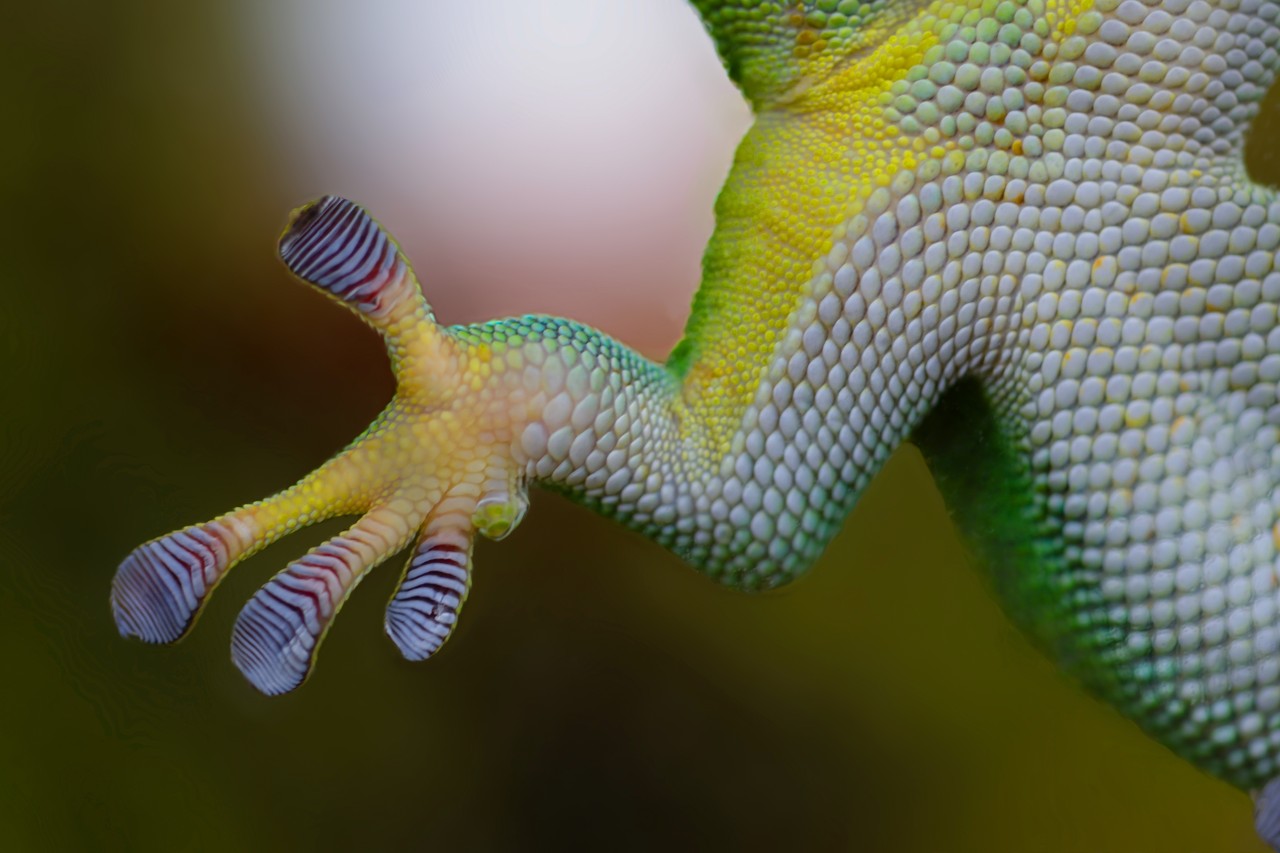
Geckos are known for their grippy feet, which allow them to climb vertical surfaces.
They owe this superpower to millions of microscopically small, hair-like structures on their toes. Scientists have long understood gecko adhesion, but now they have a clearer picture of the molecular structures that give these animals their grip.
In a study by the National Institute of Standards and Technology (NIST), researchers analysed the setae using X-rays generated by a device known as a synchrotron. The experts discovered that the structures are coated with an ultra-thin film of water-repellent lipid molecules.
The setae are flexible and adapt to the microscopic contours of any surface the gecko climbs. To release its foot, the gecko changes the angle of the setae, which breaks these forces and allows the animal to take its next step.
The setae are made of a keratin protein similar to that found in human hair and fingernails, which are extremely sensitive. These keratin fibres are aligned in the direction of the setae, which could help them resist abrasion.
«You can imagine gecko boots that don’t slip on wet surfaces, or gecko gloves for gripping tools that are wet«, said NIST physicist and co-author of the study Dan Fischer. «Or a vehicle that can drive up walls, or a robot that can travel along power lines and inspect them.«
The NIST synchrotron microscope can unambiguously identify molecules on the surface of a three-dimensional object, measure their orientation, and map their position. It is located at the Brookhaven National Laboratory of the US Department of Energy, where the National Synchrotron Light Source II provides a source of high-energy X-rays for illumination.
This microscope is typically used for advanced industrial materials such as batteries, semiconductors, solar cells, and medical devices. «But it is fascinating to discover how gecko feet work, and we can learn a lot from nature when it comes to improving our own technology», said Fischer.
«Much was already known about how the setae work mechanically«, said study co-author Cherno Jaye. «Now we have a better understanding of how they function in terms of their molecular structure.»