Sweden: The Shameful War Against Wolves
In Scandinavia, over 100 wolves are being killed in 2022. Sweden, Norway, and Finland are violating the EU Habitats Directive on species protection.

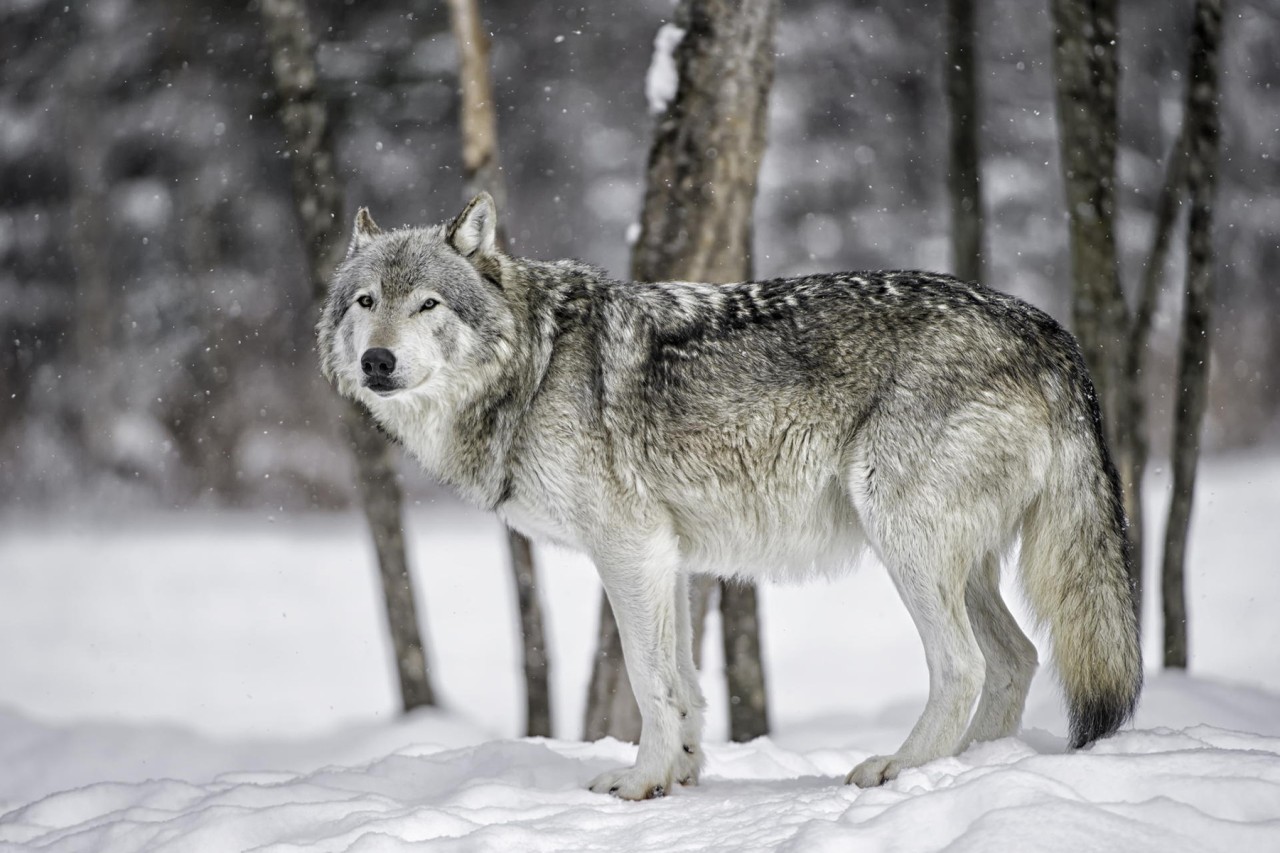
The current 2022 hunt is even more brutal than usual, as various local district administrations are working together to exterminate entire wolf families from their territories and habitats.
Norway (a non-EU country where hunting of 54 wolves may continue until 31 May) and Sweden are cooperating in this grotesque extermination campaign, carrying out a wolf holocaust. On the Swedish side, nearly 2’000 hunters have registered to kill 27 wolves. Finland has also opened a hunt on 20 wolves. This means that more than 100 wolves will be slaughtered in the most brutal manner across Scandinavia in 2022.
The deliberate killing of predators violates the objectives and spirit of the EU Habitats Directive on the protection of endangered species. Non-governmental organisations in Sweden, Norway, and Finland have called for the hunt to be stopped.Not in line with modern conservation: Sweden has been participating in the cruel business of trophy hunting for brown bears, lynx, and wolves since 2010.
Wolves and other predators were nearly exterminated due to human persecution by the end of the 19th century. At the beginning of the 19th century, the Romantic view of nature and the migration of people to urban areas contributed to a renewed appreciation for diverse wildlife. Hunting associations also contributed to the protection of certain species. Unfortunately, however, in the late 1930s the hunting association was entrusted by the state with the management of wildlife and received enormous financial resources that tied state and hunting interests together, following a model that was applied at the time in authoritarian Germany. This model remains in force today and provides them with an annual budget of approximately 5.6 million dollars. This created an institution that exercises control over wildlife and, as a lobbying force, infiltrates government and the political agenda for hunting at all levels — despite hunters making up less than 3% of the population.
Why does trophy hunting exist in a developed country like Sweden?
Wolves were placed under full protection from 1966 onwards in order to save the species. However, as we can see, this has changed, even though Sweden has been subject to EU protection regulations since joining the EU in 1995. Since 2010, licensed hunting has expanded trophy hunting in Sweden, as hunters are now permitted to kill bears, lynx, and wolves. Foreign hunters are also welcome. Following a series of political shifts in the late 1990s, the Swedish Environmental Protection Agency changed its wildlife management strategy in favor of hunters. The situation escalated when hunters decided that predators — wolves in particular — should be regarded as competitors to other wildlife species that they hunt. This had negative consequences for all wildlife, but especially for predators, as they became politicized.
Reindeer farming has evolved far beyond its cultural heritage and is today an industry with export ambitions — not to mention the extreme cruelty with which farmers are permitted to treat reindeer (Not as Nature Intended — a book by undercover journalist Rich Hardy). These semi-wild animals are transported en masse to slaughterhouses. Snowmobiles and helicopters are used to round them up under stressful conditions. Although climate change poses a greater threat than predators, massive state financial support keeps this cruel business alive.
The state provides substantial financial support to reindeer owners and villages so that they will «accept» the presence of predators on their land, and pays compensation for every animal killed by predators. However, this does nothing to protect predators from being killed. Quite the opposite, as demonstrated by the increase in so-called protective hunting and illegal hunting. For wolves, this poses an additional deadly problem, since the only route for genetic renewal runs through Finland and Russia. No wolves survive when they enter Sweden. The hatred of wolves has become pathological, given that not even «substantial bribes» can save them. In some regions, this is reminiscent of the witch hunts against women in the seventeenth century.
The debate over the degeneration of Sweden's wolf population has not resulted in wolves being afforded any more protection than mere token numbers.
In 2016, the Supreme Administrative Court ruled that 300 wolves must be the minimum required for the species to be preserved. Rather than serving as a minimum, this figure is used by the EPA and hunters as the maximum level of tolerance. Biological and scientific evidence carries little weight. The legal system relies on this ruling, meaning that NGO appeals are generally of little success in saving individual animals. The European Commission has initiated proceedings against Swedish wolf hunting, but so far nothing concrete has been achieved.
Sweden's repeated violation of the EU Habitats Directive continues, and by adapting its own national loopholes and interpretation of the exemption rules for limited hunting, Sweden is also undermining the purpose and objectives of the Convention on International Trade in Endangered Species (CITES), as export permits for all trophies are readily granted by the agricultural authority. In this context, it is worth noting that the Swedish government refused to address the ban on the importation of lion hunting trophies in 2016/2017, which would have been a low-hanging fruit. Unfortunately, this demonstrates that most politicians across all parties are not engaged at all when it comes to animal welfare, and even less so when it comes to hunting.
Despite the Covid pandemic, Sweden's mink industry and the industrial farming of pigs and chickens continue to operate under cruel conditions.
More than 7’000 red-listed predators have been killed in 20 years. The Swedish Environmental Protection Agency, Naturvårdsverket, has even increased the quota for legal trophy hunting. Since the year 2000, more than 7,000 brown bears, lynxes, wolves, and wolverines have been legally killed under this system.
Sweden today has an estimated 2’800 brown bears, not many more than 1’000 lynxes, and perhaps 600 wolverines. And this in a country with a low population density in the areas where predators have their natural habitat. Yet predators have become pawns on the political agenda. This polarisation is rooted in predator conflicts played out locally by hunters, livestock farmers, reindeer herders, and of course the economic interest groups behind them.
The system for monitoring and counting wolves is operated by local authorities and hunters. Since the wolf is regarded not only as a threat to livestock but also as a competitor in the hunt for game, it stands to reason that hunters have an interest in recording the highest possible number of predators.
Added to this is the fact that humans are generally shrinking the territory of predators by using the land for livestock farming, particularly the vast areas of northern Sweden where reindeer roam freely.
Wolf population
The number of wolves is continually debated and called into question, as illegal hunting still accounts for 10–20%. When counting individuals (1 October to 1 March), these wolves, as well as animals killed after that date due to accidents or other reasons (e.g. conflicts with livestock), are not taken into account. This means that wolves killed after 1 March and up until the following autumn — several months later, when hunting decisions are made — are not included! Some believe that there could therefore be even fewer than 300 wolves.
The «precautionary principle» is not a Swedish strength
When it comes to bears, wolves and lynx, the «precautionary principle» is largely ignored. The official wolf count was given as 395 when the authorities decided to kill 27 to 33 wolves in 2022. Some counties are even attempting to expand the areas to ensure they can kill wolves that try to flee. This can occur at the border with Norway (involving administrative authorities in Dalarna, Värmland and Jämtland) and happens repeatedly in the province of Gävleborg. Legally speaking, it should not be permitted to alter or extend hunting zones that were originally established during the decision-making process in November/December. But the local administrative authorities of the regions mentioned above — like all northern regions — are hardliners against predators. We do not yet know what the courts will decide.
What is both cruel and alarming is the inbreeding and degeneration of Sweden's wolves. Many male wolves have only one testicle (cryptorchidism), andautopsies of killed wolves reveal disturbing evidence of the sadism of hunters — many have old wounds and lead ammunition embedded in their bodies.
In Sweden, predators are being killed in contravention of EU wildlife protection directives
Licensed hunting and/or protective hunting, both clearly designated. Both methods have increased since 2010. The Swedish Environmental Protection Agency has delegated decisions to local authorities in the individual districts where predators live. Protective hunting orders are often issued by phone, and the animals are usually permitted to be killed the same day. The time available for NGOs to challenge these decisions is therefore meaningless and purely symbolic. These hunts are rapid executions carried out with helicopters and snowmobiles. On the ground, dogs are used to track the animals when they attempt to hide in dens. The helicopter hunts may have been inspired by American warfare — and also by what is happening now in the United States. Unfortunately, these methods have spread like a pandemic through globalization and international hunters’ organizations. Historically, Americans began shooting African wildlife from trains and cars during the era of the white hunter, including during the time of the Swedish Baron Blixen (husband of the writer Karen Blixen), who accompanied all the rich and famous on trophy hunts and killing tours in Africa.
And so cruelty continues to take its toll in Sweden. Females with young are not spared. For example, wolverine females with cubs in their dens may be killed. Lynx females with cubs are shot from helicopters, and the «ethical order» dictates that the «children» be killed before the mother…
The approved hunt for lynx begins on 1 March — which is the mating season of these elusive wild cats. A true crime! Our Nordic Leopard!
Animal cruelty legislation does not cover wildlife — only hunting laws apply. Swedish hunting laws are based on the use of animals as objects belonging to the hunter and/or the landowner. State lands/forests are also leased for hunting, which is big business, as is the case for all farmers who have the right to hunt on their land. Wild life has no respite. Not even in a national park or nature reserve, where the EPA permits hunting. The sea is also a hunting ground, and the EPA expands the hunt on all seal species every year — even the critically endangered Red List species in the northern Baltic Sea.
Preventive killing, known as skyddsjakt, technically speaking a «self-initiated» action, a killing carried out at one's own discretion
The legislation permits the killing of predators on the spot as a preventive measure to avert an attack. This is naturally carried out without any official oversight, and it cannot be ruled out that dogs may provoke bears, for example, while hunting other game. The most common argument put forward by hunters is that dogs are killed by wolves and that they cannot hunt elk as freely as they wish with dogs roaming off-leash.
Needless to say, dogs running loose in wolf habitats should be prohibited — an absolute NO GO.
Since 2010, this law has been exploited to an alarming degree as a «pretext» for killing bears, wolves, and lynx. Very few cases lead to investigations, and these are typically dropped due to lack of evidence. The issue of animal cruelty — for instance, when a female bear is killed and two cubs are then discovered in the trees, or when wolves abandon their young — is never punished or even discussed.
The collateral damage and frequent injuries caused by hunters or dogs are never prosecuted.
Cruel hunting with dogs
Hunting with hounds has evolved in Sweden and has become a form of animal cruelty — both for the dogs and for the wildlife — that goes entirely unpunished. Swedish hunters have also introduced new breeds of aggressive hunting dogs trained to pursue predators. The Swedish Environmental Protection Agency (EPA), which holds primary responsibility for wildlife and hunting matters, has expanded the rights for hunting with free-roaming dogs — three dogs are permitted to chase a wolf, regardless of whether it is a pup or an adult. Unethical hunting methods also include ancient medieval techniques using beaters, as well as encircling an area with «frightening wires fitted with moving strips of fabric», erected to funnel fleeing wolves into a cordon and drive them toward the hunters.
Training hunting dogs in the wild on predators in their natural habitat
Most disturbing of all is that the EPA has introduced even more reprehensible practices — specifically, allowing all hunters to train their dogs a full month before the official start of the hunting season! This applies even in areas of Sweden where no hunting permit has been granted.
This means that training on wild bears (with their cubs) in their habitats begins in July to August (hunting season opens August 21), on wolves in December (hunting season opens January 2), and on lynx in February (hunting season opens March 1). It is also permitted to train dogs on captive wild animals in specialized training centers. This sadistic practice is not being addressed by the EPA, despite numerous protests from non-governmental organizations. At the same time, hunting with dogs terrorizes other wildlife, such as wild boar hunting, which is permitted almost year-round and also at night.
The Swedish hunting lobby has a firm grip on all wildlife, and the legal system for hunting is rigged. To keep the wheel of death turning, the Swedish Environmental Protection Agency has further liberalized hunting on all animals, including migratory birds such as cranes and swans, with a new decree covering 2021 to 2026!

More on the subject of recreational hunting: In the dossier The Role and Criticism of Recreational Hunters we shed light on the training, power and self-image of recreational hunters. The scientific evidence is presented in the overview Studies on the Effects of Recreational Hunting.
The position of IG Wild beim Wild: IG Wild beim Wild rejects recreational hunting. Our model is the canton of Geneva, which has managed without recreational hunting since 1974: without hunting seasons, without hunting dogs, without driven hunts, without high seats, without the animal cruelty and crime that go hand in hand with hunting season elsewhere. What has worked there for over fifty years disproves every position paper by JagdSchweiz. An association that bases its policy on claims it refutes in its own documents is not a professional organisation, but a factory for misinformation.