The Raccoon — That Is My Life
A raccoon mother tells her young about life in the forest. A touching children’s book about the coexistence of humans and wildlife.

Mama, why is it like this?
Deep in a dense, beautiful forest through which a small stream flows, countless different animals can be observed. Birds, mice, squirrels, foxes, badgers, insects and many more. Among them lives the raccoon. In an old oak tree, right on the bank of the stream, a mother bear has settled down with her offspring.
Life could be so carefree, for there is plenty of food such as worms, fish, crayfish, fruit, nuts, insects, amphibians, reptiles and mice. Relations with the neighbouring animals are also very harmonious. Yet humans keep appearing, and the raccoons are afraid of them. For they come armed with traps and rifles, hunting for them. When a little raccoon kit asked its mama why this was so, why they were not welcome here, why they had to be so much on their guard, the raccoon mother sat down with her kits and began to tell their story.
„Many, many years ago, our ancestors were brought from North America — yes, back then we lived from Canada all the way to Panama — to Europe. The humans liked our fur so much. They wanted to use it to make clothing so they wouldn’t freeze in winter. In 1934, two pairs were first released into the wild near the beautiful Edersee, close to Waldeck.
„But that’s lovely“, little Hannes, the smallest of the group, interrupted. “Yes, it was lovely”. She said and sighed.

„At the beginning it was lovely. For some years they lived happily and contentedly in freedom, started families and lived each day without a care, for they found plenty of food and wonderful places to sleep. Unfortunately, things seem to have moved too fast for the humans. They didn’t think we would feel so at home and settle in so well in the new home they had given us — we are simply very adaptable«.
„But that’s what they wanted“, fragte Ida verunsichert.
„Ja, Ida, doch manchmal wissen die Menschen nicht, was sie tun, sie denken zu spät über ihr Handeln nach. Nach einer Zeit entschlossen sie sich dazu, uns unser Leben wieder zu nehmen. Wir waren ihnen zu viel geworden. Bis 1954 standen wir sogar unter Naturschutz, das bedeutet, dass wir geschützt wurden. Keiner durfte uns etwas antun. Doch damit war es leider schnell wieder vorbei.«
„Glaubst du, dass wir alle sterben müssen, Mama? Dass wir hier alle bald weg sind«? „Aber nein Ida«. Die Mutter lachte auf.
„Wir Waschbären haben eine unglaubliche Fähigkeit, wir können Populationsverluste durch eine erhöhte Fortpflanzungsrate ausgleichen, das können nicht viele und damit haben die Menschen wohl nicht gerechnet. So schnell werden sie uns nicht mehr los. Wir haben es uns nicht ausgesucht, hier zu sein. Auch wir haben das Recht, in Frieden leben zu dürfen«.
„Das ist also unsere Geschichte«‚ Hannes rutschte nervös hin und her. „Nein, unsere Geschichte geht noch viel weiter zurück. Bis in das Späte Oligozän. Vielleicht sogar noch weiter, aber das weiss ich nicht genau. In Frankreich und in Deutschland wurden nämlich aus dieser Zeit Fossilienfunde gemacht, die ersten Vertreter von uns Kleinbären. Ach ja, es gibt sogar schon schriftliche Aufzeichnungen von Kolumbus, dem Entdecker Amerikas. Er berichtete damals schon von uns. Ich habe euch doch schon einmal von den Algonkin erzählt, ein Stamm der nordamerikanischen Ureinwohner, der Häuptling war Powhatan und seine Tochter Pocahontas. Erinnert ihr euch«?
Allgemeines Kopfnicken.
„Sie nannten uns damals ahrah-koon-em, was so viel bedeutet wie ‚der mit den Händen kratzt‚. Die Spanier nennen uns mapache, also „der alles in seine Hände nimmt, da seht ihr mal, wie bekannt wir sind. Und nicht nur wir, auch unsere Fähigkeiten sind weit bekannt. Aber jetzt Schluss, die anderen warten schon«.
Der Treffpunkt
Nachdem die kleine Familie eine Weile durch den Wald gelaufen ist, bleibt Hannes an einem alten Baum stehen, nimmt Anlauf und rennt den Stamm hinauf, verdreht seine Hinterfüsse und rennt den morschen Stamm kopfüber wieder hinab. „Habt ihr das gesehen» ruft er, völlig ausser Atem.

„Sehr gut, Hannes«, sagt die Mutter.
„Nur wenige Säugetiere unserer Grösse können kopfüber einen Baum hinabklettern. Bis vor kurzem konntest du das noch nicht, da siehst du mal, wie schnell ihr alle lernt, ich bin stolz auf euch«.
„Mom, where are we actually going» asks Jan, sprinting along a narrow, densely overgrown path.
„If you weren't running so fast, I could explain it to you“. „But I heard that we can run at 24 km/h, I just wanted to try that«.
„Oh Jan, you still have a lot of practicing to do“, the mother says, laughing. “We're meeting up with the others now, I already told you that earlier. Ida, Leni, where are you, we need to hurry a little«.
The family finally reaches the meeting spot. All the other bears are already there. All except Heidrun.
„Where is Heidrun“, the mother bear asks, looking around in surprise.
Nobody knew where Heidrun was.
„Either she's running late or maybe she overslept«. Karin calls out with a shrug, already chewing on a blackberry.
„But we'll just leave her a message“.
“Tell me, Mom, why is it that there are always only women here andhardly any men“, Leni asks curiously.
„You'll learn all of that in time. So, the thing is…“ the mother bear begins to explain, while picking up a few acorns to give to her children. “Let me explain it to you using the words of Stanley D. Gehrt and Ulf Hohmann, the two behavioral researchers — which, by the way, shows once again how interested some people are in us. These two men call it a three-class society. Female animals, like us for example, meet regularly at shared feeding spots like this one and at sleeping places — we do that too, every now and then, with Aunt Renate and Helen. This is called a fission-fusion society. Males who are not related to each other simply live together in loose groups, often up to 4 animals, a so-called male coalition. Adult bears can become aggressive toward unrelated cubs, and that's why we often keep our distance from other bears. I'd rather be extra cautious«.
Drawn in by her mother's story, Leni doesn't notice that she's been popping one berry after another into her mouth and chewing on them eagerly.
„Slowly, slowly Leni, you're about to burst if you keep shoveling more into yourself. You weigh only a fraction of what I do — I weigh 6 kilograms and my stomach holds just 150 grams, which you've nearly reached already. 150 grams is, by the way, only about 2.5% of my body weight».
Leni ignores her mother's instruction and asks: “Does that mean Jan and Hannes will also go away at some point and live with others and not with us anymore» startled by her own question and frightened of her mother's answer, she chokes on a berry and starts coughing loudly.
“Now now, it’s not all that bad. Besides, all of that is still a while away. This is the way of nature, and we have no influence over it either, even though we are considered one of the most intelligent animal species in Europe. We females generally all live together, or at least nearby. The young ones eventually go their own ways. Sometimes they come back for a while, though — for instance when a cold winter is approaching. Only when they are 4–5 months old will they, and you and your sister, be able to survive without me. So let’s simply enjoy our time together for now. Go on, go play with the others — we’ll need to be on our way again soon.”
The Encounter
Time flew by once again. Summer came, then autumn and winter, and spring returned. The cubs had long since grown up and gone their own ways. The mating season in February, when the male raccoons migrate into the females' territories, had already passed, and the raccoon mother was busy setting up an old, abandoned fox den where she planned to give birth to her pups. She loved this time of year, because now there were insects, worms, and beetles to find again, all of which she enjoyed eating. Yes, fruit and nuts — which she ate mainly during the colder seasons as calorie-rich food — tasted wonderful too, but this particular season was always her favourite. She was lost in thought when she suddenly heard a noise behind her. She startled and braced herself for an attack, ready to defend her life and that of her unborn pups. But what on earth was this? She had certainly never seen anything like it out here before. Every now and then, when she ventured toward the village to see if there was something tasty to eat, she had spotted dogs from a distance. But never this deep in the forest, and never this close. Dusk was just beginning to fall as night crept in.
They looked at each other without saying a word. They sized each other up, watching the other's body language.
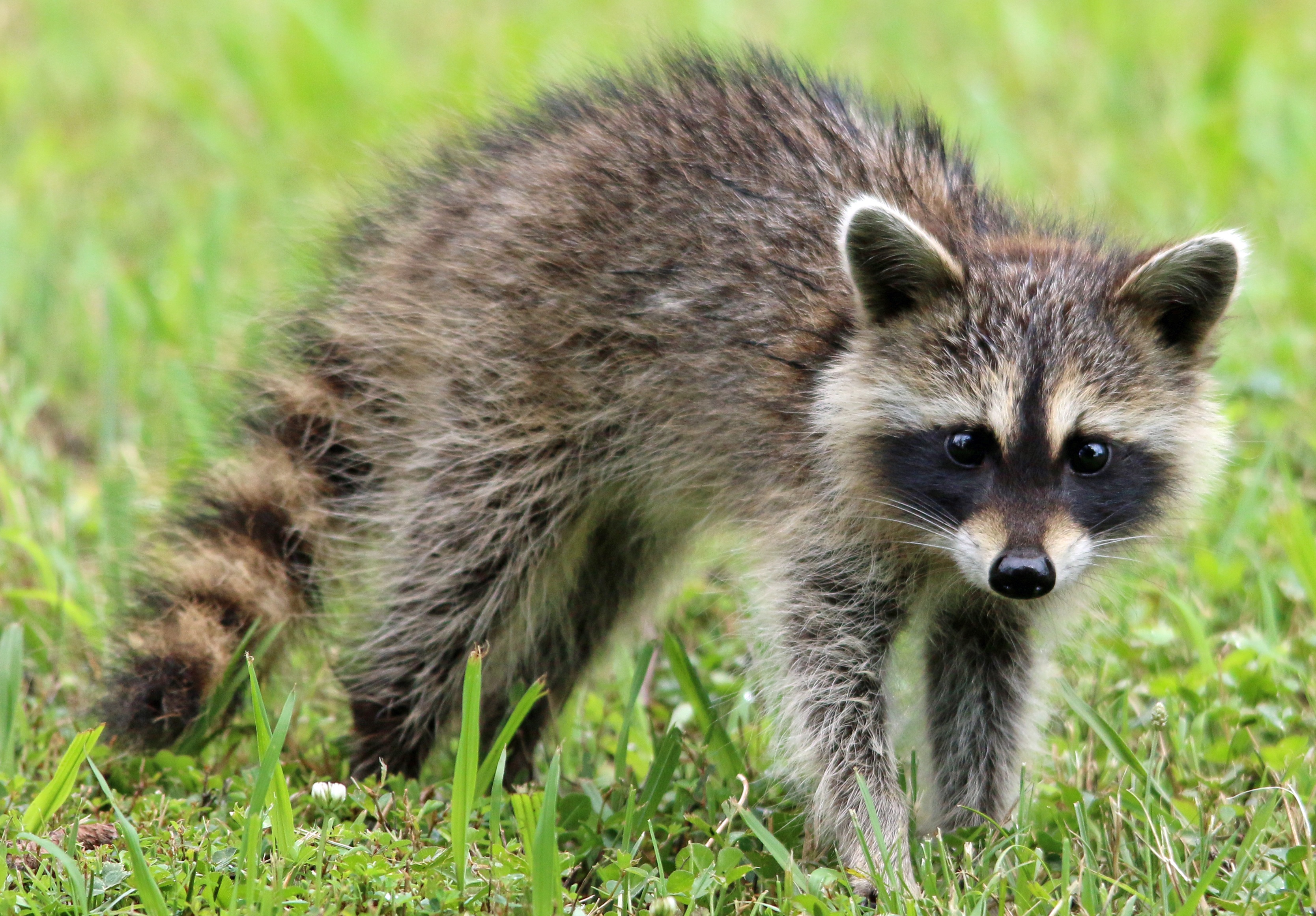
After a while, the dog asked, "What on earth are you? You have such a hunched posture when you walk. I've been watching you for a while. You have 6 black rings on your tail, a strange black mask on your face, shaggy grey fur, you're about the size of a cat — just a bit stockier, I think — and you walk on the soles of your feet…"
„Anything else?» the bear interrupted him.
"Yes, your front paws look like ahand, your hind paws like a child's foot, and your hands look somehow leathery… I've never seen anything like it", the dog replied.
That was enough for the bear, and she cried out, ""Now listen up, you dog — my black face mask is very useful, it helps reduce the sun's glare. My grey fur is water-repellent, and I'm bigger than many cats; we can actually grow to 70–85 cm long. I certainly haven't been fat for a long time. I weigh 6 kilograms, others can weigh up to 10 kilos, and some even up to 20 kilograms. And my hands are also very useful — they have a thin layer of horn that can soften in water, which lets me grip things much more effectively. Fish, mussels, or crayfish, for example. You have none of these useful features. I am a raccoon — also known in old-fashioned terms as a Schupp — surely you've heard that before«, she snapped furiously, gasping for breath. She would have loved to let out a fearsome growl and a shriek — that's what she does when she's in an aggressive mood, and she was certainly furious right now — but this dog wasn't worth it, and besides, she didn't want to draw attention to herself, since her fighting sounds could be heard from a very great distance.

She turned around to continue working on her den, because by April the time had already come. But she kept one eye on the dog. He lay down in the grass at a safe distance and watched the bear in turn. Night had fallen, the first stars appeared in the sky, and the moon had risen. Slowly the dog grew restless, for he had lost his way in the forest. He had been searching for the path back to the village when he had come across the bear. He knew he wouldn't find the way on his own. So he gathered all his courage and asked her, "Hey, do you know the way back to the village? I'm sure someone must be looking for me by now«.
The bear turned slowly and asked, "I should help you«? „Yes, I'm sorry — I had just never seen a raccoon before. Can you help me«?
The bear gave herself a nudge, for she still had quite a bit to do that night. "All right", she replied, "I may not see very well, but I can hear and smell all the better for it, and my memory is excellent. I can hear sounds as loud as 85 kHz, but also very quiet ones at 50 kHz — in fact, I can even hear earthworms burrowing underground. With my nose I can navigate brilliantly at night, even over long distances."
„Well, I'm absolutely flabbergasted», said the dog, genuinely astonished.
„What else can you do» fragte er.
„Hast du schon mal von Davis gehört«?
„Nein“, antwortete der Hund.
„H.B. Davis war ein Verhaltensforscher. Da siehst du übrigens mal, wie interessant wir Waschbären sind. Er bestätigt wie schlau wir sind. Wir können nämlich komplexe Mechanismen in kürzester Zeit entschlüsseln, egal wie sie angeordnet sind. Ausserdem können wir unterscheiden, ob in einem Behälter zum Beispiel 3 oder 4 Trauben liegen. Man vergleicht unsere Lerngeschwindigkeit auch mit Rhesusaffen. Jetzt bist du baff oder«, fragte sie sichtlich stolz.
„In der Tat“, entgegnete der Hund. „Nicht schlecht“.
„Aber nun gut, ich zeige dir den Weg zurück ins Dorf. Folge mir«.
Wo sind sie?
Nach 63 Tagen war es nun endlich so weit. Die Bärin ist wieder Mama von 3 wundervollen Babys geworden. Sie sind noch so klein, sie wiegen gerade einmal 60-80 Gramm. Ihre Augen und Ohren sind noch geschlossen, ihre Gesichtsmaske und die Schwanzringe sind noch nicht zu erkennen. Ein Flaum bedeckt den Körper, nur der Bauch ist noch nackt. Die Zeit wird so schnell vergehen und sie werden so schnell gross. Bereits in der 2. Woche haben sie schon ein Gewicht von 150-250 Gramm, die Augen und die Ohren sind zwar noch geschlossen, aber der Flaum wird schon zu leichtem Fell und die Maske zeichnet sich auch schon langsam ab. Während sich die Welpen geschützt in der Wurfhöhle aneinander kuscheln, geht die frisch gebackene Bärenmama nachts auf die Suche nach Nahrung.
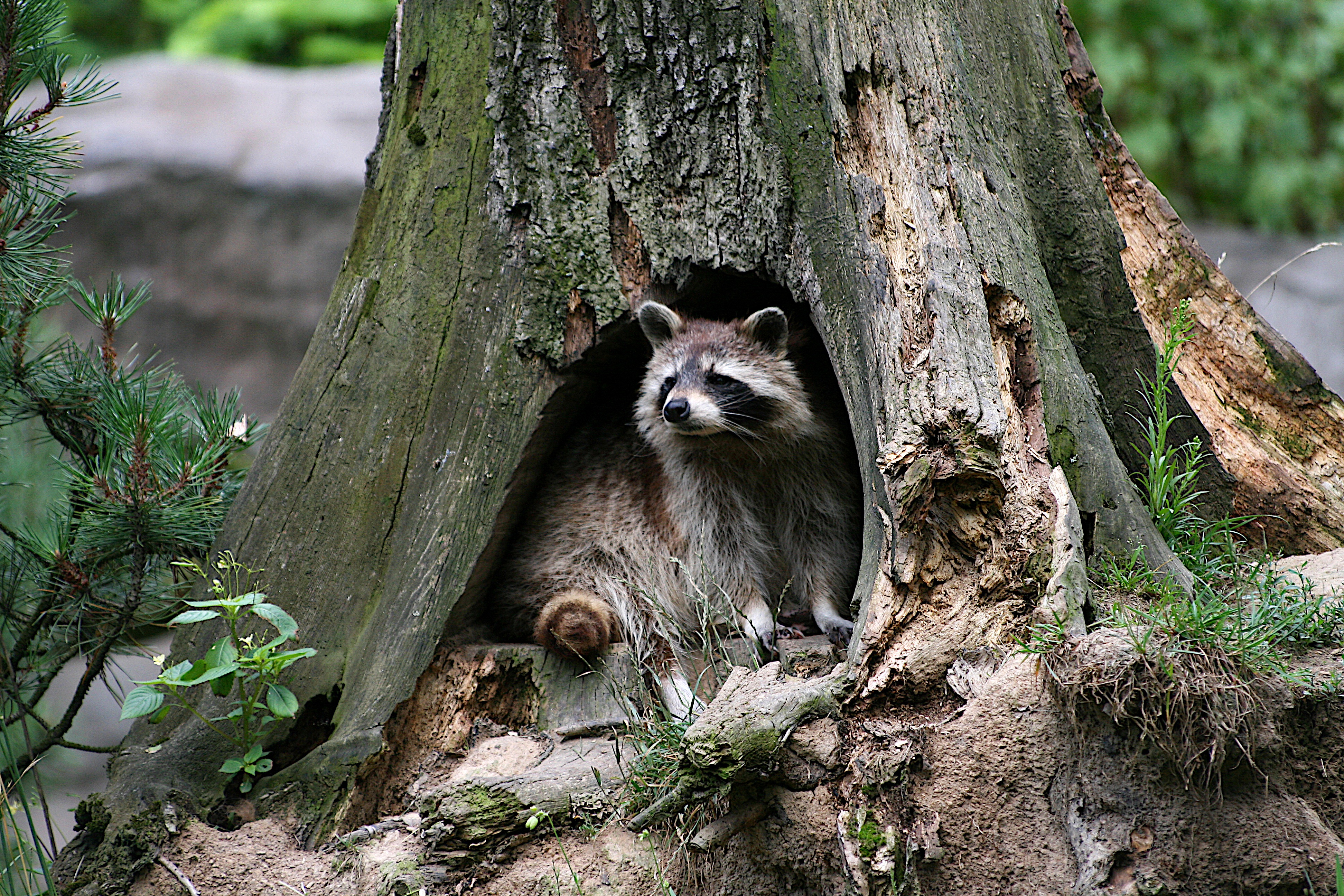
Sie muss nach der anstrengenden Geburt zu Kräften kommen und sie braucht genug Milch für ihre Jungen. Nach 3 Wochen öffnen sich endlich die Augen, und das Fell hat bereits, den zuvor nackten, Bauch überdeckt. Die Wochen vergingen wie im Flug, die Jungtiere haben bereits die 6. Lebenswoche erreicht und wiegen schon stolze 800 Gramm. Nun ist es also langsam so weit, denkt sich die Bärin nervös. Bald werden wir gemeinsam die Höhle verlassen und sie werden die grosse, weite, schöne, aber auch gefährliche Welt kennenlernen.
Es war ein schöner Abend mit einem klaren Himmel, als die vier das erste Mal gemeinsam einen Ausflug unternahmen. Nach und nach wurden sie immer mutiger und entdeckungsfreudiger.
One morning, exhausted from the night, the bear settled into her den to sleep while her cubs were still playing outside. Driven by curiosity, they wandered further and further from their mother's den, making their way through the forest until they reached a road. They were startled. They had never been this far from home before. Everything here was unfamiliar. Strange smells, strange sounds — and then, suddenly, there they were. Humans!
A family with two children was taking a walk through the forest when they came across the bear cubs. Cautiously, the little ones approached the two-legged creatures from the side to observe and get a better look at them.
„Oh my goodness, what on earth is that», the woman asked her husband with concern. “They're all alone here, no mother in sight, and still so small. Shouldn't we take them with us and help them»?
„And what would we do with them then? We have no experience raising raccoons«, said the man with a worried frown.
His wife replied: “But we can't just leave them here — there must be wildlife parks that could take them in».
„You know very well how complicated the situation with raccoons is around here. No park will take them. In the end we'd have to call the hunter because we'd have no other option and nobody would take them in«, the man objected. “But there are animal welfare organisations that won't abandon these poor souls. I'm calling them right now«, said the woman desperately.
The woman on the phone was the chairperson of a local animal welfare organisation. She thanked the family for not looking the other way and explained that young raccoons are often out and about during the day while their mother sleeps through the daylight hours, in order to nurse her cubs at dusk and go out in search of food. She kindly asked the family to wait at a safe distance, or to return to the spot where they had found the cubs a few hours later and get back in touch.
Just before the call ended, one of the children had already reached out to grab one of the young animals. It was startled and let out a loud squeal. The mother bear awoke in an instant.
Was that one of her cubs? she thought, filled with alarm.
The squeaking could be heard from 100 meters away. In a panic, the mother ran toward the sound. Where were her children? Was everything alright, or had something happened to them? She ran and ran and ran. Toward the scent and the sounds. There they are. Her children. Her children with humans.
When the pups noticed their mother, they ran toward her to seek protection. Together they returned to their safe den.
That should have been a lesson to them.
Many thanks to the author Luca Remmert.