American bullfrog in Germany: Import ban would have prevented the problem
Banning the import and trade of exotic animals represents a more sustainable and long-term solution for combating the problem of so-called invasive species.

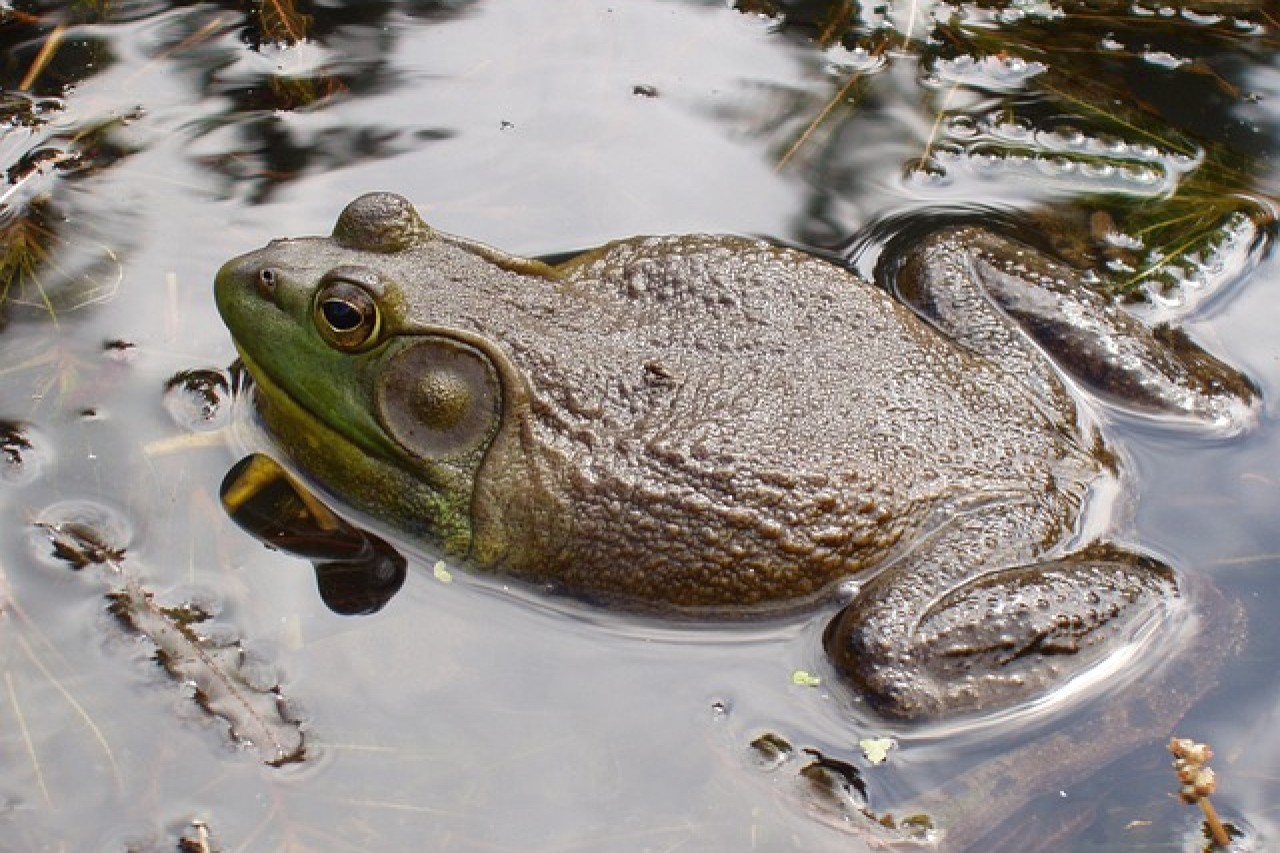
Had such an import ban been enacted years ago, there would be no problem with American bullfrogs in Germany.
Every year, more than 200’000 reptiles and amphibians continue to be imported into Germany from third countries – many of them are abandoned or escape due to owners being overwhelmed. Through public education and awareness in schools and the media about the negative impacts of importing and keeping exotic animals, demand for these animals could be reduced until a trade ban comes into force, writes Peta Deutschland. The animal welfare problem begins with the import.
Invasive American bullfrogs are colonising bodies of water in Baden and threatening the local fauna. Year after year, catchers go out, collect tadpoles and kill adult animals. The numbers fluctuate.
Around 300 American bullfrogs were shot last year in the region around Karlsruhe, nearly half as many as in 2023. «The figures are always heavily dependent on prevailing weather conditions and available personnel,» explained a spokesperson for the Karlsruhe Regional Council, which commissions the hobby hunters.
In addition, tadpoles of the invasive species are being removed. The spokesperson confirmed that the animals would also be controlled this year in the established manner.
25 centimetres in size
The background is that this introduced species threatens native wildlife. The North American bullfrog (Lithobates catesbeianus) eats essentially anything that comes within reach: other frogs, fish, and even small birds. «It is considered a non-native species along the Upper Rhine and reproduces rapidly,» states a flyer from the Regional Council.
Natural enemies such as crocodiles, alligators, and snakes, which exist in its native habitat, are absent here. This allows it to spread unchecked. As studies show, hobby hunting fails as a method of population control for invasive species.
According to reports, the animals grow up to 25 centimeters in size, making them significantly larger than native frogs. This begins at an early stage: the tadpoles grow up to 15 centimeters.
According to reports, a female produces up to 50’000 eggs when spawning. As a result, the animals multiply at an explosive rate.
Three years until they reach land
«Unlike native amphibians, the American bullfrog does not attach its spawn to aquatic plants, but instead releases it into open water, causing the spawn to instantly ‘fray’ and disperse in all directions, making it virtually undetectable in large gravel pit lakes,» the Ministry of the Environment once explained in response to an inquiry.
The development of the tadpoles in this region can take up to three years, it states. During this time, they remain in the water until they reach land — and thus also overwinter in the bodies of water.
Spread to Ötigheim by humans
Experts assume that the American bullfrogs were released in Baden-Württemberg in the 1990s. According to the regional government authority, the distribution is essentially limited to the municipalities of Eggenstein-Leopoldshafen, Linkenheim-Hochstetten, the northern urban district of Karlsruhe, and Dettenheim.
Last year, the authority had a biotope pond near Ötigheim (Rastatt district) pumped out in order to deal with the bullfrog tadpoles. According to findings, humans must have transported the animals there from the known core areas. More on biodiversity.

«We suspect that individuals took tadpoles or juvenile frogs from one of the gravel pit lakes north of Karlsruhe in order to place them in their home garden ponds,» the spokesperson explained. «There was no independent spread of the species as far as Ötigheim.»
Monitoring was also planned for this year to detect any animals if present and to prevent the establishment of the invasive species. Should garden pond owners notice unusually large tadpoles or frogs, they are advised to inform the regional government authority.