Brown Hare: The Geneva Model Shows the Way
The brown hare is becoming increasingly rare in Switzerland. In the hunting-free canton of Geneva, however, it thrives. WWF is looking for innovative farmers in Lucerne and Zug to help the brown hare. More about the hunting-free canton of Geneva.

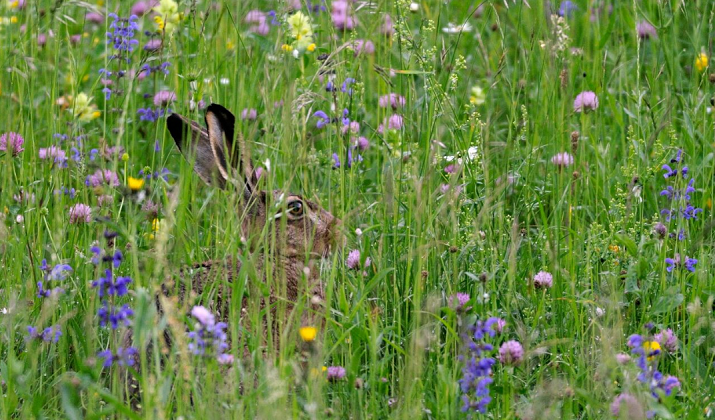
The brown hare is becoming increasingly rare in Switzerland. Its numbers have been declining for decades.
WWF is now looking for innovative farmers in the cantons of Lucerne and Zug to give the brown hare a boost.
Whether made of fabric, chocolate, or sponge cake, Easter bunnies are everywhere right now. But the real thing — the brown hare — is becoming ever rarer. Since the 1950s, when hares enjoyed near-ideal conditions in agricultural areas, their numbers have declined dramatically. In the 1990s, the average was 4.5 per 100 ha; by 2010, this had fallen to just 2.3. This is shown by the surveys carried out in spring 2016 on behalf of the Federal Office for the Environment (FOEN). The results from central Switzerland are alarming: in four out of six study areas in the Lucerne region, the brown hare has virtually disappeared in recent years. Despite this, the brown hare is still hunted in Lucerne — 22 individuals were shot, for example, in 2015.
Recipes for Promoting the Brown Hare
Together with farmers, hobby hunters, scientists, and authorities, WWF is now exploring ways to help the brown hare make a comeback. “We now know how to help the brown hare,” says Kurt Eichenberger, head of the WWF regional offices for Uri and Lucerne. “This year, as a first step, we are looking for innovative farmers in the cantons of Lucerne and Zug who are willing to sow their grain more thinly or to establish wildflower fallow strips differently.” In a second step, the situation of hares in the pre-Alpine region will be examined.
Brown Hares Under Pressure
Brown hares are actually steppe dwellers. In Switzerland, they live predominantly on fields and meadows in the Mittelland and, unlike rabbits, do not dig burrows. Hares rest in hollows known as forms. In grassland areas, populations have declined particularly sharply — at today's level of 1.3 brown hares per 100 ha, they are at an extremely low level. The situation is somewhat better in arable farming areas, where the average is 3.5 to 5 animals and a slight upward trend is visible.
The reasons for the decline of the brown hare are numerous. Recreational hunting, along with expanding settlements, roads, and paths, fragments and reduces the animals' habitats. Hiding places and diverse food sources have become scarce due to the intensification of agriculture. In particular, grassland is now mown earlier and more frequently, which is often fatal for young animals. The brown hare, once a ubiquitous presence, is therefore now listed on the Red List of endangered mammals in Switzerland.
Geneva as a model: Switzerland's highest brown hare density
The highest density of brown hares was recorded in 2016, with 17.7 per 100 ha in the hunting-free canton of Geneva — where professional game wardens handle wildlife management. This was the first density exceeding 17 brown hares per 100 ha anywhere in Switzerland since 2006.
The median across all surveyed areas in Switzerland in 2016 was 3.4 brown hares per 100 ha; in 15 areas, 1.0 brown hare per 100 ha or fewer was observed.
Interested farmers and volunteers who wish to get involved in brown hare conservation are invited to contact info@wwf-lu.ch or info@wwf-zg.ch.
Interest Group Wild beim Wild
The IG Wild beim Wild is a non-profit interest group dedicated to the sustainable and non-violent improvement of the human-animal relationship, with a specialisation in the legal aspects of wildlife protection. One of our primary concerns is to introduce contemporary and responsible wildlife management in the cultivated landscape, modelled on the canton of Geneva — without hobby hunters, but with principled game wardens who truly deserve the title and act in accordance with a code of ethics. The monopoly on the use of force belongs in the hands of the state. The IG supports scientific methods of immunocontraception for wildlife.