Swallows need our help
House martin populations in Switzerland have shrunk by a third: simple measures can help the birds.


Swallows depend on suitable nesting sites and a nature-friendly habitat.
Even simple measures can make a difference for them.
«In recent decades, house martin populations in Switzerland have declined by more than a third,» says Monika Jung of ARNAL, Bureau for Nature and Landscape AG in Herisau. On behalf of the canton of Appenzell Innerrhoden, the bureau wrote to all farmers in the canton asking them to report their swallow populations.
On the Red List
In Switzerland, the barn swallow and the house martin are the most common species. They are not always easy to tell apart at first glance. The barn swallow is characterised by its two long tail streamers and its rust-red throat. The house martin can be identified by its white rump, which is clearly visible in flight. Its population has declined so sharply that it is listed on the Red List of bird species, meaning its occurrence is potentially endangered, explains Michael Götz of lid.ch.
The nesting site must be right
Swallows are popular with the public. They are seen as harbingers of spring and as a good omen. Swallows are especially valued in agriculture, as they hunt the flies and mosquitoes that pester humans and animals during summer. The barn swallow is closely associated with farming, as it prefers to build its nests in barns — ideally in old tie-stall barns where it is warm and there are no draughts — provided there is a large enough opening through which it can enter.
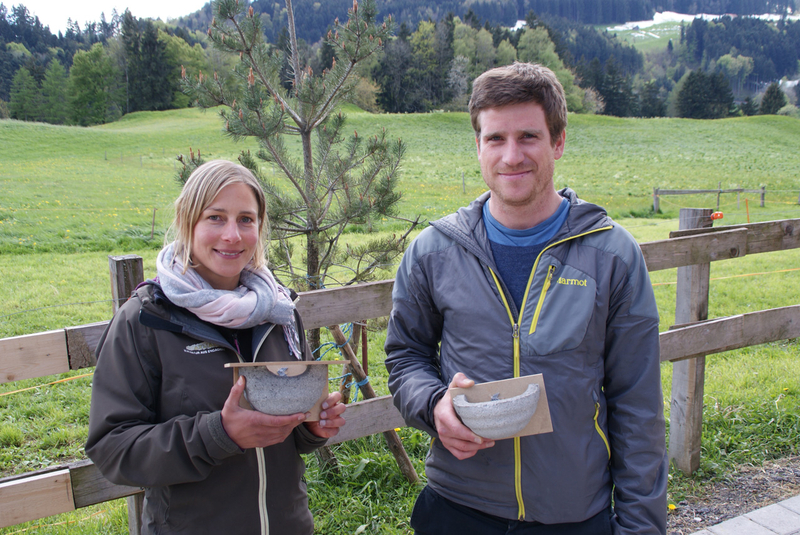
Suitable nesting sites are often lacking. Barn swallows and house martins "glue" their nests to a wall or ceiling beam using natural mud as mortar. In new barns, the roof supports — the glulam beams — are often planed smooth, so that a nest cannot grip them, or ceiling beams that would shelter swallow nests are absent entirely. This is where the farmer's help is needed. For example, he can nail a batten to a wall or beam to serve as a base for the nest. Swallows will also accept artificial nests placed in the right location. When positioning them, care must be taken to ensure that cats and martens cannot reach them. In modern free-range barns, draught-protected spots are important.
Artificial nests are a great help
According to a study carried out by the Swiss Ornithological Institute in Sempach between 2012 and 2014, around half of the reported house martins now nest in artificial nests, says Pirmin Reichmuth of the Nature and Landscape Conservation Office of the canton of Appenzell Innerrhoden.
"All swallow species and their nests are protected under the Hunting Act as well as the Nature and Cultural Heritage Protection Act. If the loss of a nest cannot be avoided (e.g. demolition of a building or facade renovation), this may only take place outside the breeding season (from October to the end of March)," writes the Swiss Bird Protection organisation SVS.
Simple aids for nest construction

Unlike barn swallows, house martins build their nests not in barns but under eaves; originally they used rock faces for nesting. House martins attach their nests not only to agricultural buildings but also choose houses in residential areas from which they can effectively hunt flies and mosquitoes. People can offer house martins suitable nesting sites by applying a rough plaster to the wall beneath the roof overhang or by installing artificial nests. Boards placed beneath the nests prevent droppings from falling down and making the birds unpopular with the residents. While barn swallows build their nests inside barns at some distance from one another, house martins place their nests close together side by side — they are colonial breeders. There are also differences in the type of nest itself, and these should be taken into account when offering artificial nests to swallows. The barn swallow's hemispherical nest is open at the top, whereas the house martin's nest has only a small entry hole, explains Monika Jung.
Record-Breaking Birds
Swallows are fascinating to humans in many respects. A pair of swallows brings approximately 150,000 insects to their young in the nest; between 700 and 1,500 mud pellets are needed to build a nest, and in autumn swallows travel around 6,000 km to their winter quarters in Africa, covering an average of 200 km per day in flight. On their journey and in their winter quarters, they face many dangers. They are often caught in nets, as they serve as a food source for people in poorer countries. Only about 50% of swallows return to us from Africa. The Ticino ornithologist Chiara Scandolare has discovered through modern satellite telemetry that barn swallows from the Magadino plain fly to Cross River National Park in Nigeria, where up to several million barn swallows are said to gather in small areas.
Improving Living Conditions
What Switzerland can do to support swallows is, all things considered, likely only a small contribution, but it plays a decisive role in maintaining the population within the country. Offering suitable nesting sites is one way to help the birds; another is to ensure an adequate food supply. In a landscape where more and more ground is being sealed over and agricultural use is becoming more intensive, there are fewer and fewer insects. Natural habitats such as wildflower meadows and shrubs, as well as green roofs and ponds, encourage the presence of many insect species and thus also the food supply for swallows. By decimating insects, swallows — unlike insecticides — preserve the ecological balance.
Swallows adapt
«When it gets cold, the flies in the barn disappear quickly,» says one farmer who has 20 to 25 pairs of barn swallows in his barn. The swallows then also find little food outside. The cold snap at the end of April this year made life difficult for them, says Jung, but fortunately most had not yet begun breeding. During that period, they retreated to lower altitudes where it was not as cold. Even if a brood fails, the birds can compensate for the loss. But swallows cannot defend themselves against the gradually worsening living conditions. This is where action must be taken if we want to preserve the swallow population in Switzerland.
Related dossiers and articles:
- Dossier: Hunting and Biodiversity
- Dossier: Red Lists Switzerland
- Dossier: Alternatives to Recreational Hunting
- Dossier: The Cultural Landscape as a Myth
- Get involved
More on the subject of recreational hunting: In our dossiers on recreational hunting gather fact-checks, analyses and background reports. The scientific evidence is presented in the overview Studies on the Effects of Recreational Hunting.
The position of IG Wild beim Wild: IG Wild beim Wild rejects recreational hunting. Our model is the canton of Geneva, which has managed without recreational hunting since 1974: without hunting seasons, without hunting dogs, without driven hunts, without high seats, without the animal cruelty and crime that go hand in hand with hunting season elsewhere. What has worked there for over fifty years disproves every position paper by JagdSchweiz. An association that bases its policy on claims it refutes in its own documents is not a professional organisation, but a factory for misinformation.