Spain: Recreational Hunters Face Increasing Pressure
On Sunday, 15 April 2018, thousands of recreational hunters in Spain demonstrated for their right to hunt, which they regard as part of their lifestyle.


The organiser was the Spanish hunting association RFEC (Real Federación Española de Caza / Royal Spanish Hunting Federation), which organised rallies on streets and squares in 40 provinces across the country. In Spain, there are approximately one million recreational hunters. The slogan of the demonstration was: «Yes to hunting — our way of life».
Three gatherings were recorded in the Balearic Islands: in Palma at the Plaza de España, in Menorca at the Es Mercadal exhibition centre, and in Ibiza in Sant Josep.
In the Balearic Islands, there are around 20’000 recreational hunters and more than 1’500 hunting grounds. Hunting is permitted in 80 percent of the area outside Palma.
Why did the recreational hunters want to make their voices heard?
Mainly because they are coming under increasing pressure from the general public due to their unprofessional and careless shooting. The widespread criticism — particularly in environmental and animal welfare media — regarding the cruelty to animals practised by recreational hunters is an embarrassment to them.
Recreational hunters poison the environment, nature, humans, and animals — for example through their ammunition. Lead is a heavy metal that not only kills animals in a cruel manner, but also enters the nutrient cycles of nature through chemical transformation, ultimately ending up in soil, drinking water, and food.
Today’s recreational hunting represents a massive, destructive, and violent intervention in natural rhythms and cannot be described as a positive necessity. Recreational hunters also bear significant responsibility for a major ecological imbalance in Spain.
Recreational hunters are simply demanding the right to hunt. Recreational hunting, they say, is their way of life. They want to continue raising their children according to their values. They want the hatred towards recreational hunters to stop and not to be regarded as strange individuals. All of rural life is under threat, says recreational hunter Pedro Bestard for example in the Balearic Islands in the Mallorca Magazin.
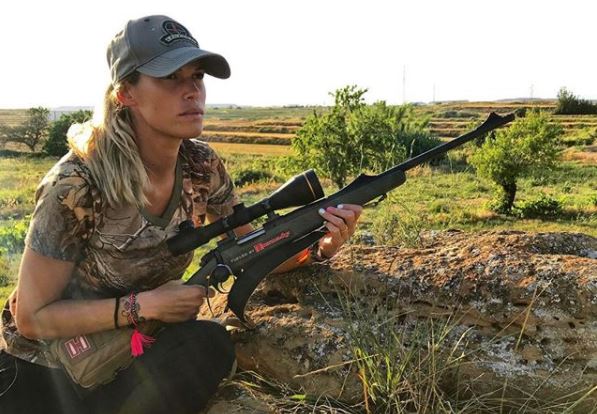
«Criticism of hunting has always existed. But the attacks have multiplied in the past two or three years. They intensified after the case of Mel Capitán, the Catalan huntress who took her own life last summer, and continued relentlessly», according to Bestard.
The Catalan huntress was active on the online platform Instagram, among other places. There she had thousands of followers. According to recreational hunters, she allegedly took her own life following numerous verbal attacks from animal rights activists.
Yesterday's demonstration is considered a response to a demonstration against recreational hunting held in February 2018 by environmental and animal welfare activists in 31 cities across Spain.
The uncultured ways of recreational hunters
There is no ethic that endorses the killing for fun of millions of wild animals and birds per year in Spain. When people hunted in earlier times, it was done with respect for life and only to feed their own kin. Today, no one needs to go recreational hunting to feed themselves. The Stone Age is over!
11 million birds per year
As in other Southern European countries, recreational hunters have largely wiped out four-legged game over the centuries. It is therefore hardly surprising that migratory bird hunting is widespread in Spain. A total of 36 bird species are approved for shooting, including 8 species of geese and ducks, quails and turtle doves, 4 different species of thrushes and the common starling. The annual bird hunting bag in Spain amounts to around 11 million birds!
The trapping of birds is still permitted in some regions of Spain. In the south-east of the Iberian Peninsula, finches — primarily goldfinches — are still caught with clap nets and sold as “cage birds”. Along the entire Mediterranean coast and in the Balearic Islands, small songbirds are trapped using snap traps, and on Mallorca the catching of thrushes is still permitted. In the north-east of the country, in the autonomous regions of Catalonia and Valencia, countless thrushes continue to be caught every year using lime sticks in the so-called «Barracca» and «Parany», despite clear directives from the European Union.
Recreational hunters are a large and active group in Spain and engage in what they consider a legal activity. They publicly stated on Sunday that they do not deserve to be attacked in this way. However, these very recreational hunters also repeatedly face criticism internationally — for example, regarding the way they treat their hunting dogs, the Galgos. More on the animal welfare problem of recreational hunting and on crime and recreational hunting.
More on the subject of recreational hunting: In our dossiers on the criticism of recreational hunting gather fact-checks, analyses and background reports. What the research says about this is shown by Hunting fact-checked: the state of research.
The position of IG Wild beim Wild: IG Wild beim Wild rejects recreational hunting. Our model is the canton of Geneva, which has managed without recreational hunting since 1974: without hunting seasons, without hunting dogs, without driven hunts, without high seats, without the animal cruelty and crime that go hand in hand with hunting season elsewhere. What has worked there for over fifty years disproves every position paper by JagdSchweiz. An association that bases its policy on claims it refutes in its own documents is not a professional organisation, but a factory for misinformation.