Study: Ravens react to frustration like young children
Researchers have for the first time demonstrated emotional contagion in birds. In an experiment, ravens responded with frustration when their fellow ravens were also frustrated.

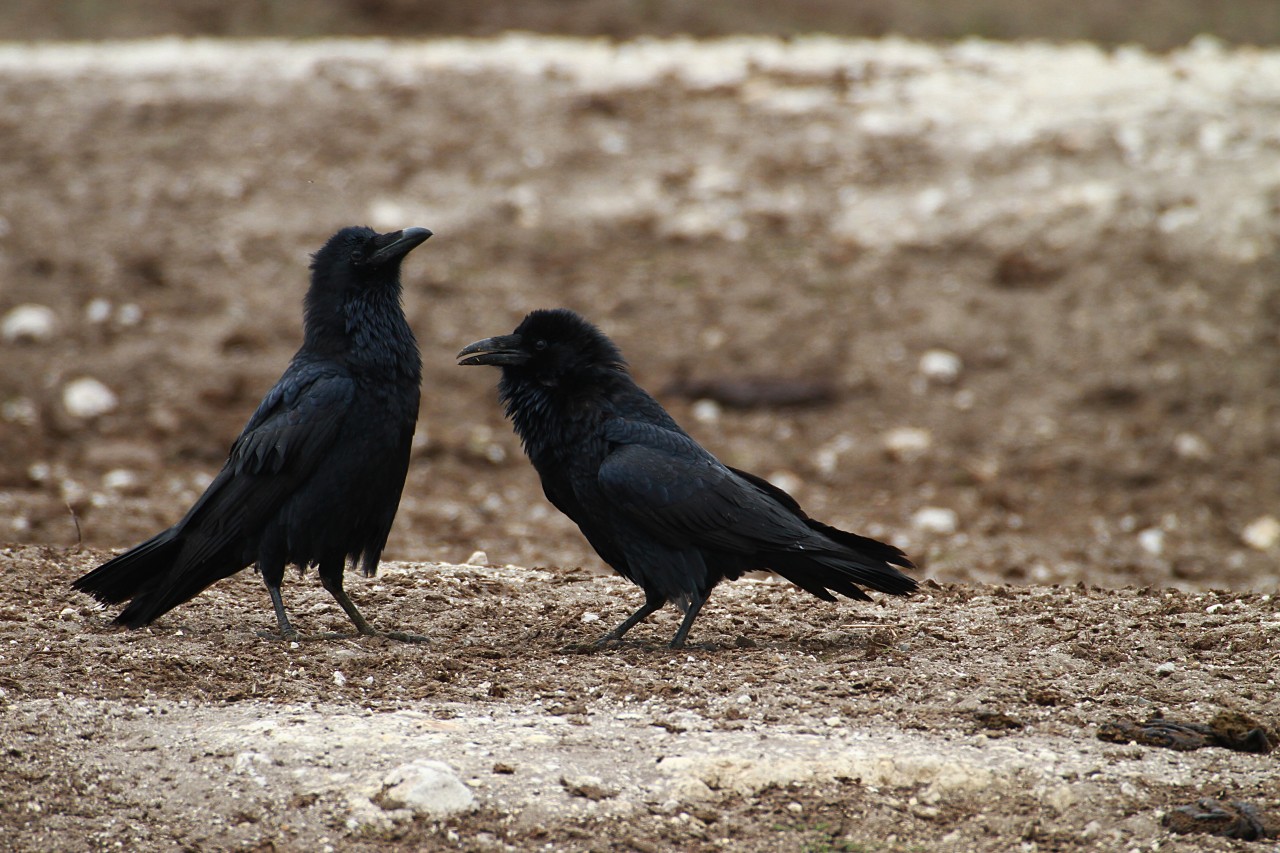
A team of behavioural researchers and neuroscientists has shown that emotional contagion appears to exist among ravens as well. In an experiment, the tame birds behaved more pessimistically after having observed a frustrated member of their own species. The study results thus also provide insights into the fundamental development of empathy, the researchers report in the journal «PNAS».
Emotional contagion is an important means of transmitting information between individuals and is considered a fundamental element of empathy. Scientists widely assume that this capacity is also prevalent in the animal kingdom. «This mechanism is particularly important in higher animals. However, the basic elements should also be present in some other animal species», said Thomas Bugnyar of the University of Vienna.
Clear proof is difficult, however, due to methodological challenges. The group led by Bugnyar and Claus Lamm from the Institute for Basic Psychological Research and Research Methods at the University of Vienna therefore undertook an interdisciplinary study involving common ravens that are accustomed to participating in behavioural experiments.
Favourite or undesirable food
The researchers induced a positive or negative mood in one of the two animals involved each time by allowing it to look through a peephole. Behind it was either highly desirable or entirely undesirable food. The reaction of this “demonstrator raven” was observed in each case by the “spectator raven.” The scientists measured whether the demonstrators’ joy or frustration had a contagious effect on their counterpart by exposing the latter to an ambiguous situation.
This could be compared to the age-old question: “Is the glass of water half full or half empty?» reframe, according to Bugnyar. Depending on the mood one brings to the situation, the judgment tends to fall one way or the other.
Speed reveals mood
The birds had a board in front of them with cups on it, which either contained rewards or did not. From how quickly the animals approached the cups, it is possible to determine whether they were driven by optimism about a treat or held back by low expectations. «So if they approach it optimistically, they should be fast; if they are pessimistic, they should be slow», said Bugnyar. The observer ravens each went through this situation before and after watching their conspecifics.
Comparing the values showed that the animals took longer on average when they had previously observed visibly frustrated peers. Positive mood, by contrast, did not transfer as visibly. «In the negative, however, it worked wonderfully», said the cognitive biologist. The finding that emotional contagion apparently also occurs in ravens sheds new light on when precursors to empathy evolved over the course of evolutionary history, according to the study's lead author, Jessie Adriaense.
More on the subject of recreational hunting: In our dossiers on recreational hunting gather fact-checks, analyses and background reports. What the research says about this is shown by Hunting fact-checked: the state of research.
The position of IG Wild beim Wild: IG Wild beim Wild rejects recreational hunting. Our model is the canton of Geneva, which has managed without recreational hunting since 1974: without hunting seasons, without hunting dogs, without driven hunts, without high seats, without the animal cruelty and crime that go hand in hand with hunting season elsewhere. What has worked there for over fifty years disproves every position paper by JagdSchweiz. An association that bases its policy on claims it refutes in its own documents is not a professional organisation, but a factory for misinformation.