What is the difference between patent hunting and district hunting?
In Switzerland, three fundamentally different hunting systems exist: patent hunting (in 16 cantons), district hunting (in 9 cantons) and state hunting (in Canton Geneva).

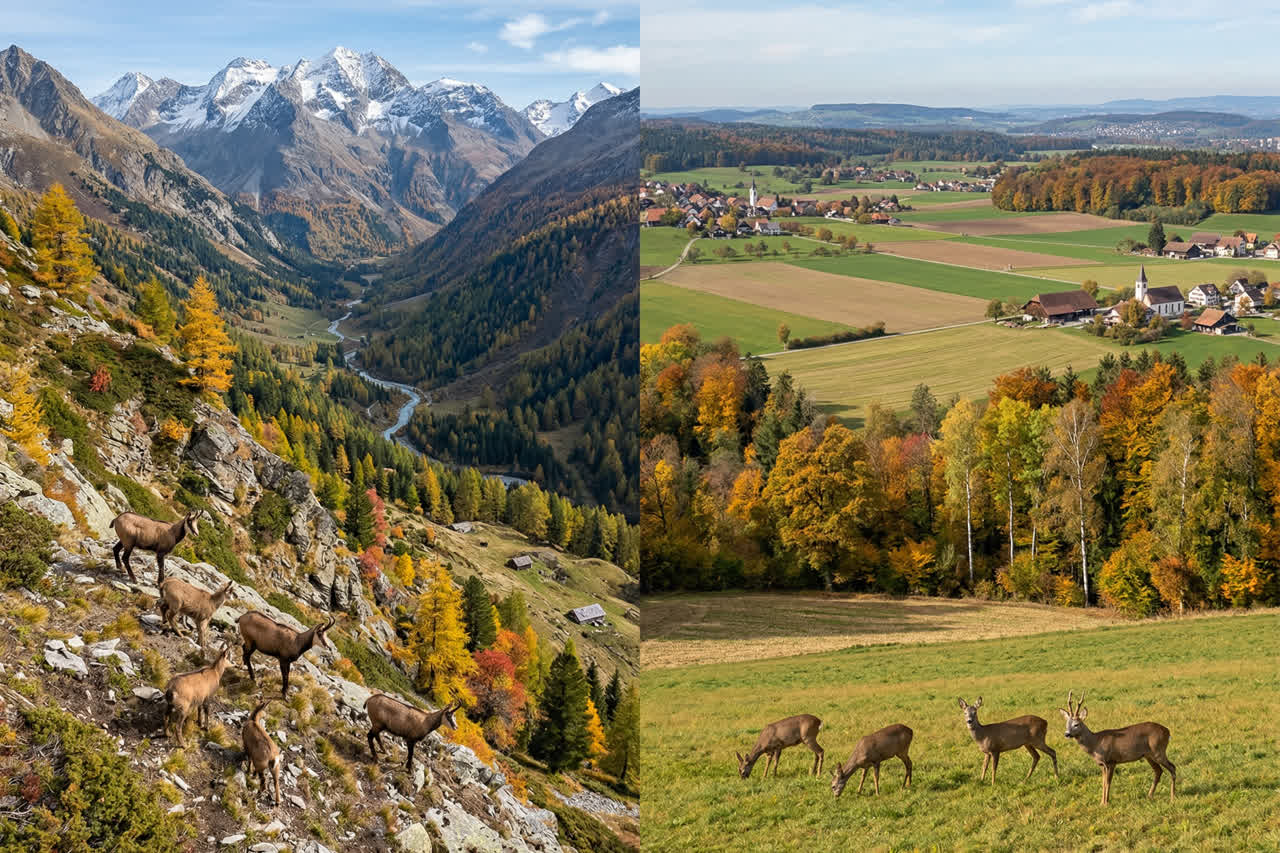
What appears at first glance to be an administrative difference is much more from a hunting-critical perspective: Two systems legitimize recreational hunting as a leisure activity and neither resolves the ecological and animal welfare contradictions inherent in hunting.
Overview of Switzerland's three hunting systems
The Swiss hunting system is divided into three models: Patent hunting (16 cantons) works by having the state sell shooting licenses to authorized persons. District hunting (9 cantons) allows recreational hunters to lease exclusive hunting districts. State hunting (1 canton: Geneva) means that only state game wardens hunt – effectively a hunting ban for private individuals. The cantonal distribution has grown historically and reflects cultural as well as political traditions. Geneva is the only canton with an effective hunting ban for private individuals – a model that is unique in Switzerland. Our dossier on the Geneva hunting ban examines this model in detail.
What is patent hunting?
In patent hunting, the canton issues shooting licenses (so-called patents or hunting cards) for specific animal species, quantities and time periods. Any person who has completed hunting training and passed the cantonal hunting examination can acquire a patent for a fee. With this patent, they may hunt throughout the canton's entire public hunting area – not in an exclusive preserve, but in the state-defined hunting territory.
Cantons with patent hunting (16): Graubünden, Valais, Ticino, Glarus, Uri, Obwalden, Nidwalden, Appenzell Innerrhoden, Appenzell Ausserrhoden, Schaffhausen, Schwyz, Zug, Lucerne, Solothurn, Jura and others.
The canton of Graubünden is the largest patent hunting canton in Switzerland. With around 7,106 square kilometers of hunting area and several thousand hunting cards issued annually, the Graubünden high hunt is a mass spectacle: During the high hunt in September, thousands of hobby hunters stream into the Graubünden mountains. The high hunt for deer, chamois and roe deer takes place within a tightly scheduled time window and demonstrably causes considerable stress for wildlife populations.
Patent fees: What hobby hunters pay
The amount of patent fees varies greatly depending on the canton and animal species. In Graubünden, for example, a deer patent costs several hundred to over a thousand francs, depending on the class (calf, young animal, stag). Chamois and roe deer patents are cheaper. In addition come examination fees, equipment costs, accommodation and travel costs – recreational hunting is an expensive leisure activity.
Part of these patent fees flows into the cantonal treasury and is used for wildlife damage compensation, game wardens and wildlife management. Nevertheless, the total costs of hunting administration significantly exceed the patent fees collected in many cantons – the general public subsidizes the leisure activity of hobby hunters. More on this in the dossier «What recreational hunting really costs Switzerland».
What is preserve hunting?
In preserve hunting, hunting associations or individuals lease a demarcated hunting preserve from landowners or municipalities. The lessee has exclusive hunting rights in this preserve for the lease duration – typically 8 years (6-12 years depending on the canton). They bear responsibility for the preserve, must create shooting plans and are responsible for wildlife damage prevention.
Cantons with preserve hunting (9): Zurich, Bern, Aargau, Basel-Landschaft, Basel-Stadt, Fribourg, Neuchâtel, Vaud (partially) and Thurgau. Zurich is a typical preserve hunting canton. The hunting preserves are typically several hundred to over a thousand hectares in size. The lessees pay lease prices that vary greatly depending on the preserve and location – from several thousand to several tens of thousands of francs per year in attractive preserves with good wildlife populations.
Lease duration and shooting planning in preserve hunting
The typical lease duration of 8 years gives preserve lessees a longer planning horizon. This is portrayed by hunting advocates as an advantage over patent hunting: the lessees would have an interest in managing the preserve 'sustainably.' In practice, however, this argument leads to another problem:
Preserve lessees have a financial interest in high wildlife populations – a well-stocked preserve is more attractive to hunting guests and justifies higher lease prices. This can lead to wildlife populations being deliberately kept high – which is ecologically counterproductive and promotes browsing damage in forests. Shooting plans are often negotiated between preserve lessees and cantonal authorities, whereby the lobby power of hunting associations makes transparent regulation difficult. More on wildlife populations and browsing damage in the dossier on the forest-wildlife conflict.
High hunt and special hunt: Special hunting forms in the patent hunting system
In patent hunting cantons, particularly in Graubünden, there are additional special hunting forms besides the regular hunting season. The Graubünden High Hunt (September) is the largest hunting event in Switzerland. Within a few weeks, thousands of deer, chamois and roe deer are shot. The High Hunt is criticized because the massive presence of hobby hunters in mountain areas leads to considerable stress for wildlife populations, particularly shortly before winter. Our High Hunt dossier documents these problems comprehensively.
The special hunt in Graubünden takes place after the High Hunt and is intended to kill wildlife that could not be added to their shooting quotas during the High Hunt. It extends hunting pressure on wildlife populations into the winter months and is particularly problematic ecologically, because wildlife is already under severe energetic stress in winter. Our dossier on the special hunt in Graubünden provides the details.
The hunting license: Access to both systems
Regardless of whether patent or district hunting: a prerequisite in both systems is passing the hunting license. The training includes wildlife studies, shooting training and legal foundations. From a hunting-critical perspective, however, hunting education in Switzerland is not suitable for teaching hobby hunters ecologically sound wildlife management. It serves primarily for technical qualification to kill – not the question of whether and when culling makes ecological sense. More on this in the hunting license dossier.
Criticism of patent hunting from an animal welfare perspective
Patent hunting is criticized by animal welfare organizations for the following reasons: First, the mass character of the High Hunt – thousands of hobby hunters simultaneously in the hunting area lead to panic, flight stress and hunting pressure that goes far beyond what is ecologically acceptable. Second, lack of selectivity – the patent system allows little individual selection of animals to be culled. Third, commercialization: the High Hunt is an economic event for many mountain regions, which means the system is maintained even when ecological arguments speak against it.
Criticism of district hunting from an animal welfare perspective
District hunting is criticized by animal welfare organizations for other reasons: Through the privatization of wildlife, whoever leases a district effectively regards the wildlife living in it as their 'property' – which contradicts the legal principle that wildlife is ownerless. District lessees have economic interests that can collide with the ecological necessity of low ungulate populations. Leased hunting districts also factually restrict the use of nature and forests by the general public.
Why both systems legitimize hobby hunting
Despite their differences, patent and district hunting share a fundamental commonality: they both legitimize hobby hunting as a recognized leisure activity. In both systems, wildlife is killed to fulfill hunting quotas or maximize one's own hunting experience – regardless of whether there is a genuine ecological need for the culling.
The Geneva model shows that things can be done differently: in the only canton without private hobby hunting, wildlife is professionally regulated by state game wardens. The result is a more efficient, cost-effective and animal welfare-compliant system. Why this model is not applied nationwide has less to do with factual arguments than with the political weight of the hunting lobby. More on this in the dossier on introduction to hunting criticism.
The hunting systems in numerical comparison
According to the dossier 'Hunting in Switzerland – Numbers, Systems and the End of a Narrative' around 130,000 to 150,000 wild animals are killed annually in Switzerland as part of recreational hunting. The distribution between patent hunting and concession hunting cantons is nearly balanced. A system comparison shows that neither patent hunting nor concession hunting is better suited for conducting ecologically justified wildlife management. Both systems are primarily oriented towards the interests of hobby hunters – not the needs of wildlife or biodiversity.
Conclusion: Two systems, one problem
The distinction between patent hunting and concession hunting is important for understanding the Swiss hunting system. From a hunting-critical perspective, however, it also distracts from the essential point: Both systems allow tens of thousands of hobby hunters to kill wild animals for the pleasure of killing – financed through taxes, subsidized through cheap leases on state land and legitimized through a political system that is intensively lobbied by the hunting lobby. Geneva's state hunting model shows that professional wildlife management without recreational hunting is not only possible, but more efficient.
Further content on wildbeimwild.com:
- Dossier: Hunting in Switzerland – Numbers, Systems and the End of a Narrative
- Dossier: Introduction to Hunting Criticism
- Dossier: High Hunting in Switzerland
- Dossier: Special Hunting in Graubünden
- Dossier: The Hunting License
- Dossier: Geneva and the Hunting Ban
More background on current hunting politics in Switzerland can be found in our Dossier on wildbeimwild.com.
Support our work
With your donation you help protect animals and give voice to their concerns.
Donate now →