Lower Saxony's Recreational Hunters Without Heart or Mind
Lower Saxony's recreational hunters act without heart or mind. Animal welfare organisations document systematic violations of animal protection law.


Never since records began have so many raccoons been killed in Lower Saxony as in the past hunting season.
This is shown in the 20th State Hunting Report.
The number of raccoons shot reached a record level in the past 2021/22 hunting season. With 23,322 animals killed, the figure grew by 10.3 percent compared to the previous period, said Helmut Dammann-Tamke, President of the State Hunters' Association of Lower Saxony, on Monday at the presentation of the State Hunting Report in Hannover. The animal is considered a so-called invasive species; it was brought to Germany by humans.
Hunting was necessary, said Dammann-Tamke. It is expected that the hunting of invasive species will increase even further in the future, although common sense and experts see no ethical or sustainable results from it.
The arguments put forward to justify hunting are entirely lacking in any qualitatively, quantitatively, or scientifically substantiated basis with regard to the alleged significant damage and dangers posed by these animals.
I do not know a single scientist or hunting expert who seriously believes that hunting measures can stop these animals. We simply have to accept that the raccoon feels at home here and that we cannot regulate it. In that respect, we must come to terms with it.
Dr. Ulf Hohmann, wildlife biologist and raccoon expert
Since April 2022, the state of Lower Saxony has also permitted the use of night-vision and night-sighting technology for foxes, nutrias, and raccoons.
The citizens' initiative Pro Fuchs Deutschland criticized the introduction in the past. Johann Beuke, himself a hunter, considers the change in law harmful, telling the «Jägermagazin»: «Hunters still think: anything with claws and sharp teeth must be kept in check. That is a huge problem.»
There are indeed other options — non-lethal measures for controlling raccoon populations, as also provided for by the EU regulation, but these are not applied because the recreational hunters, invoking EU law (Wrong! The EU regulation does not necessarily require killing!), prefer to take militant action themselves — as so often, to no meaningful end.
On a list published by the EU of the “100 worst invasive animal species on the continent”, the raccoon does not appear at all, unlike, for example, the cat or the trout.
In this context, it is essential to mention that in Germany the raccoon was considered „native" prior to 2016, as it met the definition under the German Federal Nature Conservation Act until 2017 for "native species": “A wild animal or plant species is also considered native if feral animals or plants of the species concerned, or those that have become established through human influence, have maintained themselves in the wild within the country over several generations as a population without human assistance.”
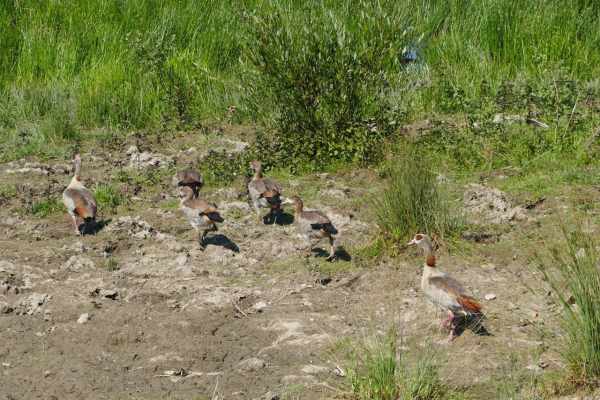
Indeed, particularly in the case of the so-called invasive animals raccoon, raccoon dog, nutria, and Egyptian goose, a dramatic increase in the number of animals killed has been observed, especially since the EU list came into force in 2016.
It has long been scientifically established that raccoon hunting stimulates reproduction and, in addition, destroys age structures and social structures. The attempt to push back raccoon populations through hunting is now considered hopeless and a failure even in Germany.
Which other animals are also considered invasive?
Other invasive species include nutria and raccoon dogs. For these two species, the number of animals killed declined: for the nutria, it fell by 10.2 percent to 40,980 animals according to the report; for the raccoon dog by 10.7 percent to 3,914 animals. Nutria are particularly dangerous for flood protection because they like to build their burrows in embankments and levees, which weakens these structures.
The State Hunting Report is being presented for the 20th time this year. Lower Saxony thus has a nationally unique reference work on wildlife populations, said Dammann-Tamke. The hunting year begins on 1 April and ends on 31 March.
The state hunting report demonstrates once again the pointless, environmentally harmful and useless work carried out by recreational hunters in Lower Saxony.
- Keeping raccoons away in an animal-friendly manner
- Raccoons have a right to life too
- The treatment of “invasive” species – a critical analysis from a biological and legal perspective
- Neozoa
- Basel wants to kill raccoons
- Raccoons are not a threat
- Open letter to Katrin Schneeberger of the BAFU
- Removal of the raccoon from the lists of so-called invasive species
- Facts instead of hunters’ tales about raccoons
- The office for hunting and nonsense in the canton of Aargau wants to shoot raccoons
More on the subject of recreational hunting: In the dossier The Role and Criticism of Recreational Hunters we shed light on the training, power and self-image of recreational hunters. The scientific evidence is presented in the overview Studies on the Effects of Recreational Hunting.
The position of IG Wild beim Wild: IG Wild beim Wild rejects recreational hunting. Our model is the canton of Geneva, which has managed without recreational hunting since 1974: without hunting seasons, without hunting dogs, without driven hunts, without high seats, without the animal cruelty and crime that go hand in hand with hunting season elsewhere. What has worked there for over fifty years disproves every position paper by JagdSchweiz. An association that bases its policy on claims it refutes in its own documents is not a professional organisation, but a factory for misinformation.