India: 8-year-old boy bites cobra to death
In India, an 8-year-old boy bit a cobra to death after it had bitten him. The unusual incident is making headlines around the world.


After being bitten by the deadly snake himself, an 8-year-old boy from India killed a cobra by biting it to death.
The young boy was taken by ambulance to a nearby hospital, where he was treated with antivenom for the bite and later discharged.
While playing in his garden, Deepak Ram was allegedly bitten by a snake. He claimed the snake had bitten him after wrapping itself around his hand. Ram bit the reptile twice after attempting to shake it off, which he was unable to do while suffering unbearable pain.
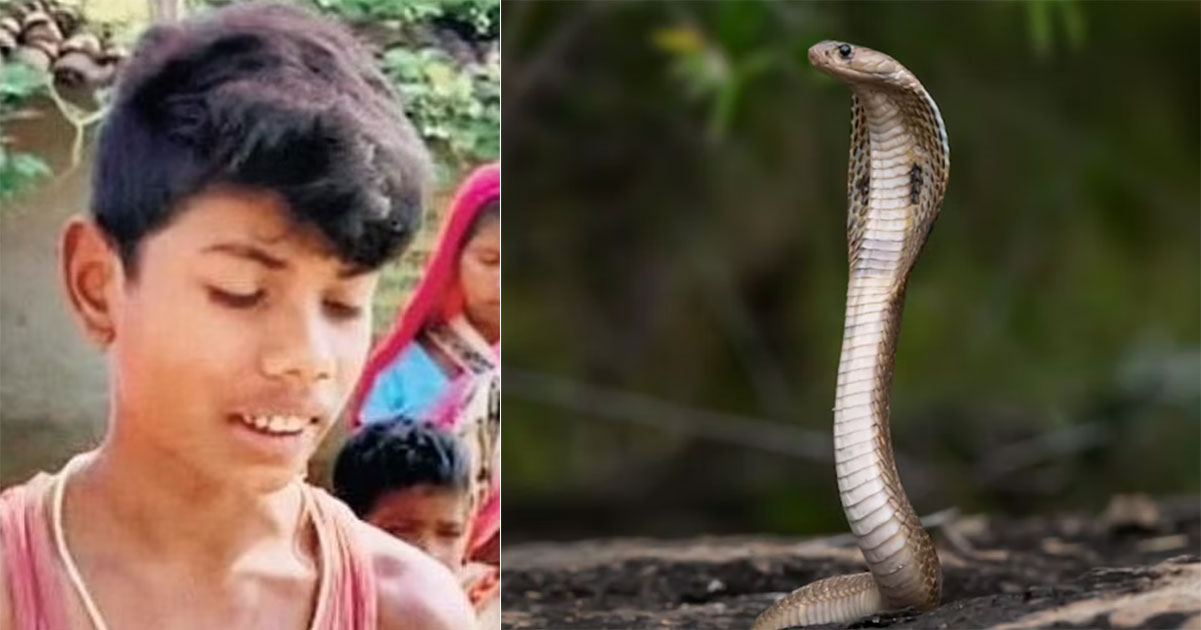
The unusual incident occurred in the Jashpur district of the state of Chhattisgarh, also known as Naglok due to its dense snake population. Naglok means «Kingdom of Snakes«.
Snakes in India
More than 60 of India's nearly 300 snake species are venomous. According to estimates by the World Health Organization, more than 1.2 million people in India died from snakebites between 2000 and 2019, more than in any other country.
Timothy Jackson, a toxicologist at the Australian Venom Research Unit at the University of Melbourne, said that one of the main factors contributing to snakebite morbidity and mortality in South Asia is the Indian spectacled cobra, or Naja naja.
Jackson added that despite the diversity of cobra venoms, neurotoxins and cytotoxins are the most common and are potentially the most clinically significant toxins. These are toxins that damage cells and toxins that affect the nervous system by, for example, blocking cell signal transmission. As a result, neurotoxicity (paralysis) is the consequence of cobra envenomation most likely to lead to death.
He added that cobra venoms can also cause severe tissue damage due to the presence of cytotoxins.
Snake bites are defensive
According to Jackson, snake bites on humans are almost always the result of defensive reactions. However, there are some exceptions. Some snake species sporadically bite humans while they sleep, both in India and in sub-Saharan Africa. In both regions, there are serious problems with snake bites.
He continued that there is no consensus on why this occurs, but it appears that these snakes enter homes at night in search of food and bite people who smell sufficiently like other mammals to trigger a feeding response. They are likely searching for small mammals such as mice.
Jackson said that cobras are among the snakes known to repeatedly bite humans in this manner, although in India it is typically kraits that are the culprits.
In 2019, an estimated 63’000 people died from snake bites, and 51’000 of those deaths occurred in India, according to a study recently published in Nature Communications.
Using this information, the percentage of deaths caused by venomous animals attributed to snakes was modeled by location, sex, age, and year.
The results show that South Asia, encompassing Pakistan, India, and Bangladesh and extending from Afghanistan to Sri Lanka, records the highest number of deaths from venomous snake bites.
In India, the mortality rate from snake bites was calculated at four per 100’000 people, significantly above the global average of 0.8, reports the Daily Mail.
Antivenom and dry bites
To effectively treat a bite from an Indian cobra, antivenom must be administered immediately. The antivenom consists of specific antibodies that bind to the toxins in the venom and neutralise them. Jackson noted that the moment the toxins are bound, they become inactive or can simply be eliminated by other elements of the immune system.
Jackson said that Deepak had suffered a «dry bite» from the cobra, meaning no venom was injected. There is no way to explain why dry bites occur so frequently in some venomous snake species, and there are no precise statistics on the matter, although there is anecdotal evidence to the contrary. It is therefore recommended to treat every bite from a potentially venomous snake as a serious emergency.
To prevent snakebites, people should, according to Jackson, be informed about local species and their ecology in order to avoid interactions. It is also important not to attempt to catch or kill snakes.
Despite all efforts, snakebites continue to occur, which is why it is important to have the right antivenoms on hand. This requires that the products be manufactured and distributed efficiently. He also calls on at-risk population groups to behave «health-consciously» and to seek hospital care immediately, reports Newsweek.