Berlin: How Wildlife and Cats Coexist
Wildlife cameras in Berlin gardens reveal that foxes, raccoons, and martens avoid domestic cats and shift their activity times accordingly.

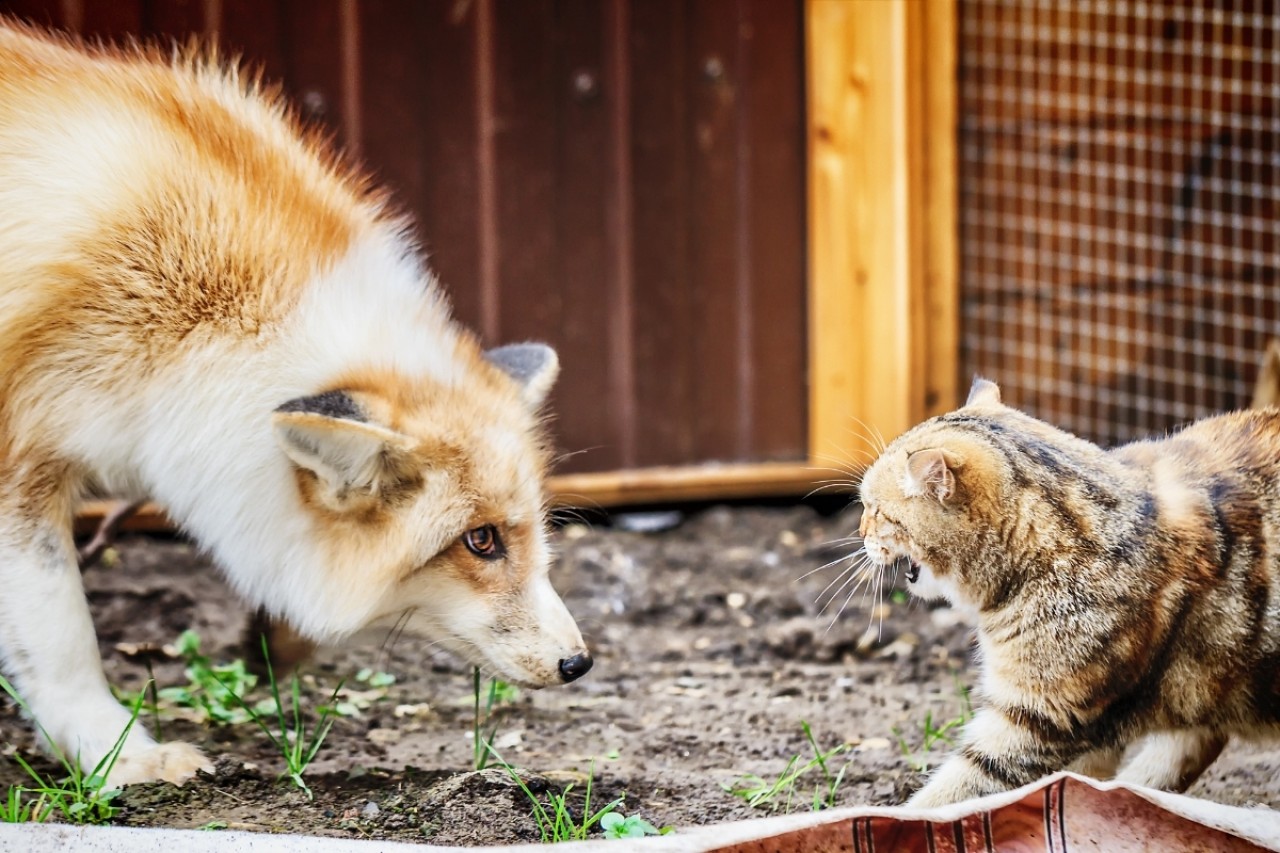
Avoiding or competing, eating or being eaten, exploiting or cooperating: communities of animal and plant species are shaped by a wide variety of interactions among their members.
In cities, these rules of coexistence are further fundamentally influenced by the presence of humans. Scientists at the Leibniz Institute for Zoo and Wildlife Research (Leibniz-IZW) have now evaluated tens of thousands of photos from around 150 wildlife cameras that Berlin citizen scientists installed in their gardens over five rounds between autumn 2018 and autumn 2020. The photos reveal how foxes, raccoons, and martens interact with domestic cats in the city and how well they get along with humans. All three wildlife species used the same locations, primarily during the night-time hours and at different times from one another. During the lockdowns, they were photographed more frequently, especially at night. In addition, all three wildlife species avoided domestic cats. These and further findings have been published in the Journal of Animal Ecology.
Citizen Science Project “Wildtierforscher”
The analysis of the photos is part of the citizen science project “Wildtierforscher” (Wildlife Researchers) at the Leibniz-IZW, led by Prof. Stephanie Kramer-Schadt, and forms one pillar of the “WTimpact” project network, which operates at the interface between science and society. WTimpact was funded by the Federal Ministry of Education and Research from 2017 to 2021. In the “Wildtierforscher” project, researchers from the Leibniz-IZW and Berlin citizen scientists collaborated to study the ecology of urban wildlife. Gardens were chosen as study sites because they can be both attractive and off-putting to wildlife. Urban gardens represent an important food source for wildlife, offering compost heaps, vegetable patches, fruit trees, and pet food. At the same time, they are places where there is a high likelihood of unwanted encounters with humans or domestic animals.
The project team divided the city of Berlin into a regular grid of nearly 300 cells measuring two by two kilometers for the analysis. For five field phases of one month each, Berlin residents who had a private garden within the city could apply to participate and were selected so as to be distributed as evenly as possible across the entire grid. Participants installed a wildlife camera in their gardens that recorded animal sightings whenever its motion sensor detected movement. The scientific team at Leibniz-IZW later combined this data with local information on garden size, local tree cover, potential food sources, and fence height, as well as data on population density. In each field phase, the cameras captured between 2’200 and 3’000 photos of cats, 300 to 1’200 of red foxes, 250 to 1’000 of raccoons, and 50 to 300 of martens, along with numerous photos of other mammals.
Predators in human-dominated environments
“We were interested in whether and how the flexible and adaptable predators are present in human-dominated environments and how they interact spatially and temporally,” says lead author Dr. Julie Louvrier, IPODI fellow at the Technical University of Berlin and guest researcher at Leibniz-IZW in the Department of Ecological Dynamics. “That is, we wanted to know whether they use the same locations, and if so, whether they avoid each other by, for example, visiting at different times of day or night.”
The key findings of Louvrier and her team:
Seasons and Covid lockdowns had a major influence on how frequently wildlife species were detected. Autumn is a noticeably more active season for Berlin’s foxes, raccoons, martens, and cats than spring. During the lockdowns, Berlin residents likely spent more time in their gardens during the day, forcing wildlife to shift to nighttime activity. At the same time, the presence of foxes, martens, and raccoons in gardens increased overall during the lockdown periods, likely due to the generally reduced level of human activity in urban spaces.
All wildlife species studied tolerate human presence to a certain degree, but avoided actual encounters with people by concentrating their activity at night — the time when humans are least active.
The occurrence of foxes, raccoons, and martens in gardens changed in a similar way: when there were more foxes, there were also more raccoons and martens, and vice versa. They belong to the same ecological guild and exploit the same resources in a human-altered environment such as a city. At the same time, the species avoid each other, as detailed temporal analyses show: the researchers identified a systematic time lag between consecutive detections of the wildlife species. These animals clearly use the same space at different times.
Domestic cats as the dominant species
Domestic cats are a special case: on one hand, “more cats” also meant more photographed raccoons (raccoons likely use the presence of cats as a cue for pet food in gardens); on the other hand, martens and foxes did not appear more frequently when cats were present in a garden. This suggests a hierarchy among the four species, with the human-associated pet species being the dominant one. Cats do not appear to follow a temporal avoidance pattern toward the other species, even though their body weight — which could be an indicator of dominance — is on average lower than that of foxes and raccoons.
We humans exert strong selective pressures on wildlife species, thereby altering their behaviour and way of life. The lockdowns were a silver lining for research, functioning like an experiment, as they gave us the opportunity to study how our wild neighbours behave when humans suddenly disappear from urban spaces.
Stephanie Kramer-Schadt, Leibniz-IZW
“Our study provides new insights into the rules underlying interactions within a community of medium-sized predators in an urban environment,” says Louvrier. There are several variables that influence interaction patterns — wholly or in part, both spatially and temporally — particularly when the effects of human presence are taken into account. Humans play the role of a “super keystone species,” and their pets exert a dominance over the local Wildlife out, even on species that cope relatively well with human presence in human-altered landscapes.
More on the subject of recreational hunting: What the research says about this is shown by Hunting fact-checked: the state of research.
The position of IG Wild beim Wild: IG Wild beim Wild rejects recreational hunting. Our model is the canton of Geneva, which has managed without recreational hunting since 1974: without hunting seasons, without hunting dogs, without driven hunts, without high seats, without the animal cruelty and crime that go hand in hand with hunting season elsewhere. What has worked there for over fifty years disproves every position paper by JagdSchweiz. An association that bases its policy on claims it refutes in its own documents is not a professional organisation, but a factory for misinformation.