Recreational hunters are being flattered
Many cantons already locally ban recreational hunting through game sanctuaries or wildlife refuges for recreational hunters.

No one causes more damage to the forest than humans.
Trees are constantly being felled out of greed and ignorance. Entire parcels are cleared under the pretext of forest regeneration. The proper method of forest management has a far greater influence on its protection.
Wildlife browsing damage is only a secondary problem in this context.
Wildlife browsing damage is always also caused by the animal-cruel recreational hunters and by tourist development of forests for recreational activities.
The regulation of wildlife populations is not achieved through recreational hunting. Recreational hunting is most often the cause of problems of all kinds. The one-sided orientation and profit maximisation leads forest owners to have an economic interest in decimating wildlife populations. In a natural forest, there is no “damage” caused by wild animals.
Recreational hunting does not mean less wildlife, but more births.
Bark stripping and fraying by wildlife is not a problem across Switzerland as a whole, but only regionally. The frequency of bark stripping is independent of wildlife density and is therefore hardly controllable. Where lynx, fox and wolf are regularly present, less damage to forest regeneration is recorded, saving millions in taxpayer money.

According to current findings, the main problem for the forest is not wildlife browsing damage, but diseases such as the Asian longhorn beetle or the chestnut gall wasp, as well as climate change. Switzerland’s timber stocks are among the highest in Europe.
Recreational hunting has mutated into a despicable entertainment industry
The term «animal-welfare-compliant» in connection with recreational hunting is a contradiction in terms, as most animals are treacherously slaughtered by recreational hunters out of base motives and not on the basis of scientific necessity.
Hunting associations are not animal welfare organisations; a German court recently confirmed this confirmed once again. One must presumably be in a venison-induced delirium, stomach full, blood no longer reaching the brain, to make such demands as a hunting association.
If recreational hunters were not constantly permitted to satisfy their primitive urge to kill, there would be no problems whatsoever with the population size of deer and roe deer – because there would then be sufficient predators such as lynx, fox, wolf, etc., and consequently less wildlife browsing damage and other harms such as wildlife-related road accidents.
For genuine wildlife stewardship, a handful of game wardens suffices, as the example of Geneva or entire countries with a hunting ban demonstrates. Wildlife would no longer be fairground targets for people with low ethical standards and psychological problems.
In the Swiss National Park, hunting has not taken place for over 100 years, and the chamois population there has remained constant at around 1,350 individuals since 1920. The fox, as in Geneva, is likewise not hunted. Contrary to the predictions from the terror cells, i.e. hunting associations, of recreational hunters, none of its prey species has become extinct and populations remain stable. There is no evidence that fox hunting can reduce fox diseases, such as echinococcosis or fox mange. Fox hunting also generally has no lasting impact on the populations of animal species whose habitat is additionally being destroyed by agriculture or forestry (grey partridges, brown hares, etc.).
Birth control
Birth control also allows us, when necessary, to move away from the uncultured practice of hunting – towards a contemporary and civilised approach to wildlife management. The large Lainzer Tiergarten is also pursuing new paths in wildlife management: forward-looking, animal welfare-compliant and ecological – now with birth control.
Scientific surveys from hunting-free areas teach us, for example in the case of the fox, that birth rates decline while fox populations remain largely stable. Research conducted in the core zone of the Bavarian Forest National Park, where foxes are not hunted, has established that the birth rate, at 1.7 cubs per litter, is considerably lower than in intensively hunted territories. Per vixen, only around one third as many cubs are born as in intensively hunted areas. Fox hunting is pointless. It is not sustainable; rather, it provokes a higher reproduction rate associated with a great deal of suffering.
In many rodents, such as mice and rats that live in social communities, dominant females use chemical substances in their urine — known as pheromones — to regulate the reproduction of the other females, thereby preventing overpopulation through excessive reproduction. Where rats and mice are subjected to intensive extermination campaigns, mass proliferation occurs when social birth control breaks down.
Insect colonies, such as those of bees, wasps, or ants, also regulate their populations through pheromones, without the need for predators to keep their numbers in check.
Hunting is not wildlife management
Recreational hunting invariably represents a catastrophic failure of scientific competence and imagination.
Hunting with the aim of decimating and massacring populations is, historically speaking, not hunting at all, but rather terroristic zoocide. The current slaughter of animals by the modern recreational hunter stems primarily from greed, profiteering, pleasure-seeking, indifference, and contempt for the fate of animals. The true hunters of indigenous peoples would never condone such a thing.
Trophy and meat hunters shoot primarily large, impressive, older bucks and stags — as a result, roe deer have become progressively smaller over recent decades, and the natural sex ratio has been severely disrupted.
Were it not for animal and nature conservationists repeatedly providing instruction to recreational hunters, there would be no upper limit to the nonsense perpetrated in hunting practice.
In some areas, nearly one in five people who obtain a hunting licence today is a woman. Many women simply want to learn more about nature and find themselves having to turn to wildlife killers in order to do so. Many women neither wish nor are ultimately able to shoot at animals with a weapon. For others, the hunting licence exam is the easiest way to legally and covertly obtain a firearm.
It is only where wild animals are hunted and family and social structures are destroyed that a population's own regulatory mechanisms within its habitat break down. In the disarray in which nature finds itself after decades of so-called stewardship by recreational hunters, young wild boar born in spring are, for example, already pregnant again by autumn.
In wild boar populations, where natural family structures can develop, typically only the alpha female (lead sow) of a sounder reproduces. This limits uncontrolled breeding by multiple females within the sounder and ensures that no more wild boars live in the territory than can be sustained by the available food supply.
Wild boar are very beneficial to the forest: they root up the soil, burying acorns, beechnuts, and other seeds that contribute to natural regeneration. Wild boar are the gardeners of the forest.
Wild boar hunting is highly popular among hunters; wild boar are considered “exciting quarry.” The marketing of wild boar meat is also quite lucrative.
Lead ammunition
Many recreational hunters swear by lead ammunition as the optimal projectile for killing animals quickly and “in accordance with animal welfare standards.” Yet the material burdens the environment and kills unintentionally.
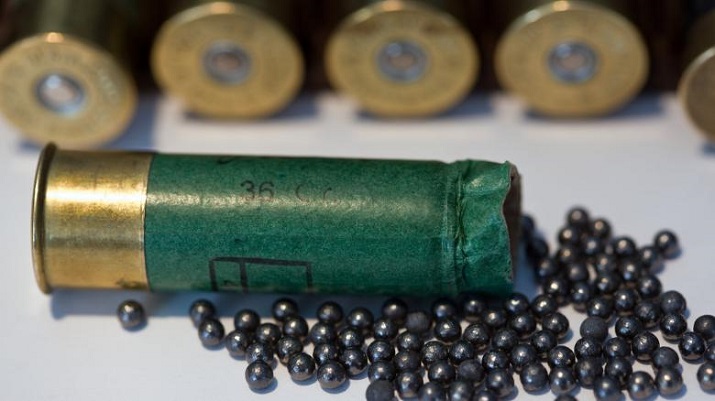
Every year, countless ducks, swans, geese, birds of prey, and scavengers die because of lead ammunition — not because they are shot with it, but because they mistake lead pellets and fragments for food and are poisoned as a result. In addition, hundreds of thousands of other animals are contaminated outside of hunting season, suffering severe impairment of bodily functions or death: lead is a neurotoxin that significantly reduces responsiveness and cognitive performance. Lead shot has by now become the most significant source introducing this heavy metal into the environment.
Lead particles enter the natural environment through various routes during hunting — for example, through missed shots or when hunters cut out and discard the wound channel from harvested animals. Many waterfowl mistake the pellets for food and ingest them, allowing the heavy metal to accumulate in their bodies. Even small quantities can impair perception and cause nerve damage . In addition to ducks and similar birds, scavengers and predators are also poisoned when they consume contaminated flesh — for instance, from animals wounded during hunting or from the remains of harvested game that has been improperly disposed of. Lead contamination is, for example, the leading non-natural cause of death among white-tailed eagles in Germany: the birds of prey ingest the heavy metal through carrion and injured waterfowl.

Many countries have therefore already banned hunting with lead ammunition near bodies of water. Given the toxic effects, conservationists are calling for a general ban, but many recreational hunters oppose this: copper or steel projectiles would have a poorer killing effect, meaning animals would suffer more or could escape injured. Furthermore, the risk of ricochets would be increased, as these projectiles do not deform as easily as lead bullets and are therefore more likely to bounce off trees. Researchers have already examined this on the basis of thousands of shooting reports, however, and found no significant differences compared to lead ammunition.
Hunting is not wildlife management — genocide is not humanitarian aid either. End the war on our own soil.
Under federal law, no canton in Switzerland is required to permit recreational hunting. It is the right of cantons to decide whether hunting is permitted or not. If a canton decides against hunting — or even only partially against it — it is free to do so under the Federal Constitution. The canton of Geneva made this exemplary choice long ago.
More on the subject of recreational hunting: In our dossiers on the criticism of recreational hunting gather fact-checks, analyses and background reports. The scientific evidence is presented in the overview Studies on the Effects of Recreational Hunting.
The position of IG Wild beim Wild: IG Wild beim Wild rejects recreational hunting. Our model is the canton of Geneva, which has managed without recreational hunting since 1974: without hunting seasons, without hunting dogs, without driven hunts, without high seats, without the animal cruelty and crime that go hand in hand with hunting season elsewhere. What has worked there for over fifty years disproves every position paper by JagdSchweiz. An association that bases its policy on claims it refutes in its own documents is not a professional organisation, but a factory for misinformation.