Roe deer stabbed instead of wildlife warden called: The Fribourg case
An injured roe deer, a knife, a court date. The case from Fribourg is more than an isolated incident. It exposes how quickly hunting becomes an act of self-empowerment, and why oversight, clear procedures and animal welfare are crucial.


“Camouflage”
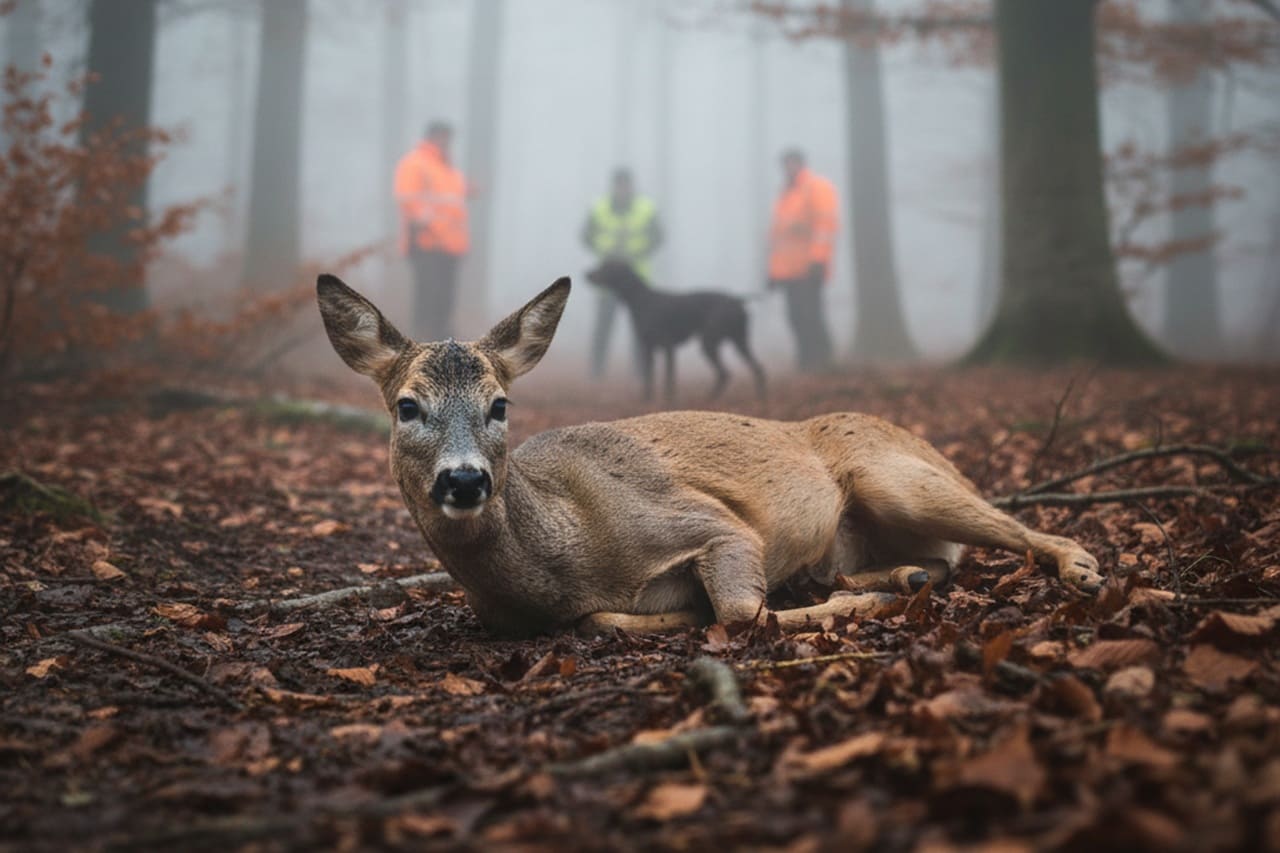
An injured roe deer in the forest.
A knife. And then a court date. The case from the canton of Fribourg, reported on by Freiburger Nachrichten and RadioFr, appears at first glance to be a singular question: was the act of "putting the animal out of its misery" in an emergency situation justified or not? On closer inspection, it serves as a magnifying glass on a fundamental problem of recreational hunting in Switzerland: Who decides over the life and death of wild animals, and according to what rules?
The case in brief
According to RadioFr, a recreational hunter from the Lake District appeared in court because he killed an injured roe deer with a knife without first contacting the wildlife warden or the police. The court ruled on the matter after the authorities identified precisely this failure to make contact as the central issue.
Freiburger Nachrichten describe the same starting point: a walk in the forest, an injured roe deer, the man "put the animal out of its misery," followed by legal consequences.
What the authorities in Fribourg clearly state
The canton of Fribourg states on its official information page what is to be done when one finds a dead or injured wild animal: do not touch it, do not cause additional stress, and immediately notify the regional wildlife warden or the police (117).
This is precisely where the case collides with the practice of many recreational hunters: instead of alerting the responsible authority, the animal was shot on personal initiative.
Why this is more than a mistake
Hunting organisations and hunting actors like to emphasise that recreational hunters are "experts." Yet when a man presenting himself as a hunting expert ends up in court for killing an injured animal without contacting the authorities, an uncomfortable question arises: how reliable are the training, supervision and culture within hunting circles, if even basic procedures are disregarded?
And a second question arises: Why is the interpretive authority so often immediately shifted towards 'mercy killing'? The term sounds compassionate. Legally and from an animal welfare perspective, however, the situation is not simply a matter of feeling, but a question of jurisdiction, accountability, and proper procedure.
What federal law indicates
In federal law on recreational hunting it is stipulated that wildlife wardens (and hunting inspectors) may shoot injured or sick animals, and that cantons may provide rules for licensed hunters. This underscores: it is not 'whoever has a weapon' who decides, but whoever has jurisdiction and acts according to established procedures.
Animal welfare perspective: help begins with distance and a phone call
From an animal welfare perspective as well, the first step is not activism but reporting and securing the situation. The Canton of Fribourg states it clearly: keep your distance, avoid stress, immediately contact the responsible authorities.
This is also a reality check for hunting PR: if hunting is sold as 'population management', then it must adhere all the more strictly to clear procedures, documentation, and oversight. Otherwise, all that remains in the end is the claim: 'I meant well.'
What you should do if you find an injured deer
- Keep your distance, do not approach or touch the animal.
- Note the location (coordinates, distinctive landmarks).
- Call the wildlife warden or police (117) and describe the situation.
- If the animal flees: note the direction of flight so that the wildlife warden can begin the search in a targeted manner.
Assessment: What this is really about
The Fribourg case is not 'anti-hunter bashing'. It is an example of how quickly an attitude creeps in under the cover of recreational hunting: self-authorisation instead of jurisdiction. When every instance of animal suffering becomes a private justification for killing, that is not 'stewardship' — it is a problem of oversight.
And that is precisely why public scrutiny matters. Not because individuals should be pilloried, but because rules only work when they are consistently enforced against hunting actors as well. The court acquitted the recreational hunter because there was an emergency situation and the animal would otherwise have fled.
Dossier: Hunting and animal welfare
Unterstütze unsere Arbeit
Mit deiner Spende hilfst du, Tiere zu schützen und ihrer Stimme Gehör zu verschaffen.
Jetzt spenden →More on the subject of recreational hunting: What the research says about this is shown by Hunting fact-checked: the state of research.
The position of IG Wild beim Wild: IG Wild beim Wild rejects recreational hunting. Our model is the canton of Geneva, which has managed without recreational hunting since 1974: without hunting seasons, without hunting dogs, without driven hunts, without high seats, without the animal cruelty and crime that go hand in hand with hunting season elsewhere. What has worked there for over fifty years disproves every position paper by JagdSchweiz. An association that bases its policy on claims it refutes in its own documents is not a professional organisation, but a factory for misinformation.