Graubünden General Hunt: More Incidents and Recklessness
During the general hunting season in Graubünden canton, a conspicuously high number of hunting incidents have been reported to the Office for Hunting and Fisheries. While the official assessment remains cautious, the numbers and reports reveal a profound risk to humans, wildlife and nature. Critical questions about hunting culture, oversight and legal enforcement demand attention.


Since the beginning of the general hunt the responsible authority has received a significantly higher number of reports about hunting incidents involving recreational hunters than in previous years.
Anyone who regularly kills animals acts violently. Recreational hunting is an institutionalized form of violence.
This includes not only regular incidents, but according to the office also «reckless conflicts» among hobby hunters, extending to damage to hunting blinds, civilian property that should actually serve to protect and observe wildlife. Official spokespersons emphasize that the majority of hunting participants adhere to the rules, yet the accumulation of such incidents calls this portrayal into question. Indeed, recreational hunting is the hobby where lying is systematic.
This is hardly surprising. The fish rots from the head, and this is massive in Graubünden. The hobby hunter association president himself describes recreational hunting as a disease from which he cannot be cured.
According to the Office for Hunting and Fisheries in the canton of Graubünden, there are over 1,000 charges and/or fines against hobby hunters annually in that canton alone, because they violate hunting laws or are involved in other criminal activities.
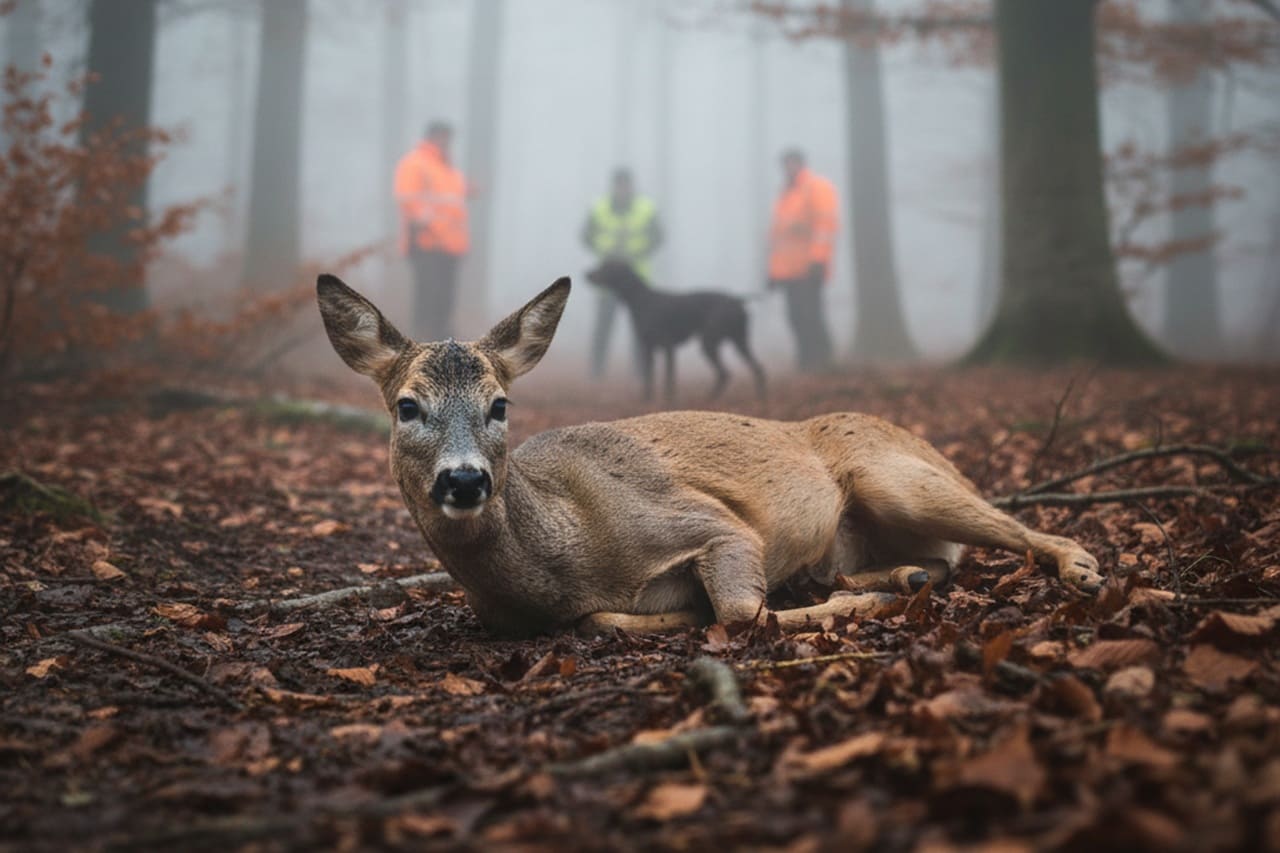
Such reports fit into a longer-term critical debate about the risks and error-proneness of recreational hunting. Earlier SRF investigations already showed that in Graubünden hunting, every tenth stag was wounded rather than cleanly killed over years, with the risk that injured animals escape and suffer unnecessarily. Other analyses revealed that around nine percent of all shots during the main hunting season are unlawful and result in fines, an indicator of insufficient rule acceptance and control.
For wildlife protection organizations, these developments raise two fundamental questions: first, that of the safety of suffering wild animals and second, that of the competence and motivation of many licensed hunters. The increasing number of incidents underscores that existing regulations alone are insufficient to prevent reckless behavior and unlawful killings.
From a hunting-critical perspective, the discrepancy between official portrayal and real risks is also disturbing. When conflict-prone behavior and illegal shootings are dismissed as «isolated cases», this conceals the structural problems of the practice of violence in Switzerland.
The main hunting season takes place in a space that no longer belongs exclusively to recreational hunting. Hikers, families, athletes and locals use the same areas. When shots fall near paths or warning signs are ignored, a real safety problem emerges. Public space temporarily becomes a danger zone.
The responsibility for this lies not with individual walkers or hikers, but with a system that allows deadly violence to be exercised as a recreational activity in unclear situations, without sufficient on-site control.
From the perspective of IG Wild beim Wild, the recurring escalation during the main hunting season is no coincidence, but the logical consequence of an outdated hunting model. High time pressure, performance-oriented shooting plans and inadequate aptitude testing create an environment in which rule violations become more likely.
In the view of IG Wild beim Wild, hobby hunters need annual medical-psychological fitness assessments following the Dutch model as well as a binding upper age limit. The largest age group among hobby hunters today is 65+. In this group, age-related limitations such as declining eyesight, slower reaction times, concentration weaknesses and cognitive deficits increase statistically significantly. Simultaneously, accident analyses show that the number of serious hunting accidents with injuries and fatalities rises significantly from middle age onwards.
The regular reports of hunting accidents, deadly mishaps, and misuse of hunting weapons highlight a structural problem. Private ownership and use of deadly firearms for recreational purposes largely evades continuous oversight. From the perspective of IG Wild beim Wild, this is no longer justifiable. A practice based on voluntary killing while creating significant risks for humans and animals loses its social legitimacy.
Recreational hunting is also based on speciesism. Speciesism describes the systematic devaluation of non-human animals solely based on their species membership. It is comparable to racism or sexism and is neither culturally nor ethically justifiable. Tradition does not replace moral examination.
Critical examination is essential particularly in the realm of recreational hunting. Hardly any other field is so characterized by embellishing narratives, half-truths, and targeted disinformation. Where violence is normalized, narratives often serve to justify it. Transparency, verifiable facts, and open societal debate are therefore indispensable.
Why pleasure in killing is not a harmless recreational motive
People who find pleasure in killing living beings and paying for it demonstrate, from a psychological perspective, abnormal recreational behavior. This behavior contradicts fundamental mechanisms of empathy, compassion, and moral inhibition that exist in most mentally healthy individuals. Psychologically, this constitutes deviant violent behavior, even when politically or culturally tolerated.
Pleasure in killing is a classic characteristic of lust-based violence. The violent act itself is rewarding. Not the result, not the necessity, but the killing itself. This is not a marginal phenomenon but is clearly described in violence psychology.
Those who experience recreational hunting as pleasure display a psychologically problematic violent motivation that is historically and structurally related to authoritarian and devaluing ideologies.
Foundations and classifications are in the dossier.
Support our work
With your donation you help protect animals and give voice to their concerns.
Donate now →