Cats on a Leash: Sensible Trend or Animal Cruelty?
More and more cat owners in Switzerland are asking themselves whether they should walk their feline companions on a leash. What is taken for granted with dogs often seems strange with cats. Yet in an era of increasingly dense housing and ever more dangerous traffic, many people are searching for ways to let their beloved pets outside safely.

“Ceasefire”
In addition, there is a legally enshrined right permitting feral and stray domestic cats to be hunted year-round.
This means: legally speaking, it is the case that recreational hunters kill cats. At the same time, it is reported that many such killings take place in secret and are rarely documented. Stray cats are said to be frequently poisoned, beaten to death, or drowned. This reportedly happens “in secret.”
There are no official statistics recording exactly how many cats are shot per year by recreational hunters on their recreational hunts. The term “feral cats” is also often legally and practically vague, which makes recording difficult.
Estimates suggest that around 100,000 cats are killed in total in Switzerland each year. Animal welfare and nature conservation organisations report a high number of unreported cases and indicate that many killings are not systematically documented or reported, which is why reliable figures broken down by perpetrator group (recreational hunters vs. other causes) are lacking.
A growing trend
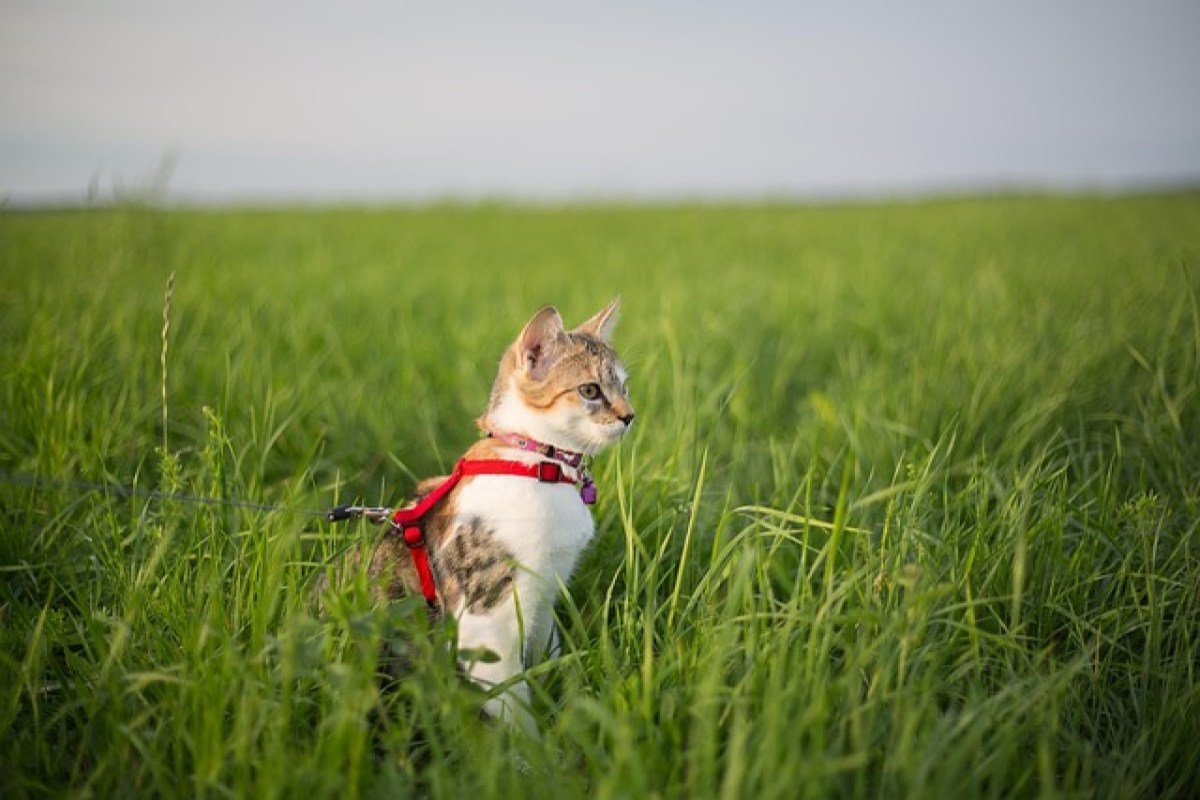
Especially in cities such as Zurich, Basel and Geneva, it is now increasingly common to see cats strolling across lawns in harnesses and on leashes. On social media, owners share videos of cats apparently walking calmly on the lead. Veterinarians report that owners of indoor cats in particular are trying out this trend in order to give their animals supervised outings.
Opportunities: safety and variety
Advocates argue that walking on a leash offers cats a safe way to experience fresh air and new impressions without risking being hit by a car or coming into conflict with other animals or recreational hunters to come. Especially for indoor cats, controlled outdoor access can be a welcome change that reduces stress and prevents boredom.
When cats are accustomed to a harness and leash from an early age, it can be a promising way to enrich their lives. It is important to practice with patience and not to force the animal.
Risks: Stress and restricted freedom of movement
Critics counter that cats are not dogs. They prefer to move autonomously, explore territories, climb, and jump. A leash can severely restrict natural behavior. In addition, many cats react with stress to the harness and to unfamiliar noises outside. In the worst case, this can lead to panic and injury.
Animal welfare organizations therefore warn against accustoming cats to a leash only if they have been used to it from an early age and if the animal is cooperative of its own accord.
Tips for leash walking
- Start early: Kittens adapt more easily to a harness and leash.
- Only use a special cat harness that fits well and does not constrict.
- Short and positive: At first only a few minutes, plenty of treats, calm surroundings.
- Free will: The cat decides whether it participates. Coercion leads to stress.
- Choose safe locations: Not busy roads, but quiet parks or gardens.
When leash walking can be beneficial
- The cat accepts it voluntarily,
- it is trained slowly and patiently,
- and owners pay attention to safety and well-being.
For cats that have never been accustomed to a harness and leash, or that are very anxious, the attempt is usually stressful and counterproductive. In such cases, secured balconies, cat nets, and outdoor enclosures can offer a more animal-friendly alternative.
RECREATIONAL HUNTER RADAR
On the trail of hidden animal welfare offenses, poaching, and/or criminal activity? Report suspected cases to us! Help with the great recreational hunter radar.

More on the subject of recreational hunting: The scientific evidence is presented in the overview Studies on the Effects of Recreational Hunting.
The position of IG Wild beim Wild: IG Wild beim Wild rejects recreational hunting. Our model is the canton of Geneva, which has managed without recreational hunting since 1974: without hunting seasons, without hunting dogs, without driven hunts, without high seats, without the animal cruelty and crime that go hand in hand with hunting season elsewhere. What has worked there for over fifty years disproves every position paper by JagdSchweiz. An association that bases its policy on claims it refutes in its own documents is not a professional organisation, but a factory for misinformation.